


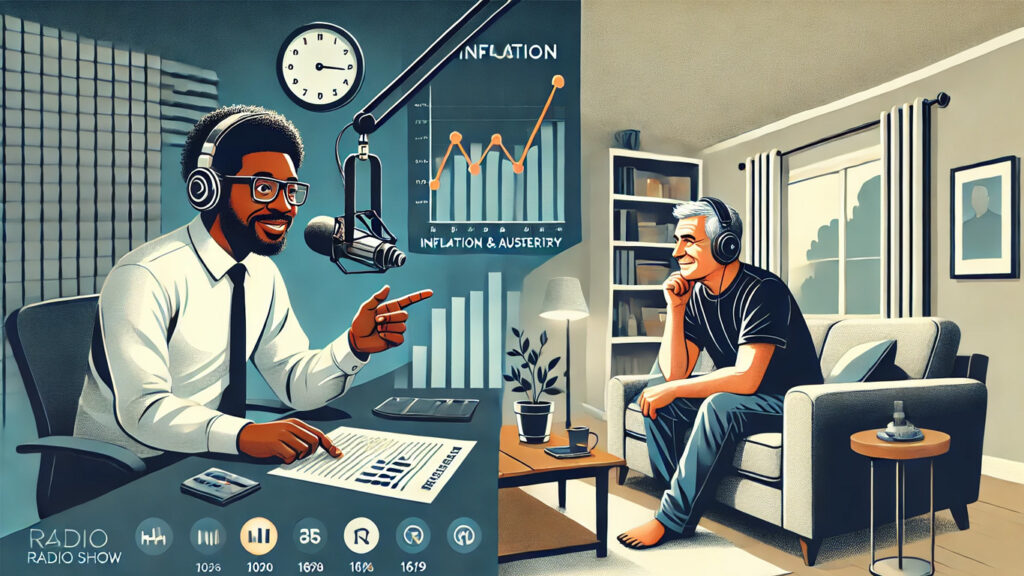
An intelligent caller called our Politics Done Right program on KPFT 90.1 FM to discuss austerity and inflation. I pointed out that, more often than not, corporations’ greed and ineptitude are responsible.
Inflation and Austerity


Podcasts (Video — Audio)
Summary:
In a recent episode, Politics Done Right engaged with a caller, Tagg, about the misconceptions surrounding inflation and the dangers of austerity. They discussed how corporate greed, not government spending, was responsible for much inflation after the pandemic and why austerity measures harm working people while benefiting the wealthy. The conversation emphasized the importance of Keynesian economic policies, prioritizing government intervention in times of crisis to ensure economic stability.
Key Points:
- Biden’s use of Keynesian economics helped prevent a deep recession after the pandemic, unlike previous administrations’ austerity-driven response.
- Austerity measures, often pushed by Republicans, hurt working-class people by cutting essential public services and slowing economic recovery.
- Inflation following the pandemic was primarily caused by “greedflation,” driven by corporations raising prices rather than genuine shortages or overprinting money.
- The caller emphasized that without government spending during the pandemic, the U.S. would have faced a depression.
- Outsourcing and fragile supply chains created by corporate greed were significant contributors to the inflationary pressures in the U.S. economy.
The conversation highlights the failure of austerity and trickle-down economics, which primarily benefit the wealthy while neglecting the needs of the working class. By prioritizing government intervention and rejecting austerity, progressive policies offer a path forward that ensures economic stability and fairness, holding corporations accountable for driving inflation.
[ppp_patron_only level=2]
The conversation between the Politics Done Right radio/media show and a regular caller sheds critical light on the misplaced economic policies of austerity and the misunderstandings surrounding inflation, particularly in recent political and economic developments. The exchange reveals the importance of grasping how governments can and should manage economic downturns—especially after global crises like the pandemic—and why austerity measures are unnecessary and harmful.
The host emphasized the need to debunk the myths perpetuated by MAGA supporters and right-wing economists, specifically the notion that Trump somehow had an exceptional handle on the economy while Biden “failed.” This revisionist narrative distorts the actual economic context in which both administrations operated. The pandemic posed unprecedented challenges, requiring a strong and responsive government to avert disaster and ensure economic recovery. As the host points out, Biden’s use of Keynesian principles—where the government steps in when the private sector falters—demonstrates the power of government spending to stabilize and stimulate the economy.
Biden utilized Keynesian economics, which is grounded in the idea that government intervention is essential during economic downturns. In contrast to the trickle-down approach championed by conservatives, where tax cuts for the wealthy and corporations are expected to benefit everyone eventually, Keynesian economics calls for direct government investment to generate demand. This approach is essential for an economy with a sovereign currency, like the United States. Unlike households or businesses, governments with sovereign currency can create money to fund recovery efforts.
The caller, “Tagg,” expands on this point, highlighting the dangers of austerity, which was famously implemented during the George W. Bush administration and inherited by Obama. Austerity policies—cutting public spending to reduce deficits—deeply hurt the economy, as they remove critical demand from the system. Cutting spending on public goods and services means fewer jobs, lower wages, and reduced consumption, all of which slow economic growth. This hurts working-class families the most, as they are often dependent on these services and are most vulnerable to job losses.
Moreover, the looming threat of austerity is tied to the ongoing political maneuvering around the debt ceiling in the United States. Republicans have been using this political leverage to impose harmful economic policies that serve only to push austerity on the nation once more. History has shown that austerity does not work, yet the GOP advocates for it. Austerity slows recovery and exacerbates inequality by slashing public services while allowing the wealthy and corporations to continue accumulating wealth. The actual beneficiaries of austerity are those at the top, while working people bear the burden.
They also discussed the nature of inflation during and after the pandemic. The host asserts that the inflation often blamed on Biden’s policies was not actual inflation driven by shortages of goods or services. Instead, much of it was “greedflation”—inflation caused by corporate profiteering. Corporations used the pandemic as an excuse to raise prices, even when their costs did not increase proportionately. The host notes that “shortages cause real inflation.” While there were some isolated shortages—such as in the oil sector or, as Tagg mentioned, the butter market in France—most of the inflation Americans experienced was artificially manufactured by corporations seeking to increase profit margins.
Tagg adds that if the government had not pumped money into the economy during the pandemic, the alternative would have been a depression. This is an important point, as many fail to consider the consequences of inaction. Austerity during such times would lead to mass unemployment, reduced consumer spending, and a longer, deeper recession if not outright depression. Inflation, while harmful, can be addressed through targeted economic policies, but the fallout from depression is far more severe and long-lasting.
The call underscores how corporate greed, not genuine market forces, drove much of the inflationary pressures in the U.S. economy. The host critiqued corporations for outsourcing production and creating fragile supply chains to pursue cheap labor. These decisions contributed to the so-called “supply chain crisis,” which was used as an excuse to justify higher prices. Corporations’ deliberate manipulation of market conditions reveals that inflation was not the inevitable result of increased government spending or stimulus but the consequence of corporate decisions driven by greed.
Ultimately, the host and Tag clearly state that austerity is unnecessary and damaging. In times of crisis, the government must support the economy and prevent widespread suffering. While conservatives push austerity as a solution to economic woes, the reality is that such measures only serve to deepen inequality and prolong recovery. Likewise, the inflation that followed the pandemic was largely the result of corporate greed, not excessive government spending. Progressives must continue to advocate for policies prioritizing working people’s needs over corporate profits, rejecting austerity, and promoting responsible government intervention when necessary.
The discussion on Politics Done Right dismantles the myths surrounding austerity and inflation, showing that progressive economic policies based on Keynesian principles are viable and essential for recovery and long-term stability.
[/ppp_patron_only]