


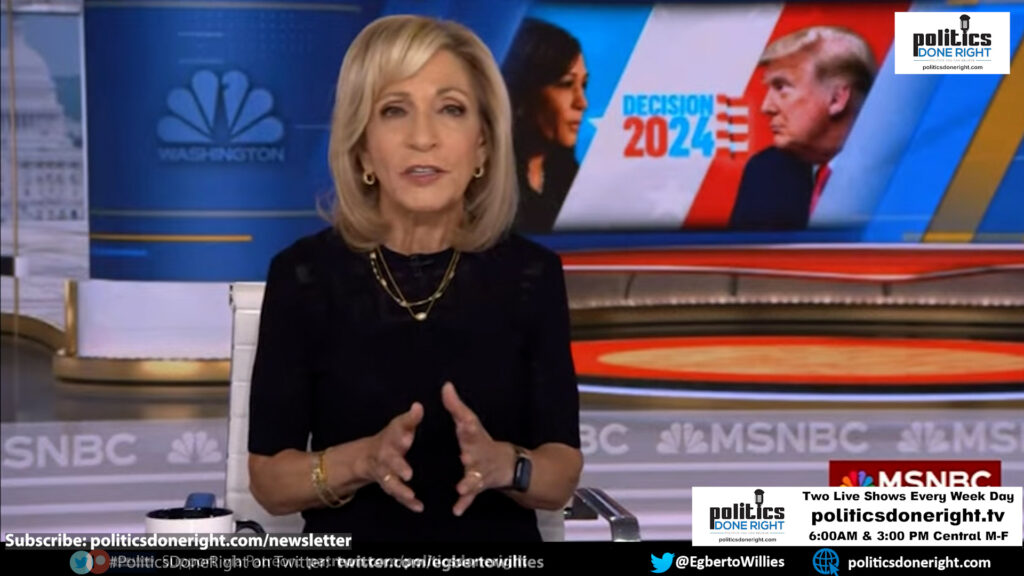
Andrea Mitchell allowed a Right-Wing talking point to cloud her interpretation of the 60 Minutes interview with VP Kamala Harris.
Andrea Mitchell fell for the Right Wing media trap.


Podcasts (Video — Audio)
Summary:
The video highlights how journalist Andrea Mitchell unfairly criticized Kamala Harris’s recent 60 Minutes interview. Mitchell echoed right-wing talking points, suggesting Harris struggled to answer questions. The reality is that Harris answered all questions thoroughly, particularly on issues like immigration and economic policy. This is the double standard in media treatment, as male politicians like Donald Trump avoid tough questions without similar scrutiny.
- Kamala Harris answered every question posed during her 60 Minutes interview with clarity and confidence.
- Andrea Mitchell, a mainstream journalist, unfairly echoed right-wing critiques of Harris’s responses.
- Harris clearly explained her approach to funding programs through progressive taxation but was still criticized as being vague.
- Male politicians, particularly Donald Trump, avoid media scrutiny despite their evasive behavior.
- The media holds women, especially women of color, to higher standards, reflecting deep-seated biases.
Kamala Harris, once again, faced unfair scrutiny from both the right-wing media and mainstream journalists who perpetuate sexist and racist double standards. Despite answering every question with clear progressive policies, Harris was criticized unfairly, while male politicians like Trump continue to avoid tough questions with little consequence. The media’s treatment of Harris exemplifies the need for fair and accurate reporting that resists falling into partisan traps.
[ppp_patron_only level=2]
In a media landscape increasingly dominated by sensationalism, even respected journalists can fall prey to the insidious traps set by right-wing media narratives. This unfortunate dynamic played out recently when a veteran NBC journalist, Andrea Mitchell, echoed baseless claims about Vice President Kamala Harris “struggling” to answer questions during a recent interview with 60 Minutes. The truth is clear: Harris answered every question before her, articulating her plans and policy positions clearly and confidently. However, the persistent and unfair treatment of Harris by both conservative outlets and more centrist mainstream media figures highlights a double standard—one steeped in sexism and a fundamental misunderstanding of progressive governance.
Kamala Harris, like many high-profile women in politics, faces an incessant barrage of scrutiny far exceeding that faced by her male counterparts. It’s not just conservative pundits who nitpick her every move; mainstream journalists, including Mitchell, sometimes take the bait and amplify right-wing talking points. In her 60 Minutes interview, Harris answered all questions on immigration, the economy, and her vision for America’s future. Yet, Mitchell chose to latch onto the narrative that Harris “appeared to struggle” with her responses—a demonstrably false claim.
This framing is emblematic of a broader media bias, particularly when it comes to female and minority politicians. Harris, a Black and South Asian woman, faces not only the usual challenges of public life but also the compounded biases of both misogyny and racism. The insistence on framing her answers as inadequate or evasive—despite her clear, substantive responses—reflects a reluctance to accept women and people of color as legitimate and capable leaders. Harris’s answers in the 60 Minutes interview, particularly on issues like taxation and immigration, were direct and policy-driven. She made it clear that the administration’s approach to paying for its programs involves taxing the wealthiest Americans, who have benefited disproportionately from the current tax structure. This is a straightforward answer, grounded in progressive economic theory, yet it was portrayed as vague or incomplete.
The right-wing media’s constant bad-faith attacks on Harris are nothing new. Their goal has always been to delegitimize her—just as they did with Hillary Clinton, Alexandria Ocasio-Cortez, and countless other women in politics. But what’s disappointing is when mainstream media figures like Andrea Mitchell unwittingly reinforce these narratives. Instead of acknowledging that Harris was precise in her responses, Mitchell repeated the unfounded assertion that Harris struggled, lending credibility to a disingenuous critique. This isn’t journalism; it’s capitulation to a harmful and misleading discourse that undercuts women’s credibility in the public sphere.
Moreover, the focus on Harris’s perceived “struggles” contrasts sharply with the media’s handling of male politicians—especially former President Donald Trump. As noted in the video, Trump has repeatedly refused to engage with journalists in any substantive way. His frequent dodging of tough questions, unwillingness to submit to fact-checking, and outright lies go largely unchallenged by mainstream outlets. Yet, there is no consistent outcry about his evasiveness or incoherence. The media holds Harris to a much higher standard than her male counterparts, especially those on the right.
In reality, Harris’s interview showed her adeptness in handling complex topics, including immigration. She discussed the bipartisan agreement that had been reached but blocked by Republicans under Trump’s direction. The media has the responsibility to provide context here: Trump’s administration contributed to the very immigration issues it now weaponizes against the Biden administration. Harris answered questions about immigration. Americans should be made to understand that immigration failures occur out of the structural factors contributing to the crisis, including U.S. policies in Central America. Yet, this context is often missing from mainstream coverage, leading to a distorted public perception.
The broader issue here is that mainstream media, by picking up on right-wing narratives, often becomes an unwitting accomplice in perpetuating misinformation. Journalists like Andrea Mitchell have a responsibility to push back against such narratives, not to amplify them. Harris did not struggle to answer questions—she answered them thoroughly and thoughtfully. The fact that her answers were characterized as inadequate speaks more to the deep-seated biases in the media than to her performance.
It is crucial to recognize the damage that such biased coverage inflicts, not just on Harris but on the broader progressive movement. Progressive policies, including those championed by Harris, are often complex and require nuanced discussions about addressing inequality, climate change, healthcare, and more. By reducing these discussions to soundbites that favor right-wing talking points, the media does a disservice to the public. Americans deserve a fair and accurate portrayal of their leaders and their policies—not one filtered through the lens of partisan attacks.
Andrea Mitchell’s comments reflect a larger pattern of how women, especially women of color, are treated in the media. Kamala Harris answered every question during her 60 Minutes interview. The claims that she struggled are baseless and stem from the ongoing right-wing effort to delegitimize her. It is high time that journalists recognize and resist these traps, rather than falling into them. Only then can the public receive the objective, factual reporting they deserve.
[/ppp_patron_only]