


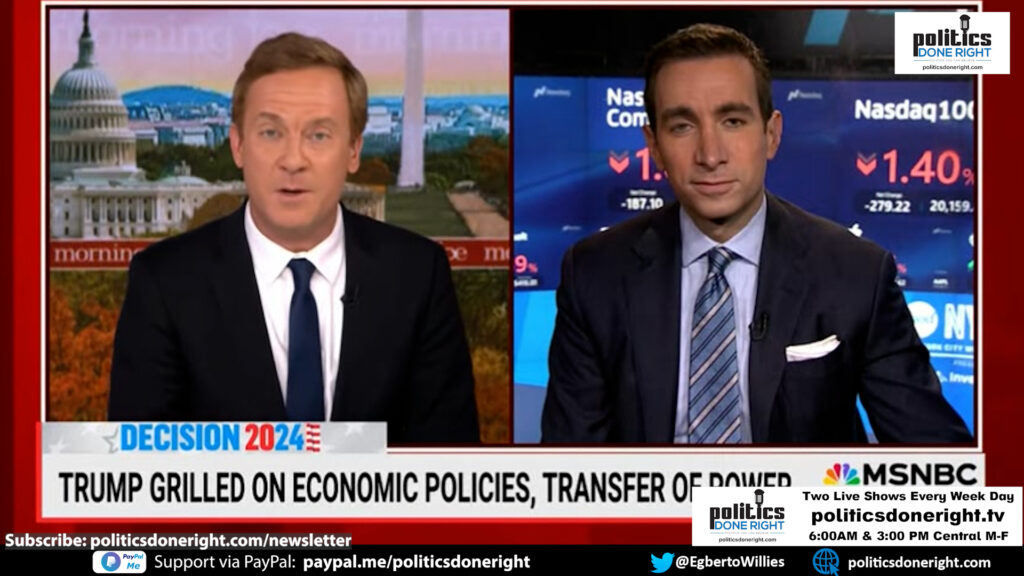
Donald Trump cannot distinguish between a small business and a large one or understand tariffs. Yet they are asking Kamala Harris to say more.
Trump’s small business and tariff ineptitude


Podcasts (Video — Audio)
Summary:
The video covers former President Donald Trump’s failure to articulate coherent economic policies for small businesses and tariffs during an interview. When asked about support for small businesses, Trump deflected with examples of large corporations like Apple, showing a clear misunderstanding of small business needs. He also proposed tariffs that, according to experts, could harm the U.S. economy, ignoring the potential for retaliatory measures from other nations. Critics highlight that Trump’s policies would raise costs for American consumers, damage export opportunities, and benefit the wealthy through a regressive tax system.
- Trump struggles to explain policies for small businesses, referencing only large corporations.
- Tariffs, as proposed by Trump, are inaccurately described and would function as a tax on American consumers.
- His approach could lead to trade wars, causing retaliatory tariffs from other countries and damaging U.S. industries.
- Small businesses and American farmers would suffer due to lost international market access.
- Trump’s policies ultimately benefit large corporations and the wealthy while hurting small businesses and working-class Americans.
The video underscores Trump’s incompetence in addressing small business needs and his reckless tariff proposals that favor corporate giants over everyday Americans. His economic policies would increase costs for working people while shielding billionaires and threaten vital U.S. industries like agriculture. In contrast, progressive policies empower small businesses, protect jobs, and foster equitable economic growth for all.
[ppp_patron_only level=2]
In a recent interview, former President Donald Trump was pressed on his economic policies, particularly regarding small businesses and tariffs. The resulting exchange left much to be desired, especially for those concerned with the economic well-being of small business owners, who make up the backbone of the U.S. economy. Trump’s responses, riddled with a lack of understanding and misinformation, highlight the grave consequences of his proposed tariffs. Not only would his policies disproportionately harm small businesses, but they also threaten to drag the U.S. economy into chaos.
Small Business Neglect
Trump’s inability to grasp the importance of small businesses became glaringly apparent in the Bloomberg interview. When asked about policies he would implement to support small businesses, Trump responded with examples related to large corporations like Apple and Mercedes-Benz. He mentioned that he gave Apple an exception to avoid tariffs, citing its competition with Samsung. However, this misses the point: Apple is not a small business, and these policies only benefit corporate giants, leaving small businesses out in the cold.
Small businesses account for about 99.9% of all U.S. businesses and employ 47.1% of the private workforce. Yet, Trump’s economic rhetoric continually bypasses them. His bluster over corporate tax cuts and deregulation for the largest players in the market leaves out the fact that most small businesses don’t see the same benefits. These businesses thrive on fair competition, local consumer demand, and manageable overheads, all of which are put at risk by misguided tariffs that raise the cost of imported goods and threaten retaliation from other nations, damaging export opportunities for U.S. companies.
The Misunderstanding of Tariffs
Trump’s tariff proposals are a disaster waiting to happen. His inability to explain what a tariff truly is—essentially a tax on imported goods—shows a fundamental misunderstanding of how international trade works. Worse, Trump repeatedly claims that exporting countries would pay tariffs, which is not true. As noted in the video, tariffs are paid by the importer—meaning American companies and, ultimately, American consumers bear the cost of these taxes.
A tariff acts as a sales tax on goods entering the country, raising their prices and making them less competitive in the U.S. market. In theory, tariffs could protect domestic industries by discouraging imports, but this logic breaks down when the country levying the tariffs faces retaliation. Trump’s proposal to implement tariffs across the board will inevitably lead to a trade war where foreign nations, such as China or Germany, respond with their tariffs. The result: American farmers, manufacturers, and small businesses will lose access to crucial international markets, stunting their growth and profitability.
The agriculture sector provides a clear example. During Trump’s presidency, tariffs led to China retaliating by reducing its purchases of U.S. soybeans, opting instead to buy from countries like Brazil. This shift dealt a severe blow to American farmers, many of whom rely heavily on exports to keep their operations afloat. Returning to Trump’s tariff-heavy policies would risk similar retribution, threatening farmers and other export-driven industries like technology and automobiles.
How Tariffs Could Wreck the Economy
The economic fallout from Trump’s proposed tariffs would be catastrophic. For one, the cost of living would rise dramatically for everyday Americans. The prices of imported goods—everything from electronics to clothing—would increase, leaving consumers with fewer choices and higher expenses. It is not just the price at the register that will go up; the broader impact on businesses dependent on imported parts or materials will drive up production costs across the board. Many small businesses, which operate on tighter margins than large corporations, will be unable to absorb these increased costs and could face bankruptcy.
Additionally, Trump’s failure to recognize how tariffs would invite retaliatory measures from trading partners shows a dangerous naivety. As Andrew Ross Sorkin points out in the transcript, countries like Germany will raise their tariffs on U.S. imports in response to American tariffs on their exports. According to many economists, this vicious cycle of economic retaliation could lead to a $5 trillion hit to the U.S. economy. Furthermore, countries like China may block American companies like Intel from selling certain products, jeopardizing jobs and stifling innovation.
Ultimately, the cost of Trump’s tariffs would not just be borne by American consumers and businesses; they would reverberate throughout the global economy. U.S. companies would find it harder to sell their products abroad, weakening their ability to compete in international markets. This would directly impact the strength of the U.S. dollar, inflation, and the country’s overall economic health.
A More Thoughtful Alternative
Not all tariffs are inherently bad; they can be useful tools when applied strategically to protect key industries. However, Trump’s blanket tariff proposals are reckless and ignore the nuances of international trade and diplomacy. A more thoughtful approach, like the one outlined by Vice President Kamala Harris, focuses on targeted support for small businesses and responsible trade policies that maintain global partnerships while protecting American workers and industries. Harris’ policies starkly contrast to Trump’s vague, poorly thought-out plans. She aims to strengthen the middle class, increase wages, and offer direct assistance to small business owners, the backbone of the U.S. economy.
Trump’s proposed tariffs represent an outdated, destructive approach to economic policy that would stifle growth and harm American workers. His lack of understanding about small businesses and the ripple effects of tariffs makes his proposals a threat to the U.S. economy. Conversely, a progressive approach focusing on equitable policies and sustainable trade agreements can protect small businesses and American jobs while keeping the economy competitive in a global market. The question voters must ask is whether they want a leader who plans to strengthen the economy for all, or one whose ignorance will bring it to its knees.
[/ppp_patron_only]