


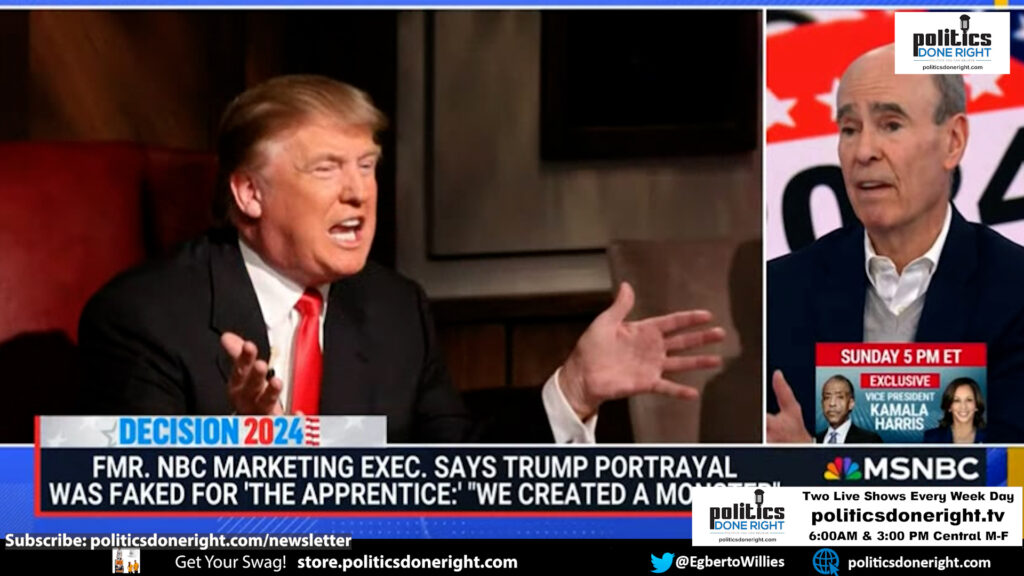
John D. Miller, former chief marketing officer for NBC and NBCUniversal, apologized for helping create Donald Trump, a monster whose fake business success persona was created for The Apprentice show.
NBC’s The Apprentice Exec.: We created a monster, Trump.


Podcasts (Video — Audio)
Summary:
A former NBC marketing executive, John D. Miller, has expressed regret for his role in creating the false narrative of Donald Trump as a successful businessman through The Apprentice. He explains how the show exaggerated Trump’s business acumen, leading many Americans to believe Trump could run the country like a corporation mistakenly. Miller’s confession reveals the harmful consequences of this manufactured persona, which many voters still hold as true.
- The Apprentice heavily exaggerated Trump’s business success by crafting a false narrative for television.
- Trump’s real businesses experienced multiple bankruptcies, contradicting his TV persona.
- Many voters believed Trump’s television image and supported him, thinking he could “run the country like a business.”
- Miller expressed regret, calling Trump’s false narrative a “dangerous” myth that has impacted the U.S. politically.
- Miller came forward to correct this narrative before Trump’s potential future political ambitions, feeling it was his patriotic duty.
John D. Miller’s confession underscores how media manipulation can have dangerous political consequences. Trump’s fraudulent business image, built for entertainment, deceived voters into trusting a man fundamentally unfit for leadership. This highlights the need for a more informed electorate, unshackled by myths peddled by corporate media, and a greater focus on leadership that prioritizes the common good over personal profit.
[ppp_patron_only level=2]
Donald Trump’s rise from reality TV star to U.S. President has always hinged on one central claim: that he is a successful businessman capable of running the country like a corporation. This image, however, did not emerge organically. In recent years, the architects behind Trump’s TV persona have come forward, expressing regret over the role they played in creating what they now view as a harmful and misleading narrative.
In a startling admission, former NBC marketing executive John D. Miller, who was instrumental in promoting The Apprentice, reflected on the exaggeration of Trump’s business acumen. Miller explained that the show depicted Trump as a highly successful executive, an image that resonated with millions of viewers across the country. But in a confession as revealing as it is damning, Miller admitted that much of this portrayal was a “substantial exaggeration” at best and a “false narrative” at worst.
The Making of a False Persona
The Apprentice was launched when Trump’s real estate empire had already endured multiple bankruptcies. Before the show’s debut, Trump’s business reputation was largely confined to New York, where he was known more for his bombastic personality than for any real financial prowess. Miller and his team had to turn this localized figure into a national symbol of corporate success. The show’s concept—where contestants vied for the chance to work alongside Trump for a year—gave the impression that they were learning from one of the best in business. However, as Miller reveals, this mentorship was essentially staged for entertainment.
In the years following The Apprentice, millions of Americans came to see Trump as a model of business leadership. As Miller noted, the show’s structure required that Trump be portrayed as a titan of the industry when, in reality, his businesses were consistently failing. Between his notorious bankruptcies and continued mismanagement, the real Trump was a far cry from the charismatic mogul portrayed on TV.
The Consequences of the Myth
The long-term effects of The Apprentice on the American psyche cannot be overstated. Many of Trump’s 2016 supporters cited his supposed business experience as a key reason for backing him in the presidential race. The idea that Trump could “run the country like a business” was persuasive for voters who were disillusioned with traditional politicians. However, this notion is flawed on several fronts.
First, the very premise that a country should be run like a business is misguided. Governments exist to provide services, enforce laws, and protect citizens’ welfare—not to maximize profits. A business, on the other hand, is driven by the pursuit of profit, often at the expense of broader societal needs. The two are fundamentally incompatible, as evidenced by Trump’s own presidency. His administration’s policies, such as the 2017 tax cuts, disproportionately benefited the wealthy while leaving many working-class Americans behind. Moreover, his handling of crises like the COVID-19 pandemic revealed his lack of understanding of governance, prioritizing image over substantive policy.
Furthermore, Trump’s own business record is far from exemplary. He has overseen six major bankruptcies and has been involved in numerous legal battles, many of which accused him of fraud and mismanagement. Far from being a model of success, Trump’s business ventures often left investors and employees high and dry, while Trump himself maintained a lifestyle funded by debt and licensing deals. The New York Times revealed that Trump paid little to no federal income taxes for several years, further undermining the image of Trump as a financial genius.
Apology and Reflection
John D. Miller’s apology comes at a crucial moment in U.S. political history, with Trump remaining a powerful figure in the Republican Party. In a recent op-ed for U.S. News & World Report, Miller implied that he felt a “patriotic duty” to come forward and dismantle the myth he helped create. His reflections highlight a deeper problem in American culture: entertainment and politics often blur. For years, Trump expertly exploited this confusion, using the skills he learned from television to sell an illusion of success that bore little resemblance to reality.
Miller’s regret is compounded by the dangerous implications of Trump’s continued political influence. Despite his well-documented failures—both in business and in government—Trump’s persona as a savvy businessman remains a core part of his brand. This is particularly concerning as Trump runs in the 2024 presidential run, leveraging the same rhetoric that won him the White House in 2016. The myth of Trump’s business acumen is not just a distortion; it is a “clear and present danger” to the country’s future.
Moving Forward
The apology from Miller and other insiders from Trump’s television career serves as a critical reminder of the dangers of media manipulation. When entertainment becomes a vehicle for creating political personas, it distorts public perception and undermines democracy. Miller’s candid admission that The Apprentice was designed to inflate Trump’s ego and image should give pause to anyone who still believes in the myth of Trump as a successful businessman.
Progressives must continue exposing the truth behind these carefully constructed images. As Trump eyes a return to power, it is essential that the public sees him for what he truly is—a man whose success has been built on illusion, bankruptcy, and deceit. Progressives must push back against the narrative that equates wealth with competence and remember that the qualities needed for effective governance are far more complex than those required to make a good television show.
The confessions of NBC executives like John D. Miller reveal the truth behind Trump’s carefully curated image: he is a businessman only in appearance, with a trail of failures that belie the success many believe he represents. The dangers of electing someone based on such a false premise cannot be overstated, and it is imperative that these myths be debunked before they lead the country down a perilous path once again.
[/ppp_patron_only]