


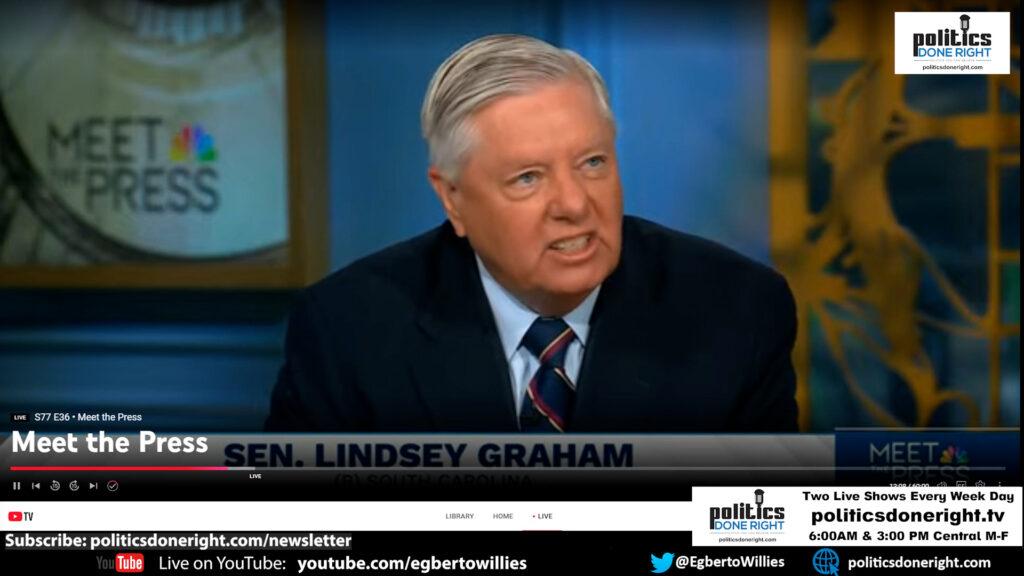
Donald Trump’s prolific sycophant, Sen. Lindsey Graham, appeared on Meet The Press with Kristen Welker and went into meltdown mode when asked about Gen. Mark Milley saying Trump’s a fascist.
Lindsey Graham completely melts down.


Podcasts (Video — Audio)
Summary:
In a heated exchange, Senator Lindsey Graham had a meltdown when confronted by journalist Kristen Welker with comments from General Mark Milley, who called Donald Trump a fascist and a danger to the country. Rather than addressing Milley’s concerns, Graham deflected by attacking the Biden administration’s policies on the economy, energy, and foreign affairs. His response reflected the GOP’s broader strategy of distracting from Trump’s authoritarian tendencies by focusing on divisive political issues.
- General Mark Milley called Trump the most dangerous figure in U.S. history, labeling him a fascist.
- Lindsey Graham dismissed Milley’s warning, shifting the conversation to Biden’s policies.
- Graham focused on attacking Biden’s handling of Israel, Ukraine, energy, and the economy.
- Republicans continue to blame Biden for inflation despite the pandemic’s role under Trump.
- Graham’s meltdown reflects the GOP’s strategy of avoiding Trump’s authoritarian legacy.
Lindsey Graham’s meltdown is emblematic of the GOP’s refusal to confront the very real danger that Donald Trump poses to American democracy. Instead of addressing Trump’s authoritarianism, Republicans like Graham continue to deflect by attacking the Biden administration despite the successes Biden has achieved in energy production and foreign policy. Progressives argue that this fear-based deflection distracts from Trump’s fascist tendencies, which Milley and other former officials have courageously called out.
[ppp_patron_only level=2]
Senator Lindsey Graham‘s recent outburst when confronted by journalist Kristen Welker highlights a key issue that has been plaguing the Republican Party since Donald Trump emerged as its dominant figure: the internal conflict between members of the GOP who are willing to acknowledge the dangers Trump poses and those who remain devoted to his leadership, regardless of the consequences. The video reveals Graham’s frantic attempt to deflect criticism of Trump following the statement by General Mark Milley, former chairman of the Joint Chiefs of Staff, calling Trump a fascist and a danger to the country.
In a progressive reading of Graham’s response, one can see his desperate refusal to confront the growing alarm among some in the military and political establishment about Trump’s authoritarian tendencies. When confronted with the clear assertion from Milley, someone Graham had previously praised, Graham deflects by pivoting to a laundry list of grievances about President Biden’s administration. This tactic is not new for Graham or Republicans at large. Still, it is emblematic of the more significant issue of the GOP’s unwillingness to engage critically with the very real threat that Trump represents to American democracy.
One of the most significant parts of the video comes when Welker asks Graham why voters shouldn’t trust Milley, a top general who worked closely with Trump. In a statement to Bob Woodward, Milley said, “No one has ever been as dangerous to this country as Donald Trump.” Instead of addressing the substance of Milley’s comments, Graham sidesteps into a defense of Trump by attacking Biden’s policies—altogether avoiding the core issue that a high-ranking official had called Trump a fascist. This reaction from Graham reflects the broader Republican strategy of deflection and misdirection that has characterized the post-Trump GOP.
Graham’s meltdown is also emblematic of a more profound fear within the Republican establishment: the acknowledgment that Trump’s appeal is built on a cult of personality that sidelines critical thinking and suppresses dissent. Milley and other officials like John Kelly, Trump’s former chief of staff, have provided firsthand accounts of Trump’s dangerous behavior while in office. Kelly corroborated that Trump frequently suggested using the FBI and IRS to go after political opponents, reflecting the fascist tendencies Milley warned about.
Despite this, Lindsey Graham doesn’t just ignore these concerns—he doubles down by painting Biden and Vice President Kamala Harris as the real threats. His attack on Biden’s foreign policy, particularly concerning Israel, Ukraine, and energy production, is a textbook example of how the GOP shifts the narrative away from Trump’s authoritarianism. By invoking fear of high gas prices, immigration, and Biden’s energy policies, Graham engages in what can only be described as hyperventilation, as noted in the video. This tactic is designed to stoke fear and distract from the real issue at hand: Donald Trump’s growing influence on American politics and the authoritarian risks he poses.
Graham’s emphasis on the economy and energy policy is vital to this exchange. He blames Biden for high prices, even though, as progressives point out, much of the inflation we are experiencing was set into motion by Trump’s mishandling of the COVID-19 pandemic. Trump’s refusal to take the pandemic seriously led to an economic slowdown, supply chain disruptions, and inflation. Yet Republicans, including Graham, continue to blame Biden for these challenges, conveniently ignoring Trump’s role in exacerbating the crisis.
Moreover, Graham’s comments about energy independence under Trump versus Biden are misleading. Under Biden, the United States has increased oil production compared to Trump’s administration. But for Republicans like Graham, facts are less important than maintaining the narrative that the country was better off under Trump. This false nostalgia for the Trump years is another tactic used by the GOP to obscure the reality of his presidency: that he left office with the country in turmoil, with rising unemployment, a botched pandemic response, and a deteriorating global standing.
The progressive response would emphasize that the economy, energy production, and even foreign policy under Biden are not as Republicans like Graham suggest. Biden has strengthened alliances abroad, particularly in Europe, with his support for Ukraine and has navigated the complexities of Middle East politics with a level of diplomacy that Trump lacked.
On immigration, while there are ongoing challenges, Biden’s administration has been more humane in its approach, attempting to balance border security with compassion, a far cry from the cruelty of Trump’s child separation policies. Yet, Graham and his fellow Republicans remain fixated on portraying Biden as weak on immigration despite the complexities of the issue and the need for bipartisan solutions that the GOP continues to obstruct.
Lindsey Graham’s meltdown ultimately symbolizes a broader existential crisis within the Republican Party. The GOP’s refusal to reckon with Trump’s dangerous behavior is not just about defending a former president; it’s about maintaining a political movement built on fear, lies, and division. As progressives argue, this refusal to confront reality threatens not only the future of the GOP but the future of American democracy itself. Graham’s hyperventilation is not just a performance—it is a sign of a party on the brink, desperately trying to hold together a narrative increasingly unraveling in the face of undeniable truths about Donald Trump’s authoritarianism.
Progressives see this as a moment for Democrats to push back harder, not just on the GOP’s false economic narrative but on the more significant issue of Trump’s fascist tendencies. As Milley, Kelly, and others have pointed out, the stakes could not be higher. The danger Trump poses is not theoretical—it is accurate, and the time to confront it is now.
[/ppp_patron_only]