


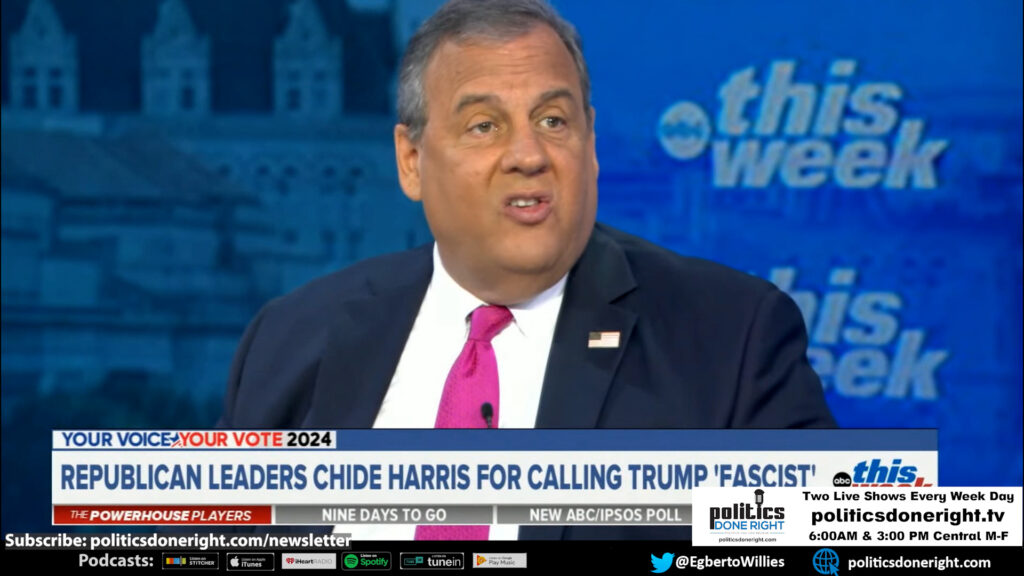
After Trump sycophant Lindsey Graham appeared on This Week and hyperventilated about how much better Trump would be than Harris, Chris Christie destroyed Graham with his own words.
Chris Christie embarrasses Trump sycophant Lindsey Graham.


Podcasts (Video — Audio)
Summary
Chris Christie recently called out Senator Lindsey Graham for his inconsistent stance on Donald Trump, using Graham’s words from January 6 to highlight his hypocrisy. Christie criticized Graham’s unwavering loyalty to Trump, suggesting that such behavior undermines public trust in politicians and represents a broader issue within the GOP.
Key Points:
- Chris Christie criticized Lindsey Graham for defending Trump despite Graham’s earlier denunciations, calling him a “textbook hypocrite.”
- On January 6, Graham expressed feeling “humiliated” and “embarrassed” by Trump but later resumed supporting him.
- Christie argued that this inconsistency fuels public disillusionment with politics, as it showcases politicians prioritizing power over principles.
- Christie contended that Trump’s influence creates a culture of fear, making GOP leaders betray their own beliefs.
- The exchange highlights the GOP’s struggle to move beyond Trump, with loyalty to him overshadowing the party’s commitment to democratic values.
Chris Christie’s takedown of Lindsey Graham reveals the damaging effects of Trump’s grip on the GOP, where loyalty often trumps integrity. This exchange underscores the need for transparent, accountable leaders who put the country before personal allegiance to a divisive figure. For democracy to thrive, politicians must reject fear-driven loyalty and commit to the public good.
[ppp_patron_only level=2]
Chris Christie recently delivered a blunt critique of Senator Lindsey Graham, exposing what he views as the senator’s relentless hypocrisy regarding his allegiance to Donald Trump. Christie’s criticisms resonate because they articulate the frustrations many Americans feel when watching prominent political figures surrender their convictions to appease Trump. The setting for this confrontation highlights the ongoing divisions within the Republican Party—between those who openly challenge Trump and those who continue to defend him, regardless of his controversial actions and rhetoric. Christie’s comments reveal Graham’s inconsistencies and underscore the broader implications of Trump’s influence on GOP politicians and the growing mistrust among the American public toward those who continually shift their positions to align with Trump’s.
Graham’s history of shifting allegiances has been well-documented. From his close friendship with the late Senator John McCain to his current defense of Trump, Graham’s political maneuvers reveal a pattern of self-serving adaptation rather than adherence to consistent principles. As Christie argues, this behavior has alienated many who once admired Graham’s stance on national security and bipartisanship. Christie’s commentary uses Graham’s words against him, highlighting how, on January 6, 2021, Graham expressed deep disappointment in Trump, saying he was “humiliated” and “embarrassed for the country.” Yet, despite this public denouncement, Graham quickly reverted to publicly supporting Trump, appearing alongside him at rallies and on television, defending his most indefensible actions.
This inconsistency has become a defining characteristic of many Republican leaders in the Trump era, contributing to what Christie describes as a textbook case of hypocrisy. This kind of political duplicity is, Christie asserts, exactly why so many Americans are disillusioned with politics. Voters watch Graham and others like him betray their previously stated values and conclude that such politicians are willing to sacrifice integrity for power. This behavior ultimately undermines public trust, which is already at a historic low. It fuels the perception that politicians, particularly within the GOP, prioritize loyalty to Trump over their duties to their constituents and the nation.
Christie’s scathing critique of Graham is part of a broader condemnation of Trump’s lasting grip on the Republican Party. Many GOP politicians, fearing retaliation from Trump and his base, have continued to endorse him despite privately acknowledging his dangerous rhetoric, authoritarian tendencies, and divisive influence on American politics. Christie makes a case that Trump has imposed a culture of fear among Republican leaders, making them complicit in perpetuating his influence by constantly shifting their narratives and positions to align with his. This culture has resulted in a party struggling to distance itself from a figure whom several members, including Graham, once criticized as threatening democratic principles.
Graham’s apparent willingness to abandon his convictions has left many questioning his motivations. Is Graham simply fearful of political isolation? Is he concerned that breaking ranks with Trump could mean losing his Senate seat or influence within the GOP? This desperation is evident, Christie argues, in the senator’s demeanor, especially during recent media appearances, where he defends Trump with what appears to be forced conviction. For Christie, this isn’t just about political survival; it’s about loyalty at any cost, even if that cost is one’s integrity.
Additionally, this incident underscores a larger theme within American politics: the abandonment of accountability and transparency. Politicians like Graham, who repeatedly contradict their previous statements and align themselves with leaders they’ve denounced, erode the public’s trust in democratic institutions. Christie’s criticism suggests that voters are not just disillusioned by the policies or outcomes of political decisions but are increasingly skeptical of politicians’ motivations. The blatant disregard for consistency or accountability shown by figures like Graham feeds a growing cynicism that American democracy is more about power plays than public service.
Moreover, Christie’s emphasis on Graham’s behavior raises broader questions about the future of the Republican Party. Can it recover its reputation as a party of principle and policy, or will it continue to be defined by Trump’s cult of personality? The upcoming election may determine whether the GOP can re-establish itself as a party grounded in ideological diversity and integrity or whether it will remain, as Christie suggests, a party held hostage by the whims of one man. Politicians like Graham, who continue to defend Trump at the expense of their values, face a growing backlash not just from Democrats but from independents and traditional conservatives who see their behavior as a betrayal of core democratic principles.
In the broader context, Christie’s critique of Graham illustrates the importance of political accountability and the damage a lack of transparency can do to public trust. Politicians are expected to uphold their commitments to their constituents, and when they fail to do so, they weaken the very fabric of democracy. Christie’s words serve as a reminder that accountability in politics should not be optional and that politicians like Graham, who engage in political flip-flopping, contribute to the erosion of trust essential to a healthy democracy.
Ultimately, Christie’s rebuke of Lindsey Graham is more than a personal criticism; it is an indictment of the sycophantic loyalty that characterizes so much of contemporary GOP politics. As Christie suggests, voters deserve leaders to prioritize their principles over political expediency. If the Republican Party wishes to move forward, it must address the culture of fear and blind loyalty that Trump has instilled within it. Graham’s actions, as Christie highlights, serve as a cautionary tale of what happens when political integrity is sacrificed for personal gain and the desire to remain in power. The hope is that more GOP leaders will heed Christie’s words and prioritize the interests of the American people over the interests of one man, restoring a sense of accountability and transparency that the country so desperately needs.
[/ppp_patron_only]