


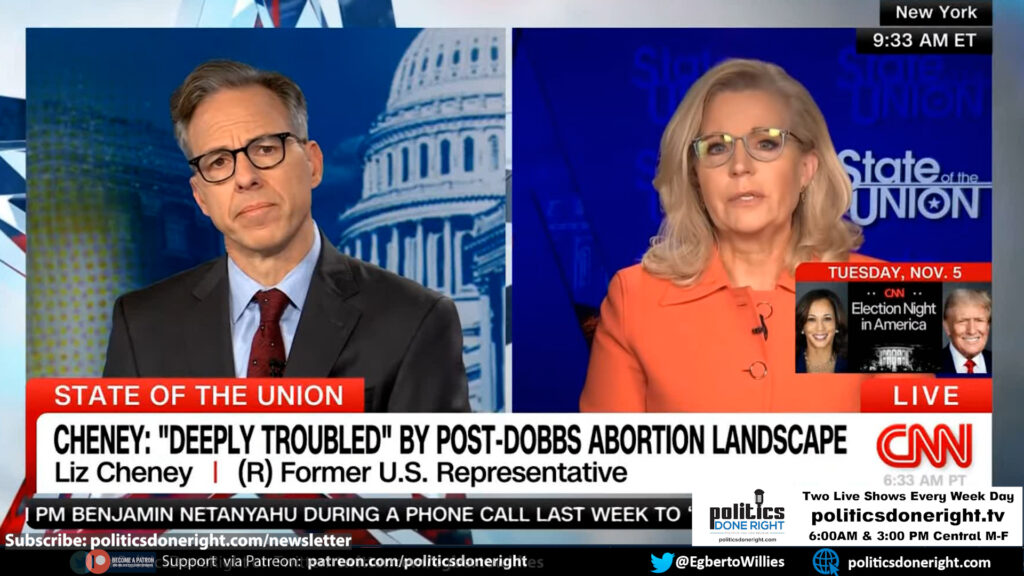
Former Congresswoman Liz Cheney and anti-choice Republican statement on her new awareness of the damage done by SCOTUS’ Roe v Wade repeal is a permission slip for Republican women to vote for Harris.
Liz Cheney’s message on women’s abortion rights.


Podcasts (Video — Audio)
Summary
Liz Cheney, in a recent CNN interview with Jake Tapper, expressed her deep concern over the extreme abortion restrictions enacted in some Republican-led states following the Dobbs decision. While still identifying as pro-life, Cheney underscored that these restrictive laws endanger women’s lives and infringe on privacy, urging conservative women to consider the real-life impact of such policies. Her stance marks a rare bipartisan moment where a staunch Republican acknowledges the need for accessible healthcare, even if it means aligning, in part, with the views of Kamala Harris on women’s reproductive rights.
- Cheney, a pro-life advocate, spoke critically about extreme anti-abortion laws, particularly in Texas and North Carolina, noting they endanger women’s access to life-saving healthcare.
- She expressed frustration with policies that allow invasive practices, such as Texas Attorney General Ken Paxton’s attempt to access the medical records of women seeking abortions.
- Cheney underscored the need for reasonable healthcare access for women facing medical emergencies, such as miscarriages, which are jeopardized by strict anti-abortion laws.
- She acknowledged that many pro-life women are troubled by these policies and may reconsider their alignment with hardline Republican views on abortion.
- Cheney’s stance provides conservative women a bridge to support reproductive rights without fully abandoning their pro-life values, calling for bipartisan collaboration on healthcare.
Liz Cheney’s stance highlights a vital moment where conservative women can question and oppose the extremism driving today’s anti-abortion laws. By focusing on real-life healthcare consequences, Cheney helps reframe the abortion debate as one centered on empathy, practical healthcare, and women’s safety—values central to progressive movements fighting for reproductive rights and bodily autonomy.
[ppp_patron_only level=2]
Liz Cheney’s recent comments regarding abortion rights signal a pivotal moment for the conservative women’s movement and the greater bipartisan dialogue on reproductive rights. Cheney, known for her steadfast conservatism, holds deep-rooted anti-choice views, having supported the 2022 Supreme Court decision that overturned Roe v. Wade. However, during a CNN interview with Jake Tapper, Cheney outlined her disapproval of the extreme measures taken by states like Texas and North Carolina in the aftermath of the Dobbs decision, showcasing her capacity to critique policies that disregard women’s health. Her stance opens doors for conservative women to align with progressive policy initiatives on reproductive health without renouncing their values, an essential step in bridging ideological divides.
Cheney’s statements could serve as a crucial opening for conservative women to embrace a more nuanced perspective on reproductive rights. She spoke openly about the real-life consequences of extreme abortion restrictions, mainly when life-saving care is at risk. By highlighting the potential for harm when women cannot access timely medical intervention, she exposed the inherent dangers of rigid anti-abortion laws. Cheney mentioned that many pro-life women are reconsidering the implications of recent policies that criminalize aspects of healthcare essential to women facing emergencies like miscarriages, setting a stark contrast to the narrative traditionally pushed by the Republican establishment.
In her interview, Cheney also pointed out the disturbing trajectory of some conservative leaders who, as she put it, “crossed over” into invasive practices that infringe on privacy and health. For instance, Texas Attorney General Ken Paxton’s attempts to access medical records of women who sought abortions reveal an alarming overreach of state power, especially when juxtaposed with the secrecy around Donald Trump’s medical history. This ironic twist underlines a profound inconsistency within the GOP’s stance on personal freedoms. Cheney’s critique underscores the authoritarian bent in these policies, a stark reminder of the slippery slope anti-abortion advocates risk sliding down, where basic privacy and healthcare are jeopardized in pursuit of ideological purity.
Cheney’s comments also underscore the importance of flexibility and empathy in political ideology. Though she remains anti-choice, Cheney’s acknowledgment of the real, often life-threatening implications of anti-abortion policies shows a rare willingness to prioritize women’s lives over rigid partisan positions. This capacity to adapt and reflect on the broader human impact marks a stark departure from many of her GOP colleagues, who have clung to stringent, often dehumanizing stances on reproductive health. Cheney’s viewpoint presents a hopeful prospect for women who identify as conservative but feel alienated by the current trajectory of the Republican Party’s stance on abortion rights.
Kamala Harris’s support for abortion rights has been instrumental in cementing the administration’s stance on women’s autonomy and healthcare access. Given their substantial ideological differences, Cheney’s willingness to align with Harris on this issue is noteworthy. By supporting Harris’s position, Cheney implicitly endorses a pragmatic approach that transcends party lines, where women’s health and well-being are non-negotiable. This collaboration could serve as a “permission slip” for conservative women to support reproductive rights without feeling they must renounce their pro-life identity. Cheney’s message could signal a turning point in the reproductive rights debate, wherein the need for reasonable healthcare access supersedes divisive ideological boundaries.
Cheney’s words expose a dissonance within the Republican Party between its leaders’ professed concern for “life” and the harmful consequences of their policies. For years, progressive activists have warned of the dangers of restricting access to reproductive healthcare, pointing out that these laws disproportionately impact marginalized women and lead to preventable suffering and death. Cheney’s statement mirrors these progressive warnings, as she highlighted cases where women could face dire health consequences under anti-abortion laws. Her remarks reveal the chasm between the GOP’s rhetoric and the reality that progressive activists have long asserted: denying access to reproductive healthcare has devastating consequences, not only for women’s autonomy but for their very lives.
Cheney’s courage in breaking ranks with the GOP on such a critical issue sets a precedent for others within the party. Cheney’s actions suggest that issues as fundamental as healthcare and bodily autonomy demand a bipartisan approach in a political landscape often defined by divisive rhetoric. Her willingness to stand with those she disagrees with ideologically, such as Kamala Harris, signals a shift toward constructive dialogue rather than partisan gridlock. As Cheney stated, the status quo is “simply unsustainable,” and her comments provide an example of how leaders on both sides of the aisle might work toward solutions that safeguard women’s health while respecting diverse viewpoints.
Ultimately, Cheney’s critique of the Republican Party’s abortion stance and her implicit support for Harris’s approach challenges conservative women to consider the broader implications of their political positions. Her statement serves as a bridge for those who are ideologically pro-life yet feel uncomfortable with the extremism dominating current GOP policies. This permission slip, so to speak, could lead conservative women to reassess their affiliations and lend support to leaders willing to prioritize compassion and practical healthcare access over dogma.
Liz Cheney’s stance on abortion rights signals a call for bipartisan collaboration on women’s reproductive healthcare. Her willingness to engage with Kamala Harris’s perspective demonstrates a rare moment of unity in today’s polarized environment. It gives Republican women a powerful signal that they, too, can support humane policies without abandoning their values. Cheney’s approach shows that courage in political leadership is often about acknowledging when rigid ideology must yield to empathy and pragmatism. This lesson could reshape the political landscape around abortion rights for years to come. She provides the permission slip for Republicans to vote for Harris.
[/ppp_patron_only]