


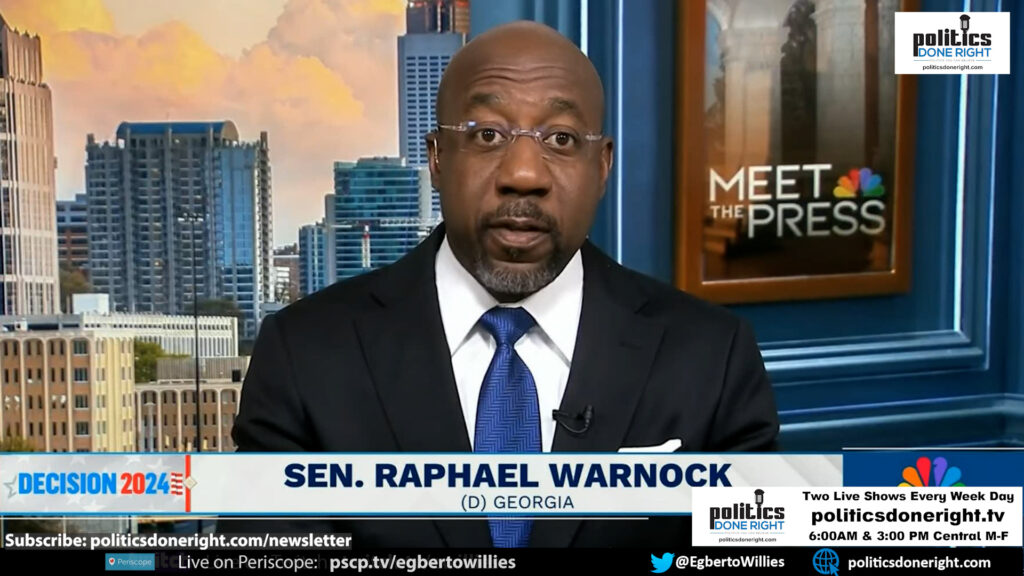
Senator Raphael Warnock did not mince his words on Meet The Press when he said, “We don’t need a predator. We need a president,” which is why Kamala Harris must win.
Warnock: We don’t need a predator.


Podcasts (Video — Audio)
Summary:
In a powerful statement, Senator Raphael Warnock urged voters to reject Donald Trump, emphasizing the importance of electing leaders who respect women’s rights. Warnock contrasts Trump’s harmful history with Kamala Harris’ commitment to protecting women’s autonomy and fighting for all Americans, framing the upcoming election as a choice between a predatory leader and a president with a progressive agenda.
- Warnock argues that Trump’s actions reflect a predatory attitude that endangers women’s rights and autonomy.
- He emphasizes Kamala Harris’s dedication to defending women’s rights, including reproductive freedom.
- Warnock’s line, “We don’t need a predator; we need a president,” highlights the need for respectful leadership.
- Early voting among women, including Republicans and Independents, signals a desire for change.
- Voters who respect women’s rights support Harris.
Senator Warnock’s message is a call for change, urging Americans to reject Trump’s dangerous, authoritarian stance toward women and choose Kamala Harris’s compassionate, rights-focused leadership. With women’s rights under threat, Warnock’s remarks echo the urgency of electing leaders who protect the freedoms and dignities of all people, advocating for a nation rooted in equality and progressive values.
[ppp_patron_only level=2]
In an era of polarized politics and heightened awareness around the protection of women’s rights, Georgia Senator Raphael Warnock’s recent remarks strike a powerful chord. His speech, juxtaposing the abusive behavior of Donald Trump with the empathetic leadership of Kamala Harris, serves as a rallying cry not only for women but for all who respect women’s autonomy. Warnock’s statement, “We don’t need a predator; we need a president,” is more than a call to arms—it encapsulates the growing urgency to elect leaders who prioritize respect, equality, and protection for all citizens, especially women. His words illustrate the stark contrast between Trump’s self-centered motives and Harris’s commitment to championing women’s rights and the rights of marginalized communities.
Warnock’s statement resonates at a time when Trump’s numerous allegations of sexual misconduct, as well as his documented derogatory statements about women, remain fresh in the public’s mind. Trump’s boasts about assault and the multiple accusations from women who have come forward over the years create a haunting image of a leader far removed from the ideals of respect and accountability. The fact that Warnock specifically addressed Trump’s predatory history reinforces the need for voters to reject not only his candidacy but also the type of leadership it represents. On the other hand, Harris is positioned as a leader focused on the well-being of all, a message that echoes across political lines, reaching Republicans, Independents, and Democrats alike.
Warnock makes it clear that the stakes of this election extend beyond party lines; they reach into the core of American values. His line, “She has a to-do list; he has an enemies list,” draws attention to Trump’s consistent prioritization of his grievances over the needs of the American people. Harris, by contrast, represents a practical, grounded approach, focusing on women’s rights as a cornerstone of her platform. As Warnock points out, Harris’s list of priorities includes protecting women’s right to choose—an issue that has become even more critical as conservative legislators across the nation attempt to restrict access to reproductive health services. Harris’s policy stance demonstrates her understanding that women’s rights are human rights, and these rights must be defended vigorously.
The broader context here is clear: the Trump administration, and by extension Trump himself, is seen by many as a threat to women’s autonomy, equality, and safety. Trump’s infamous statement, “I will protect women whether they want it or not,” encapsulates a paternalistic attitude that strips women of their agency, painting them as individuals in need of control rather than protection. This is a dangerously outdated view that fails to respect women as capable individuals with the right to make decisions about their lives and bodies. Harris, in stark contrast, is advocating for a society in which women have control over their reproductive rights and are seen as equal contributors to society, not subjects of male dominance.
Warnock’s statement is not just an appeal to women; it speaks to men who respect women and recognize that real leadership involves empathy, respect, and an unwavering commitment to equality. It suggests that men who truly value women will join this movement, seeing the need for a president who honors women’s autonomy rather than undermines it. As Warnock points out, men who love and respect women should feel compelled to vote for a leader who embodies these values and rejects the notion of women as mere objects of control or possession.
The senator’s remarks also highlight the power of women voters in this election. Early voting turnout among women is historically high, with many Republican and Independent women crossing party lines to cast their ballots for Harris. This phenomenon speaks volumes about the collective commitment of American women to safeguard their rights. Women across the political spectrum understand that a vote for Trump is a vote against their autonomy, safety, and respect. Recent studies show that women voters are increasingly dissatisfied with Trump’s leadership, particularly in light of his administration’s actions on reproductive rights and gender equality.
Beyond his message to women, Warnock’s speech reflects a progressive vision for a country that values and upholds the rights of all its citizens. His words are a powerful reminder of the strength of unity and the importance of standing against those who threaten equality and justice. His message extends beyond party lines, calling on Americans to reject divisive and harmful leadership in favor of a president who truly represents the people. For Warnock, Harris symbolizes this kind of leadership—committed, empathetic, and resolute in protecting the rights of the vulnerable.
Warnock’s appeal must be a call to action for progressive voices to amplify this message, populating “the entire internet with the truth. His statements remind voters of the critical importance of shared values in leadership and governance, urging all who care about equality, fairness, and human dignity to stand together. Harris represents a vote for progress and a stand against regressive forces that threaten to dismantle hard-won rights.
Ultimately, Warnock’s message is clear: this election is a defining moment, a choice between a leader who respects women and a predator who threatens them. It is a choice between progress and regression, between unity and division. As the election approaches, voters can reject Trump’s dangerous rhetoric and support a candidate who embodies the values of respect, equality, and justice. Harris represents the path forward for Warnock and the millions of women and men who share her vision. This path values all Americans and champions women’s rights as essential to the health and future of the nation.
[/ppp_patron_only]