


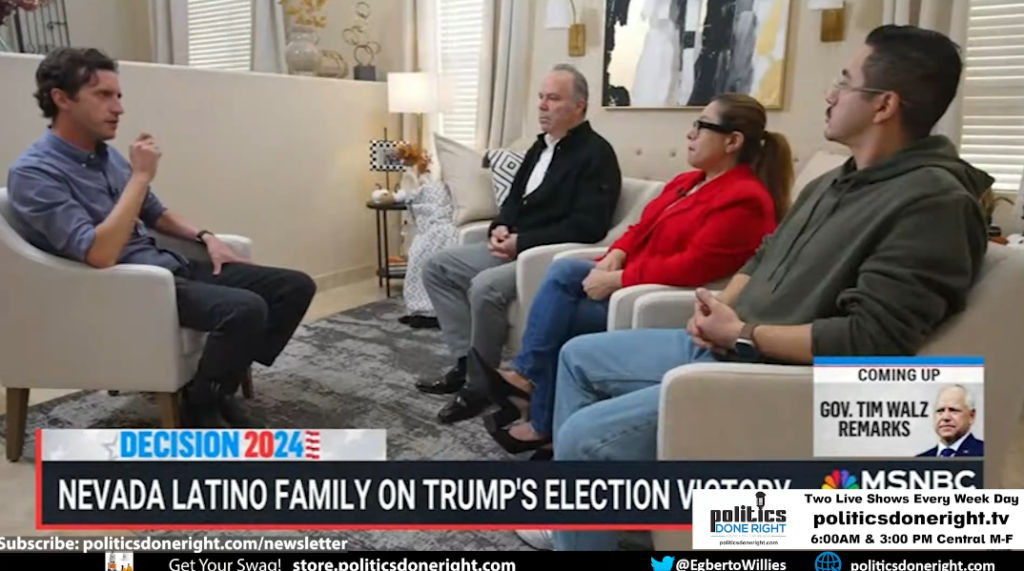
This Latino family that crossed the border illegally now thinks that those crossing the border illegally are criminals. That is the power of the Trump-targeted indoctrination.
A couple who crossed the border illegally voted for Trump.


Podcasts (Video — Audio)
Summary
The video discusses the complexities and contradictions within immigrant communities who support anti-immigrant policies. The Alvarez family, who crossed the border illegally but later became citizens, now support Donald Trump and view recent immigrants as “criminals.” This shift, attributed to targeted political propaganda, reveals how conservative messaging exploits economic fears and social insecurities among Latino voters. The speaker highlights the psychological manipulation used by conservatives to foster divisive attitudes, noting the need for progressive media to counteract these harmful narratives and unify immigrant communities around shared struggles and aspirations.
- The Alvarez family, immigrants who became citizens under Reagan’s amnesty, now vote for Trump and support his strict immigration stance.
- They view newer immigrants as “criminals,” influenced by targeted conservative messaging that divides immigrant communities.
- Conservatives use psychological tactics, targeting specific demographic fears within Latino communities, to build anti-immigrant sentiment.
- Economic insecurities and fears of marginalization are exploited to distract from more significant systemic issues affecting working-class communities.
- Progressive media and activists need stronger support to counter these narratives and promote solidarity among immigrant and marginalized groups.
The Alvarez family’s experience highlights the harmful effects of conservative messaging that distorts immigrants’ perceptions of one another. Despite benefiting from U.S. opportunities, they view recent immigrants through a lens shaped by targeted propaganda. This messaging pits struggling communities against each other, benefiting only the wealthy and powerful. Progressive movements must prioritize uniting immigrant communities through shared struggles, pushing back against divisive narratives, and advocating for economic and social policies that uplift all marginalized people.
[ppp_patron_only level=2]
In today’s political landscape, stories like that of Mario and Mira Alvarez—a Latino couple who immigrated to the United States illegally and eventually became citizens—bring an unexpected layer of complexity to discussions around immigration and political allegiance. Despite their history of undocumented entry, they and their family voted for Donald Trump in part because of his hardline stance on immigration. This decision raises questions about identity, assimilation, and the psychological impact of political messaging. The Alvarez family embodies a cognitive dissonance present in some immigrant communities, particularly among Latinos, who simultaneously strive for inclusion in American society and seek to distance themselves from those they perceive as “other.” This stance, fostered by targeted political propaganda and socio-economic fears, has created divisions that not only impact voting patterns but also undermine solidarity within immigrant communities.
The Alvarez family’s story isn’t isolated; it represents a broader phenomenon among Latino voters in recent years. As reported by NBC, Donald Trump made significant gains among Latino voters, particularly Latino men, who voted for him in increasing numbers between the 2020 and 2024 elections. This shift suggests that his message resonates with a portion of the Latino population despite—or perhaps because of—his rhetoric on immigration, which often labels undocumented migrants as criminals. What is perplexing and, to many progressives, disheartening is that some of these voters are themselves immigrants or descendants of immigrants who once sought refuge and opportunity in the United States under similar circumstances to today’s migrants. This seeming paradox is not merely a quirk of individual belief; it reflects a more significant and meticulously crafted psychological campaign to reshape Latino identity within the American political landscape.
Examining the psychological strategies employed by conservative political operatives is essential to understand this phenomenon. For years, right-wing think tanks, media outlets, and social media influencers have honed their messaging to sway various demographic groups by appealing to specific fears and insecurities. For Latino immigrants, the messaging often involves portraying new migrants as a threat to their hard-won status and security. As the video indicates, this messaging leverages psychological warfare techniques, painting immigrants crossing the border today as “criminals” while positioning earlier waves of immigrants, such as the Alvarezes, as morally distinct. By framing current immigration issues in terms of criminality and moral inferiority, conservative narratives encourage earlier immigrants to see themselves as different and to believe that their success is threatened by the arrival of others who ostensibly do not “deserve” the same opportunities.
This manipulation is particularly effective because it speaks to a real concern among Latino immigrants: the fear of being marginalized or economically disadvantaged. The Alvarezes worry about the cost of living and job security, issues that are real and pressing for many working-class Americans. However, Trump and his allies have used these fears to redirect attention away from structural economic problems—such as stagnant wages, lack of affordable housing, and the declining bargaining power of workers—and instead scapegoat immigrants as the cause of these issues. This technique has historical roots, as similar tactics have been used to pit marginalized groups against each other. By diverting frustration towards new immigrants, conservative narratives succeed in distracting from policies that undermine the economic security of working-class families, Latino or otherwise.
Moreover, the Alvarez family’s rejection of new immigrants is tied to a broader trend of cultural assimilation within immigrant communities. As some immigrants achieve a certain level of success or legal status, they may adopt values and attitudes that align with the dominant culture, including anti-immigrant sentiment. This tendency can be exacerbated by propaganda that reinforces notions of American exceptionalism and demonizes foreign cultures. The story of the Alvarezes illustrates this point vividly. Despite their shared heritage and similar backgrounds with new immigrants, they distance themselves from today’s migrants by branding them as inherently criminal. This is not just a personal opinion; it is the product of a systematic effort to mold the beliefs of immigrants by emphasizing fear, competition, and division over empathy and shared experience.
Progressives face a significant challenge in counteracting this narrative, which has been deeply ingrained through years of targeted messaging. To disrupt the hold of anti-immigrant sentiment among immigrants themselves, it is essential to address the root causes of economic insecurity and to dismantle the cultural myths that fuel divisiveness. As mentioned in the video, progressive activists and independent media outlets are critical in offering alternative narratives emphasizing solidarity, community, and mutual support among immigrants. Organizations dedicated to progressive change can amplify voices like those of immigrant community activists who highlight how new immigrants’ struggles mirror their own and why resisting the forces that seek to divide them is vital.
A renewed emphasis on grassroots education and coalition-building can help immigrant communities see the bigger picture: their economic struggles are part of a broader pattern that affects all working-class Americans, not just immigrants. The progressive movement must engage directly with Latino communities to foster an understanding of how policies that harm one group ultimately harm everyone. By supporting policies that benefit the working class—such as a living wage, affordable housing, and healthcare reform—progressives can offer a tangible alternative to the divisive narratives peddled by conservatives.
The story of the Alvarez family is emblematic of the challenges facing the progressive movement in reaching immigrant communities who may be susceptible to anti-immigrant rhetoric. It highlights the need for a compelling counter-narrative that addresses both the economic anxieties and the psychological tactics used to divide immigrant groups. Progressives must double down on efforts to build unity within immigrant communities, emphasizing shared experiences and collective interests. Through focused outreach, education, and community organizing, progressives can work to dismantle the toxic myths that pit immigrants against each other and replace them with a message of solidarity, resilience, and mutual respect. The path forward requires a commitment to transformative policies that benefit all Americans, an approach that offers real solutions rather than scapegoats for systemic problems.
[/ppp_patron_only]