


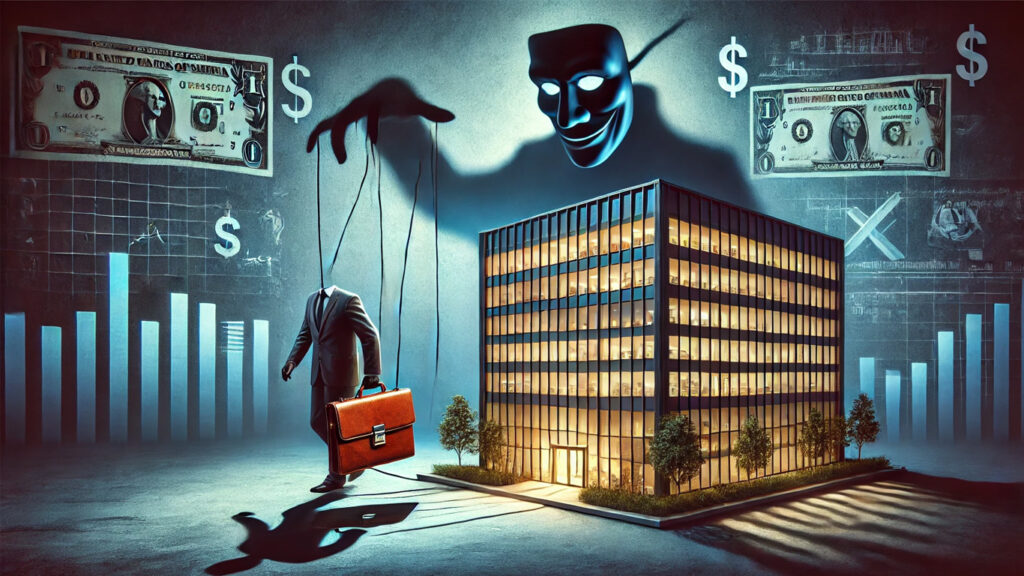
Corporate executives are given carte blanche to do as they please because corporations are considered persons who absorb their guilt.
Executives’ evil deeds are hidden behind corporations.

Watch Politics Done Right T.V. here.

Podcasts (Video — Audio)
Summary
The video discusses the harmful consequences of corporate personhood, a legal doctrine that shields executives from accountability while granting corporations disproportionate rights. It critiques how this framework allows corporations to evade responsibility for actions that harm individuals and communities, such as denying life-saving care or causing environmental destruction. The speaker emphasizes the need to abolish corporate personhood and redefine money as speech to restore fairness and justice in society.
- Corporate personhood grants corporations rights similar to individuals, shielding executives from accountability.
- Harmful corporate actions, like denying care or polluting, are often penalized as business expenses, not crimes.
- Citizens United expanded corporate influence by equating money with free speech.
- The current system undermines democracy, prioritizing profit over human life and environmental health.
- Reform is needed to hold decision-makers accountable and prioritize humanity over capital.
Corporate personhood is a dangerous construct that lets the wealthy hide behind fictional entities, leaving everyday people to bear the costs of their greed. The video highlights how unchecked corporate power harms lives and democracy while shielding those responsible. Progressives must challenge these injustices, eliminate corporate personhood, and ensure that money no longer drowns out the voices of the people.
[ppp_patron_only level=2]
The concept of corporate personhood has enabled a moral and legal bait-and-switch that shields executives and board members from accountability for the often disastrous consequences of their decisions. By granting corporations the rights of individuals without imposing corresponding responsibilities, society has created a loophole that allows those at the helm of these entities to act with impunity. This phenomenon raises fundamental questions about justice, accountability, and the ethical limits of capitalism.
The video highlights a crucial issue: when a corporation denies life-saving care, pollutes the environment, or makes decisions that result in harm or death, the legal system typically holds the corporation—not the individuals responsible for those decisions—accountable. This structure stems from the doctrine of corporate personhood, which treats corporations as separate legal entities with certain rights akin to those of individuals. While this legal framework simplifies contracts and liabilities, it also creates a shield behind which executives can evade responsibility.
The Problem of Corporate Personhood
As solidified in landmark cases like Santa Clara County v. Southern Pacific Railroad (1886) and expanded by Citizens United v. FEC (2010), corporate personhood grants corporations many of the same rights as individuals, including the right to free speech. However, this legal fiction ignores a critical distinction: corporations are not human beings. They lack a conscience, empathy, and the ability to suffer consequences like individuals do. Yet, they wield disproportionate power due to their vast financial resources and legal protections.
When a corporation engages in harmful behavior—denying coverage for essential medical treatments or contaminating an ecosystem—the penalties often fall on the entity itself, not the individuals who made the decisions. Corporations may pay fines or settle lawsuits, but these costs are typically absorbed as a business expense, often without meaningful changes to their operations or culture. Meanwhile, the CEOs and board members responsible for these actions continue to collect bonuses and enjoy their impunity.
Moral and Legal Accountability
Corporate harm should be treated as individual criminal acts. If an individual knowingly takes an action that leads to someone’s death, they face criminal charges. Yet, when a corporate board approves policies that result in preventable deaths—such as denying life-saving care due to cost—they escape prosecution. This discrepancy underscores the need for reform.
Holding individuals accountable for corporate decisions would create a powerful deterrent against harmful practices. If executives and board members faced the prospect of personal liability for their actions, they would likely prioritize ethical considerations alongside financial ones. This shift could lead to a more humane and sustainable economic system where the pursuit of profit does not come at the expense of human lives and well-being.
The Role of Citizens United
The Citizens United decision exacerbated the problem by equating money with speech. This ruling gave corporations nearly unlimited power to influence elections and public policy, further entrenching their ability to evade accountability. With their vast financial resources, corporations can drown out the voices of ordinary citizens, shaping laws and regulations to their advantage. This dynamic creates a democracy where the wealthiest entities wield disproportionate influence, undermining the principle of equal representation.
The Path Forward
To address these issues, progressive reformers advocate for two critical changes: ending corporate personhood and redefining the role of money in politics. Eliminating corporate personhood would strip corporations of the legal protections that allow them to evade responsibility for harmful actions. It would also make it easier to hold individuals accountable for decisions that cause harm. Meanwhile, overturning Citizens United and enacting campaign finance reform would restore balance to the political system, ensuring that the voices of ordinary citizens are not drowned out by corporate money.
These reforms would require a cultural shift from unbridled capitalism toward a system that values humanity over profit. As the video suggests, this transition would involve redefining economic success to include ethical and social considerations. A “free enterprise system governed by rules and laws prioritizing humanity” could create a more equitable and just society.
Conclusion
The current system allows corporate executives to hide behind the legal fiction of corporate personhood, avoiding accountability for actions that harm individuals and communities. This bait-and-switch undermines justice and perpetuates inequality. By challenging the doctrines of corporate personhood and money as speech, society can hold those in power accountable and create a more democratic and humane economic system. The path forward requires bold action, but the stakes—human lives, environmental sustainability, and the integrity of democracy—demand nothing less.
[/ppp_patron_only]