


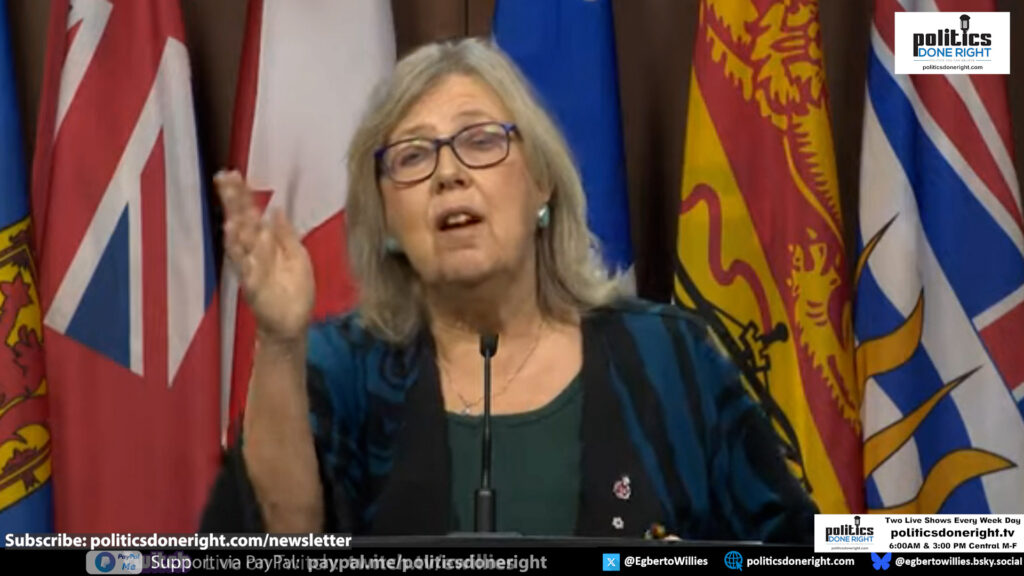
Canadian Green Party leader Elizabeth May had a suggestion for Donald Trump’s suggestion that Canada become the 51st state: make California, Oregon, Washington, & Vermont Canadian provinces.
Canadian political leader responds to Trump.

Watch Politics Done Right T.V. here.

Podcasts (Video — Audio)
Summary
Canadian Green Party leader Elizabeth May humorously responded to Donald Trump’s suggestion that Canada become the 51st state by proposing an alternative: progressive U.S. states like California, Oregon, and Washington should consider joining Canada as provinces instead. She highlighted Canada’s universal healthcare, stricter gun laws, and substantial social equity as reasons why such a move could appeal to Americans frustrated with the U.S. government’s systemic failures. May also emphasized Canada’s sovereignty and pride in its values, rejecting Trump’s imperialist rhetoric.
- Trump’s Provocation: Trump suggested Canada become the 51st U.S. state, which May dismissed as absurd and imperialist.
- Counterproposal: May humorously suggest that progressive states like California, Oregon, and Washington join Canada instead.
- Healthcare Contrast: She emphasized Canada’s universal healthcare system as a model of equity compared to the U.S.’s profit-driven system.
- Gun Safety: Canada’s strict gun laws and low rates of gun violence highlight a stark difference from America’s gun crisis.
- Sovereignty and Values: May reaffirmed Canada’s identity as a proud, sovereign nation committed to social justice and equality.
Elizabeth May’s response underscores the failures of the U.S. system while championing Canada’s progressive policies. Her critique challenges Americans to rethink their priorities, urging them to embrace values like universal healthcare, gun control, and equity over corporate greed and political stagnation. This is a call to action for progressive reform and cross-border solidarity.
[ppp_patron_only level=2]
The provocative idea of the United States absorbing Canada as its 51st state is not only absurd but reveals the hubris and imperialist tendencies that have characterized Donald Trump’s rhetoric. However, this farcical suggestion opens the door to a counterproposal that flips the narrative entirely. Elizabeth May, the leader of Canada’s Green Party, humorously challenged Trump by proposing that progressive U.S. states such as California, Oregon, and Washington consider joining Canada instead. Her remarks underscore the absurdity of Trump’s comments and highlight the stark contrast between Canada’s social policies and the systemic failings in the United States.
May’s response was sharp and witty, but it also thoughtfully critiqued the dire state of American governance under Trump-era politics. She highlighted Canada’s universal healthcare system, stringent gun laws, and progressive policies as reasons why certain U.S. states might find alignment with Canada more attractive than remaining tethered to federal dysfunction in Washington, D.C. Her words encapsulate a larger conversation about governance, equity, and public welfare that resonates beyond borders.
The Healthcare Divide
One of May’s most compelling points was the stark contrast between Canada’s universal healthcare system and the United States’ fragmented, profit-driven model. In Canada, no child falls off a healthcare plan due to bureaucratic red tape or financial constraints. Universal healthcare ensures that medical care is a right, not a privilege. This stands in sharp contrast to the U.S., where millions remain uninsured or underinsured, and families often resort to GoFundMe campaigns to cover basic medical needs.
The American healthcare system’s failures disproportionately affect marginalized communities, perpetuating cycles of poverty and inequality. Meanwhile, Canada demonstrates that universal healthcare can coexist with a capitalist economy, providing a framework for ensuring public health as a cornerstone of societal well-being. This disparity alone would make Canada’s offer to progressive states appealing to millions of Americans frustrated by their system’s inadequacies.
Gun Laws and Public Safety
May also underscored Canada’s stricter gun laws, which have resulted in significantly lower rates of gun violence compared to the United States. According to recent statistics, the U.S. experiences a staggering rate of 5.9 gun-related fatalities per 100,000 people, compared to Canada’s 0.88. These figures illustrate the devastating consequences of America’s lax gun laws, which powerful lobbying groups like the NRA and a culture of political cowardice drive.
In contrast, Canada’s approach to gun control prioritizes public safety over the interests of firearm manufacturers. The absence of mass shootings in Canadian schools and public spaces serves as a stark reminder of what is possible when a society takes proactive measures to regulate deadly weapons. Progressive U.S. states, which already advocate for stricter gun control, might find Canada’s safer streets an enticing proposition.
Reproductive Rights and Social Equity
Another critical difference May highlighted is the protection of reproductive rights under Canada’s universal healthcare system. As states across the U.S. face increasing restrictions on abortion access due to conservative policies, Canada offers a sanctuary where women’s autonomy is respected and supported. The Dobbs v. Jackson Women’s Health Organization decision has made reproductive healthcare a battleground in the U.S.. Still, Canada remains steadfast in ensuring access to abortion and other essential healthcare services as fundamental rights.
Cascadia: A Vision for the Future?
May’s mention of “Cascadia,” a hypothetical bioregion encompassing parts of the U.S. and Canada, taps into an existing cultural and political alignment between progressive regions. States like California, Oregon, and Washington share geography and values with Canadian provinces like British Columbia and Quebec. Initiatives like carbon trading partnerships already demonstrate the potential for deeper collaboration on climate and environmental policies.
While largely rhetorical, the idea of a referendum allowing these states to join Canada underscores the dissatisfaction many Americans feel with the federal government’s inability to address systemic issues. It also highlights the growing desire for regional solutions to global challenges like climate change, healthcare, and economic inequality.
Sovereignty and Identity
May’s final point was perhaps the most poignant. She reminded Trump—and, by extension, the world—that Canada is a sovereign nation with its own identity, values, and aspirations. Canadians, while not prone to boastfulness, take pride in their social policies and their role as global actors committed to peace, equity, and sustainability. The suggestion of becoming the 51st state of a nation riddled with political strife, inequality, and gun violence is not only insulting but reflects a profound misunderstanding of what Canada represents.
Conclusion: A Lesson in Humility
Elizabeth May’s response to Trump’s outlandish remarks serves as both a humorous rebuttal and a powerful critique of the United States’ systemic failures. By flipping the script and proposing that progressive U.S. states consider joining Canada, she challenges Americans to reflect on the policies and values that define their nation. Her comments also highlight the urgent need for bold, progressive reforms to address healthcare, gun violence, and social inequality in the U.S.
This episode is a reminder that nationalism and imperialist fantasies have no place in a world striving for justice and equity. Instead, nations and regions should work together to build systems that prioritize the well-being of all people. May’s words are a call to action for progressives everywhere to demand better from their governments—and to imagine a future where borders are less about division and more about shared values and collaboration.
[/ppp_patron_only]