


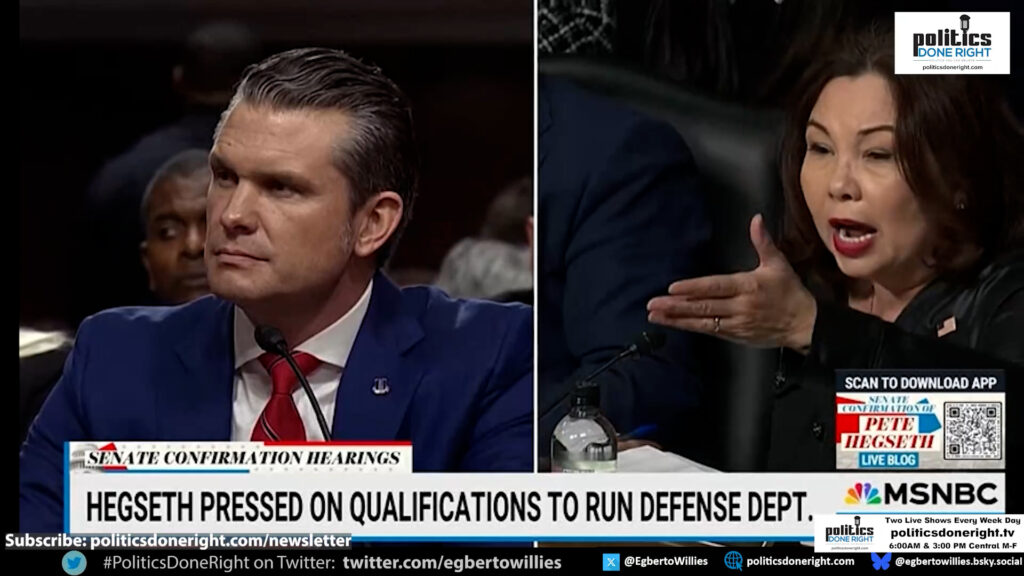
Senator Tammy Duckworth did not disappoint as she made it clear that Pete Hegseth is incompetent and not qualified to be Secretary of Defense.
Sen. Tammy Duckworth embarrasses Pete Hegseth

Watch Politics Done Right T.V. here.

Podcasts (Video — Audio)
Summary
Senator Tammy Duckworth delivered a pointed critique of Pete Hegseth’s qualifications for Secretary of Defense during his confirmation hearing, highlighting his lack of preparedness, questionable moral character, and failure to meet the basic standards required for the role. Duckworth dismantled Hegseth’s arguments and exposed his incompetence, emphasizing the dangers of placing unqualified individuals in critical positions of power.
Key Points:
- Qualifications in Question: Duckworth underscored Hegseth’s limited experience, including his inability to name key defense agreements or demonstrate leadership in critical areas like audits and international negotiations.
- Unprepared for the Role: Hegseth’s lack of knowledge about the Department of Defense’s essential functions revealed his unpreparedness for such a crucial position.
- Cronyism Over Competence: Duckworth criticized the nomination as an example of loyalty to Trump outweighing expertise and fitness for the job.
- Sexist Undercurrents: Duckworth, a combat veteran, countered Hegseth’s dismissive views on women in the military, illustrating the hypocrisy of his stance.
- Higher Standards for Leadership: Duckworth emphasized the importance of holding leaders to the same high standards expected of service members, rejecting any attempt to lower the bar for personal connections.
Progressive Perspective
Senator Duckworth’s fearless critique of Pete Hegseth highlighted the systemic issues of privilege and mediocrity in leadership. By holding Hegseth accountable for his glaring unfitness, Duckworth championed a vision of governance rooted in merit, equity, and respect for public service. Her insistence on integrity over cronyism serves as a progressive call to action for a government that reflects the excellence and sacrifice of the people it serves.
[ppp_patron_only level=2]
Senator Tammy Duckworth’s scathing rebuke of Pete Hegseth during his confirmation hearing as Secretary of Defense nominee is a masterclass exposing the pitfalls of cronyism and incompetence in government. Her remarks cut through the noise of personal scandals and political theatrics to focus on a critical truth: the qualifications for a job as vital as Secretary of Defense must be unimpeachable. Duckworth, a combat veteran and double amputee who has sacrificed immeasurably for her country, embodies the meritocratic spirit Hegseth utterly fails to meet.
At the heart of Duckworth’s argument lies a profound critique of unearned privilege and the normalization of mediocrity among certain elites. Hegseth, a former Fox News commentator and Trump loyalist brought little besides his connections to the outgoing president. His track record, as Duckworth meticulously pointed out, showcased a glaring lack of preparedness for a role that demands both strategic acumen and a deep understanding of global defense operations. Her interrogation revealed a lack of qualifications and a fundamental disrespect for the position—a man asking to lead the Pentagon without even studying its essential functions or the agreements it handles.
Duckworth’s relentless questioning of Hegseth’s qualifications underscored her more significant point: leadership of the U.S. military cannot be handed to someone who cannot name ASEAN nations, articulate key defense agreements, or understand the Department of Defense’s audit requirements. In a world where adversaries are constantly watching for weaknesses, placing an unqualified person at the helm of the Pentagon risks national security. Duckworth’s statement that “our troops deserve a leader who can lead them, not a leader who wants to lower the standards for himself” strikes the heart of this issue. American soldiers operate under the highest discipline, skill, and sacrifice expectations. Shouldn’t their leaders be held to the same standard?
Beyond the immediate dangers posed by Hegseth’s incompetence, Duckworth’s critique also illuminated a broader issue: the insidious double standard that pervades discussions of leadership and meritocracy. Time and again, men like Hegseth ascend to influential roles despite glaring deficiencies in skill or character. This phenomenon—often described as “failing upward”—is emblematic of a system that rewards connections over competence. Meanwhile, women, people of color, and others who have traditionally been excluded from the halls of power are held to exacting standards far beyond those applied to their privileged counterparts.
Hegseth’s nomination is emblematic of a larger pattern under Trump’s administration, where loyalty often outweighed expertise. From Education Secretary Betsy DeVos, who showed little understanding of public education, to the revolving door of acting officials across departments, the Trump era frequently elevated individuals who lacked the experience to govern effectively. This trend undermined public trust in government and posed real risks to policy outcomes. Duckworth’s interrogation of Hegseth is a rebuke of one man’s unfitness but a call to restore integrity to public service.
The senator’s words also resonate deeply in the context of gender equity in the military. Duckworth, who lost her legs while piloting a Black Hawk helicopter in Iraq, embodies the sacrifices and capabilities of women in combat roles. Hegseth’s past statements dismissing women’s contributions in these roles were not just offensive but demonstrably false. Duckworth’s very presence in the Senate chamber—questioning the qualifications of a man whose views she has disproven through her own actions—was a powerful rebuke to the entrenched sexism that persists in some corners of the military and beyond.
Ultimately, Duckworth’s critique of Hegseth reminds us of what is at stake when unqualified individuals are handed immense power. The Secretary of Defense oversees America’s military strategy, its relationships with allies, and its responses to global crises. This is not a role for amateurs or ideologues. It requires a depth of knowledge, a strategic mindset, and a commitment to the values that America claims to represent. Hegseth’s lack of preparation and questionable moral character made him uniquely unfit for the job.
Duckworth’s performance in this hearing serves as an example of what effective oversight looks like. Her pointed questions, grounded in facts and experience, highlighted the absurdity of Hegseth’s nomination. At a time when American institutions face deep polarization and distrust, Duckworth’s insistence on holding leaders accountable to high standards is a vital reminder of how democracy should work. Public servants should serve the public, not their ambitions or the whims of powerful friends.
Hegseth inferred, with hubris, that he was selected by Donald Trump, someone he considered a great businessman. That elicited a perfect response from the Senator.
“We ask troops who man that ship, fight that fight, fly that helicopter until their very last breath and they do that every single day,” Duckworth said. “They cannot be led by someone who’s not competent to do the job. How can we ask these warriors to train and perform at the absolute highest standards when you are asking us to lower the standards to make you the Secretary of Defense simply because you are buddies with our president-elect? “
Duckworth took a swipe at Trump.
“By the way, he has filed for bankruptcy six times,” Duckworth said. “I’m not quite sure he’s the kind of CEO you want to refer to as a successful businessman.”
She then made it clear he is incompetent and will not get her vote.
“Let me make it clear. You can’t seem to grasp that there is no US military as we know it without the incredible women that we serve,” Duckworth said. “Women have earned their place in their units. You have not earned your place as Secretary of Defense. You say you care about keeping our armed forces strong and that you like that our armed force is a meritocracy, then let’s not lower the standards for you. You, sir, are a no-go at this station.”
Ultimately, Duckworth’s message to Hegseth—and the American people—is clear: leadership matters. The stakes are too high to settle for mediocrity, especially when defending the nation. America’s troops deserve better. Its citizens deserve better. And Duckworth’s fearless advocacy for competence and accountability reminds us of what good governance should look like.
[/ppp_patron_only]