


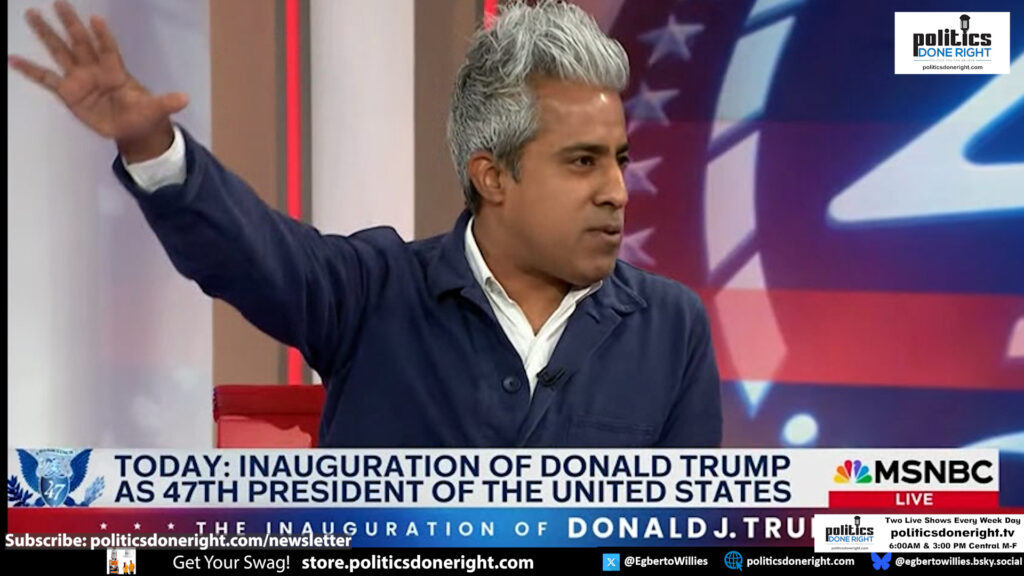
Anand Giridharadas: It is easy to believe that less than 50% of America voted for or wanted Trump. Unfortunately, if we had less Trump in us as a nation, he would have lost in a landslide.
Anand Giridharadas: A Trump in all of us?

Watch Politics Done Right T.V. here.

Podcasts (Video — Audio)
Summary
Anand Giridharadas argues that Donald Trump is not an anomaly but a reflection of America’s deep-seated systemic issues. He describes Trumpism as an “autoimmune disease” rather than an infection, meaning that the country itself has internal dysfunctions fueling his rise. Many Americans, despite disapproving of Trump, remain disengaged due to systemic disenfranchisement and apathy. The persistent myth of rugged individualism keeps working people believing in a system rigged against them while oligarchs consolidate power. Progressives must counter this by mobilizing voters, exposing the economic and cultural roots of Trumpism, and offering a bold, inclusive vision for the future.
- Trump is not an outsider; he is a product of America’s obsession with wealth, deception, and oligarchy.
- Many voters did not actively support Trump, but systemic voter apathy and disenfranchisement helped him win.
- The myth of rugged individualism enables economic exploitation and justifies extreme wealth inequality.
- Oligarchs maintain control by discouraging civic engagement and promoting cynicism about the system.
- Progressives must counter Trumpism by mobilizing participation, challenging oligarchy, and advocating for systemic change.
Trumpism is a symptom of America’s deeper structural issues—unchecked capitalism, wealth worship, and institutional decay. The fight against it is not about one man but
dismantling the economic and political systems that allow authoritarianism to thrive. Progressives must empower the working class, promote policies that benefit the majority, and remind Americans that democracy only survives through active participation.
[ppp_patron_only level=2]
Anand Giridharadas presents a stark and unsettling diagnosis of American democracy that challenges the conventional wisdom that Donald Trump is merely an anomaly—a glitch in the system. He argues instead that Trump is not an external invader, not an infection imposed on the American body of politics, but rather a manifestation of deeper national dysfunctions. His rise, fall, and return to prominence are symptoms of an autoimmune disease where the country is at war with itself. This metaphor carries profound implications, not only for understanding Trump’s endurance but for how progressives must respond in the face of creeping authoritarianism and oligarchic rule.
Trump is Not an Outlier—He is a Reflection
For years, mainstream political discourse has treated Trump as a mistake, an aberration in American history that will be corrected through institutional checks and balances. This belief has driven a cycle of wishful thinking: Robert Mueller will save us, impeachment will save us, the courts will save us, and Jack Smith will save us. Each time, this faith has been met with disappointment because the root problem has never been Trump himself. It has been the conditions that made him possible.
Trump’s brand of politics—xenophobia, authoritarianism, cult-like loyalty, and blatant disregard for the truth—did not emerge in a vacuum. It is a direct consequence of a political and economic system that has, for decades, nurtured inequality, rewarded corruption, and fostered a culture of impunity for the wealthy. America’s obsession with billionaires, its blind allegiance to capitalism at all costs, and its willingness to let institutions rot in pursuit of profit have all made space for someone like Trump to thrive.
As Giridharadas points out, this is the country of get-rich-quick schemes, of salesman culture, of elevating wealth as the highest moral achievement. Trump’s rise was not a fluke; it was an inevitability. His success reflects deep-rooted American ideals that valorize greed and deception under the guise of individualism and freedom. When people ask, “How could this happen?” the answer is simple: America built the conditions for it to happen.
Why Voter Apathy is Part of the Problem
One of the most troubling aspects of Trump’s continued influence is not just the millions who actively support him, but the tens of millions who remain indifferent. Voter turnout in the U.S. remains abysmally low compared to other democracies, and this apathy is not accidental. It is a byproduct of a system that discourages participation, whether through voter suppression tactics, gerrymandering, or the erosion of faith in government.
Many Americans did not see the 2024 election as existential because they have been conditioned to believe that the oligarchs will rule no matter what. A significant number of people who stayed home in 2024 likely did so not out of support for Trump, but out of resignation. They did not believe that their vote mattered, that their lives would change regardless of the outcome. This is precisely the kind of disillusionment that oligarchs rely on to maintain their grip on power.
This presents a challenge for progressives: how do you convince people that the stakes are real, that the system is not hopelessly rigged, and that their participation can make a difference? It requires breaking through the apathy and the cynicism that have been deliberately cultivated by the wealthy elite who benefit from disengagement.
The Myth of Rugged Individualism
Another critical aspect of this discussion is the persistent myth of rugged individualism—the idea that success in America is purely a result of hard work and personal responsibility. This narrative has been weaponized by the ruling class to justify policies that gut social programs, weaken labor protections, and consolidate wealth at the top.
The reality is that the ultra-rich did not attain their wealth through sheer effort; they acquired it through exploitation, inheritance, and systemic advantages that have been built into American capitalism. The oligarchy is not a club that working people will ever be invited to join. The billionaire class thrives by extracting labor, resources, and wealth from the majority while selling them the illusion that they too can ascend to the top.
Trump himself embodies this contradiction. He claims to be a self-made businessman, but his empire was built on inherited wealth, tax fraud, and shady dealings. His supporters, many of whom buy into the illusion of American exceptionalism, fail to see that he is the very embodiment of the system that keeps them economically and politically powerless.
A Progressive Path Forward
If Trump represents an autoimmune disease, then the solution is not simply to excise him from the body politic. The disease will persist unless the underlying conditions that allow it to flourish are addressed. This means taking bold action to combat economic inequality, protect voting rights, and challenge the cultural narratives that sustain oligarchic rule.
Progressives must go beyond simply opposing Trump; they must articulate a vision that inspires participation and engagement. This means confronting the entrenched power structures that have made wealth accumulation the primary goal of governance. It means investing in policies that prioritize working people—universal healthcare, student debt relief, climate action, and stronger labor protections. It means pushing for systemic reforms that make voting easier, dismantle gerrymandering, and remove money from politics.
Moreover, progressives must challenge the cultural underpinnings of Trumpism. They must counter the glorification of wealth and individualism with a renewed emphasis on community, solidarity, and collective responsibility. They must make it clear that democracy is not a spectator sport—it requires active participation, not just in elections but in daily civic life.
Conclusion
Giridharadas’ analysis should serve as a wake-up call. Trumpism is not an infection that will pass with time; it is a deeply ingrained part of American society that must be actively confronted. The problem is not just the people who vote for Trump, but the structures, narratives, and institutions that enable someone like him to rise to power in the first place.
If progressives want to build a healthier democracy, they must address the root causes of the disease, not just its symptoms. They must offer real alternatives to a system that has failed so many, and they must instill in people the belief that their voices matter. Because if they don’t, the cycle will repeat. And next time, the consequences could be even more dire.
The fight ahead is not just about one man. It is about what kind of country America wants to be.
[/ppp_patron_only]