


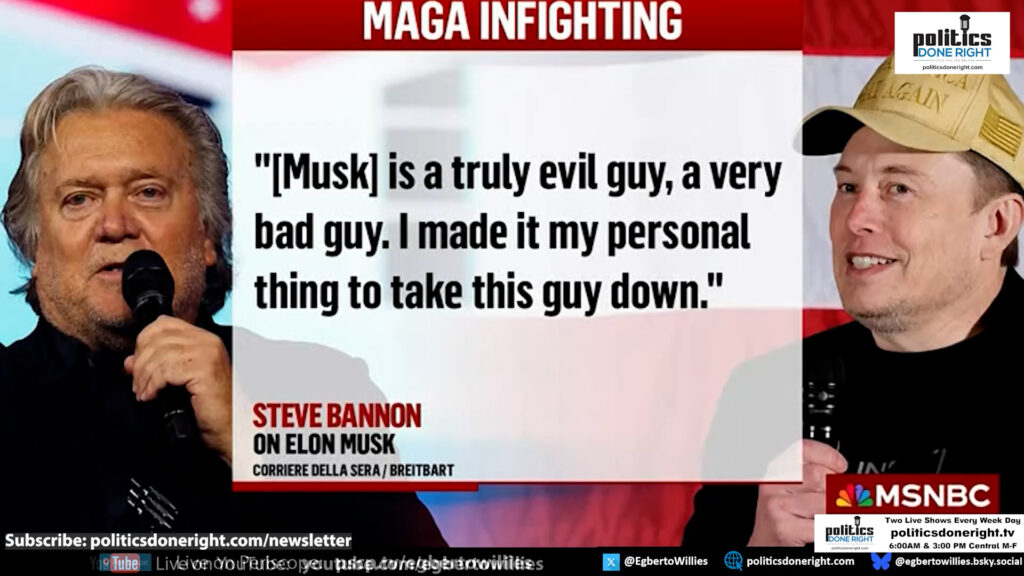
The fight feud between MAGA white nationalist Steve Bannon and Oligarch Elon Musk is on. And the oligarchs are winning.
The MAGA vs MAGA feud is on

Watch Politics Done Right T.V. here.

Podcasts (Video — Audio)
Summary
The MAGA movement is experiencing an internal power struggle between Steve Bannon’s nationalist faction and Elon Musk’s corporate oligarchs. The dispute, which began over H1B work visas, exposes deeper ideological fractures between isolationist white nationalists and pro-corporate globalists. As Trump attempts to balance both factions, this infighting could destabilize the MAGA coalition, potentially influencing future elections.
Key Takeaways:
- Bannon vs. Musk Feud: Bannon, representing far-right nationalists, has turned against Musk, accusing him of being a globalist and a sellout to China.
- Oligarchs vs. White Nationalists: The fight highlights the inherent contradiction in MAGA—between anti-elite rhetoric and billionaire dominance.
- Trump’s Dilemma: Trump enjoys support from both factions but risks alienating either his grassroots base or his wealthy backers.
- MAGA Instability: The movement’s internal conflicts could lead to decreased voter turnout or fractured support in future elections.
- Progressive Opportunity: Democrats could capitalize on MAGA’s failures by embracing a true populist agenda that challenges corporate power while rejecting xenophobia.
Progressive Perspective
The MAGA civil war is proof that right-wing populism is an unsustainable mix of elite interests and reactionary grievances. Billionaire oligarchs like Musk will always prioritize profits over people, while figures like Bannon exploit the anger of working-class conservatives for personal gain. As their movement fractures, progressives have a chance to step in with a pro-worker, anti-corporate message that truly serves the interests of the people—not the billionaires pulling the strings.
[ppp_patron_only level=2]
The internal battle within the MAGA movement exposes the fundamental contradictions of right-wing populism in America. What began as an opportunistic marriage between billionaire-backed corporate elites and grassroots white nationalists has now devolved into an all-out war. At the center of this feud are Steve Bannon, representing the far-right nationalist faction, and Elon Musk, the tech oligarch who has become a major political force in the post-Trump era. The ongoing dispute reveals not just a split in ideology but a broader lesson about the unsustainability of political coalitions built on contradictions.
The Rise and Fracturing of the MAGA Coalition
The MAGA movement has always been a hybrid of reactionary forces. On one side are the hardcore nationalists, represented by figures like Bannon, who advocate for an isolationist, anti-immigrant, and anti-globalist agenda. These elements see themselves as the true ideological heirs of Trumpism, fighting for a protectionist economic vision and a hard-right, white ethno-state project. On the other side are the billionaire oligarchs like Musk, who embraced MAGA not out of ideological commitment but because it offered a vehicle to dismantle government regulations, crush labor movements, and maximize their personal wealth.
For a time, this uneasy alliance worked. Trump’s presidency provided tax cuts for the rich, deregulation for corporations, and culture war rhetoric to keep the nationalist base engaged. However, as the movement plots its next steps, these factions are now turning on each other. The immediate flashpoint in this feud was a debate over H1B visas—work permits that allow skilled foreign workers to fill specialized jobs in the U.S. Bannon and his allies argue that these visas undercut American workers, while Musk, whose companies depend on international talent, supports them.
Yet, the real fight is deeper than immigration policy. It is about power—who controls the MAGA movement, who influences the next Trump administration (should it come to pass), and, ultimately, who benefits from the spoils.
Bannon vs. Musk: A Struggle for Influence
Steve Bannon, a longtime architect of far-right nationalism, has gone scorched earth on Elon Musk. He openly accuses Musk of being a globalist sellout, working with China, and undermining the MAGA agenda. In a particularly revealing moment, Bannon even suggested that Musk should “go back to South Africa,” an ironic attack considering Bannon’s own long history of championing white nationalism.
Musk, for his part, has wielded his control over X (formerly Twitter) to silence some of Bannon’s allies, exposing the hypocrisy of the so-called “free speech absolutist.” His feud with Bannon reveals a key tension within right-wing populism—while figures like Bannon pretend to fight against the elite, Musk and the billionaire class are the elite. The moment their interests diverge, the pretense of solidarity crumbles.
Trump’s Role: Playing Both Sides
Donald Trump remains the central figure in this conflict, and his instincts are telling. While he may share the rhetoric of Bannon’s faction, he also craves the approval of billionaires like Musk. This puts him in a difficult position. Trump knows his nationalist base detests corporate globalists, but he also understands that his political survival depends on keeping powerful donors happy.
This dilemma could come back to haunt Trump in a future election. If he tilts too far toward Musk’s faction, Bannon’s base may sit out key races in protest. If he leans too much toward Bannon’s worldview, he risks alienating the financial backers who can flood the airwaves with pro-Trump messaging.
The Progressive Takeaway: Learning from MAGA’s Mistakes
There is an important lesson here for progressives. The collapse of the MAGA coalition is a reminder that broad political movements cannot function when they are built on internal contradictions. The Democratic Party has long faced a similar struggle between its corporate-friendly establishment and its progressive grassroots. For years, centrist Democrats have tried to balance the interests of Wall Street and Silicon Valley with the demands of labor unions, environmental activists, and racial justice movements. This balancing act has often resulted in policy paralysis, leaving working-class voters disillusioned.
Unlike the MAGA movement, progressives have the opportunity to build a coalition that is genuinely aligned in its goals. The key is recognizing that corporate elites—whether they brand themselves as libertarian tech disruptors like Musk or old-money establishment figures—are fundamentally at odds with the interests of the working class. The Democratic Party should seize this moment to drive a clear populist message: the billionaire class does not work for you.
This MAGA fracture also presents an opportunity to peel off some disillusioned right-wing voters. If Bannon’s supporters feel betrayed by Trump’s coziness with oligarchs, Democrats could make inroads by emphasizing an anti-corporate, pro-worker message. Attacking tech monopolies, supporting unionization efforts, and challenging corporate dominance in government are issues that transcend party lines. The challenge for Democrats is whether they have the courage to fully embrace this populist economic vision or whether they will continue to cater to the donor class.
Conclusion: MAGA’s Civil War is Just Beginning
The feud between Bannon and Musk is not just a petty squabble—it is a reflection of the deep contradictions within right-wing populism. As Trump positions himself for another presidential run, this internal conflict could have major consequences for the future of the Republican Party. If the nationalist base feels betrayed, turnout could be depressed. If the corporate elite feels threatened, financial support could dwindle.
For progressives, the lesson is clear: movements must be built on coherent, sustainable principles. The oligarchs and white nationalists were never truly aligned, and their breakup was inevitable. Now, as they turn on each other, the opportunity exists to build a left-wing populism that genuinely serves working people—without the baggage of xenophobia and billionaire worship.
The MAGA civil war is just beginning, but one thing is certain: in the battle between oligarchs and nationalists, the real losers are always the people they claim to represent.
[/ppp_patron_only]