


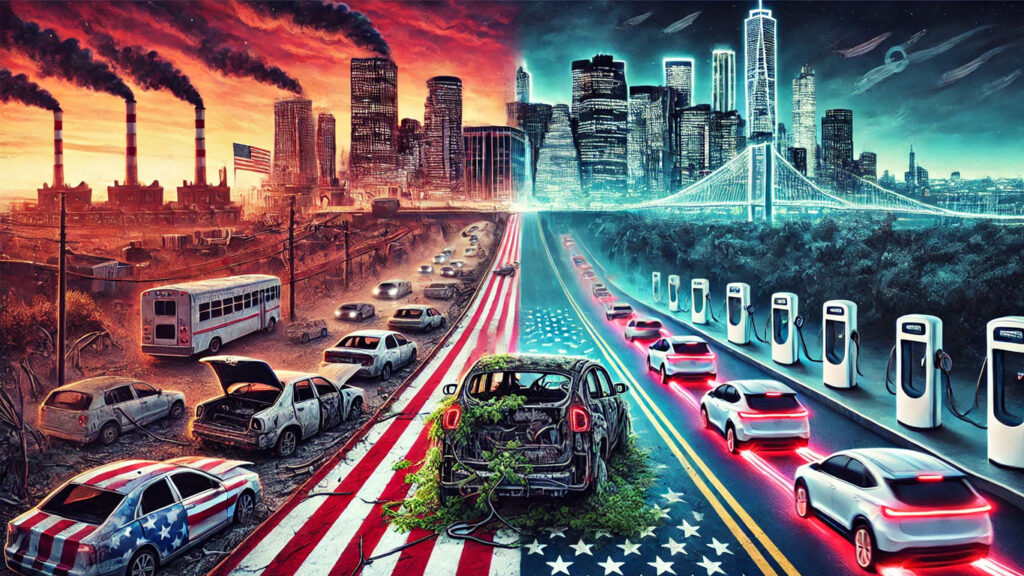
Trump’s executive order to eliminate the “electric vehicle mandate” and freeze EV infrastructure expansion will stunt our advancement in clean energy and other areas.
Trump’s attack on electric vehicles hurts us.

Watch Politics Done Right T.V. here.

Podcasts (Video — Audio)
Summary
The video discusses how America is falling behind in the global shift to green energy, particularly in the electric vehicle (EV) sector. Meanwhile, BRICS nations like China, Brazil, and South Africa surge ahead. The host highlights China’s dominance in battery and EV manufacturing, Brazil’s sustainable ethanol fuel economy, and America’s failure to compete due to corporate greed and outdated policies. The influence of billionaires like Elon Musk and the corporate media’s role in keeping Americans uninformed are also criticized. Trump’s anti-EV stance and protectionist policies are detrimental to U.S. innovation and economic progress.
Key Takeaways:
- China’s EV and battery industry outpaces the U.S., offering high-quality, affordable models.
- BRICS nations invest heavily in green energy, while the U.S. clings to outdated fossil-fuel policies.
- American billionaires profit from worker innovation but fail to reinvest in real advancements.
- The media keeps Americans uninformed about the rapid progress of other nations.
- Trump’s attack on green energy will leave America further behind in the global economy.
Progressive Commentary
The U.S. is at a crossroads—either embrace green energy and technological advancement or continue enabling billionaire greed and corporate stagnation. BRICS countries are proving that sustainable innovation and economic progress go hand in hand, while America, under conservative leadership, remains stuck in an extractive, exploitative economy. Without urgent investment in renewable technology and a commitment to worker-led innovation, the U.S. risks becoming irrelevant in the 21st-century economy.
[ppp_patron_only level=2]
The United States has long been a technological innovation and industrial advancement leader. However, as the world shifts toward a green energy revolution, America’s resistance to progress—particularly under leaders like Donald Trump—is costing the country its standing on the global stage. Nowhere is this decline more evident than in the electric vehicle (EV) sector, where aggressive policies from China and other BRICS (Brazil, Russia, India, China, and South Africa) nations are propelling them forward while America lags. Instead of embracing the future, Trump and his allies in the fossil fuel industry are actively working to stifle green innovation, setting the nation on a trajectory of economic and technological regression.
The Cost of American Stagnation
China, for example, has firmly established itself as the dominant force in electric vehicle production, renewable energy, and battery technology. While American automakers like Tesla struggle to keep up with demand and affordability, Chinese manufacturers produce high-quality EVs at a fraction of the cost. A $12,000 EV in Jamaica, shipped directly from China, is an indicator of China’s growing export dominance and a glaring reminder of the U.S.’s failure to provide affordable green technology at home.
Much of this failure can be attributed to U.S. policies that protect legacy automakers rather than encourage competition and innovation. The Biden administration has imposed tariffs on Chinese EVs to boost domestic manufacturers, but these protectionist policies are doing little to force American automakers to step up their game. Instead of producing competitive and affordable EVs, companies like Tesla, Ford, and GM continue to lag, offering overpriced, often underwhelming models.
Trump’s policies make this situation even worse. His open hostility toward renewable energy—his rhetoric about windmills causing cancer, his deregulation of fossil fuels, and his attempts to cut green subsidies—only serve to entrench American dependence on outdated technology. By contrast, through strategic investments in Africa and partnerships with other BRICS nations, China has secured a near-monopoly on the materials needed for batteries, ensuring that it remains at the forefront of the EV revolution.
BRICS: Rising While America Falls
Meanwhile, BRICS nations are thriving, each finding its pathway to green energy leadership. Brazil has built a sustainable ethanol-based fuel economy using sugarcane, a method that balances carbon emissions and makes them less reliant on foreign oil. Despite its conflicts and global sanctions, Russia continues to expand its resource extraction and trade relationships with BRICS allies, ensuring economic survival and even growth in the face of Western opposition.
India is rapidly expanding its solar and EV markets, aiming to become a global hub for green technology. South Africa invests in large-scale renewable energy projects, leveraging its vast natural resources to build a more sustainable energy infrastructure. These countries actively work toward long-term economic sustainability while America remains beholden to an outdated fossil-fuel-based economy.
Perhaps the most shocking revelation is that as an economic bloc, BRICS now has a combined GDP that surpasses that of the G7. This shift signals a seismic change in global economic power that America’s political and corporate elites refuse to acknowledge, much less address.
The Myth of American Innovation
The belief that capitalism fosters innovation is a key component of America’s economic ideology. However, the structure of late-stage capitalism in the U.S. has made it increasingly clear that the wealthiest individuals and corporations prioritize profit over progress. Billionaires like Elon Musk take credit for groundbreaking technology, but engineers, scientists, and workers innovate. And while Musk and his counterparts extract billions from the economy, they reinvest little into genuine advancements or affordability.
Instead of reinvesting in infrastructure or pushing EV technology forward, these billionaires hoard wealth while American automakers produce expensive, subpar vehicles. The Cybertruck, for instance—a vehicle Musk hyped as revolutionary—turned out to be overpriced and impractical, especially when compared to sleek, efficient, and far more affordable models produced in China.
Capitalism does not drive innovation in its current form—it stifles it by prioritizing shareholder profit over research, development, and accessibility. The reality is that when left to their own devices, American corporations fail to compete, and when propped up by protectionist policies, they stagnate.
The Media’s Role in American Decline
One of the most alarming aspects of this economic shift is how little the average American knows about it. The corporate-controlled media continues to sell the illusion of American superiority, keeping people uninformed about the rapid advancements happening elsewhere. Most Americans have never seen what modern cities in China look like—Shanghai, Beijing, and Shenzhen are home to cutting-edge infrastructure, high-speed rail systems, and EV markets that dwarf those in the U.S.
The same goes for other BRICS nations. How many Americans have seen the modern, sprawling metropolis of Johannesburg? How many know about India’s booming space program or Brazil’s green energy initiatives? The American public is kept in the dark because the country’s ruling class benefits from their ignorance. If people believe that America is still number one, they will continue to support policies that favor the wealthy while the country falls further behind.
A Path Forward: Reclaiming American Leadership
If the U.S. wants to reclaim its status as a global leader in innovation, it must abandon the regressive policies championed by figures like Trump and the fossil fuel lobby. America must invest aggressively in renewable energy, EV technology, and infrastructure. This means:
- Massive federal funding for green research and development.
- Breaking up monopolies that suppress competition and innovation.
- Dismantling the billionaire class that hoards wealth instead of reinvesting it in progress.
- Reforming trade policies to encourage competition rather than protectionism.
- Educating the public on global advancements so they can push for change.
The choice is clear: embrace the future of green energy or continue down a path of economic and technological decline. BRICS nations have already made their decision, and they are rapidly pulling ahead. If America fails to act now, it will not just lose to China—the entire developing world will leave it behind. The time to act is now.
[/ppp_patron_only]