


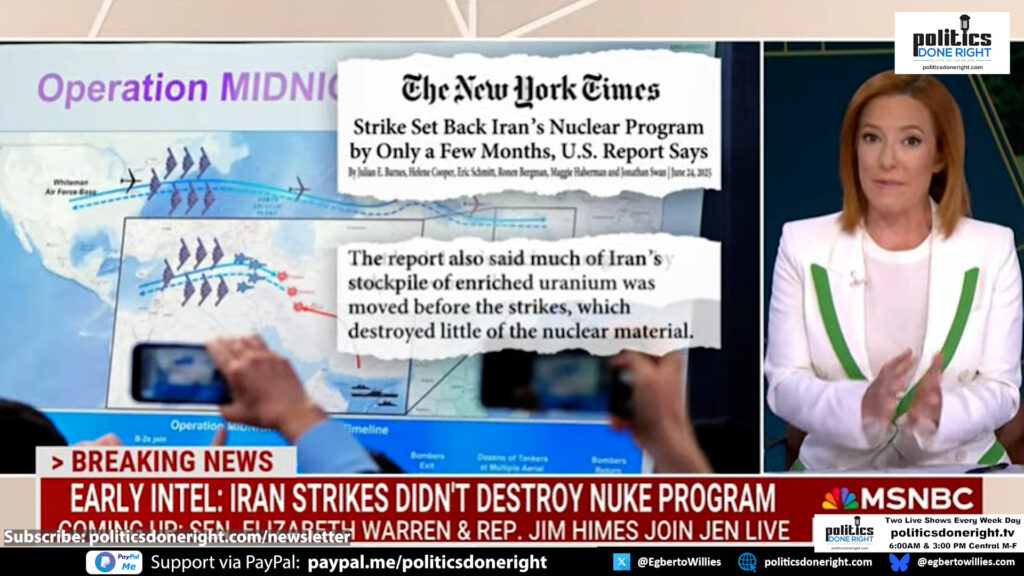
A leaked top secret report makes it clear that at best, the Iran nuclear program was set back a few months with the uranium stockpile moved before the failed bombardment.
The Iranian nuclear program was not obliterated.

Watch Politics Done Right T.V. here.

Podcasts (Video — Audio)
Summary
Former President Donald Trump boasted that U.S. air and missile strikes “obliterated” Iran’s nuclear program, yet early intelligence and congressional briefings tell a different story, indicating only a brief setback to Tehran’s enrichment capacity. Lawmakers and analysts now weigh the strategic costs of an operation that burned through stealth-bomber flight hours and expensive bunker-busters while yielding little lasting security.
- Intelligence dispute: A preliminary Defense Intelligence Agency assessment says the strikes set Iran’s program back mere months, contradicting Trump’s “total obliteration” rhetoric.
- Capitol skepticism: Senators from both parties left a classified briefing unconvinced that Iran’s centrifuges or uranium stockpiles were destroyed, with Democrat Chris Murphy calling the president’s claim “deliberately misleading.”
- White House push-back: Press Secretary Karoline Leavitt dismissed the leak as the work of a “low-level loser” and insisted eyewitness pilots achieved “bullseye” results, without addressing the uranium that intelligence says was moved beforehand.
- Stealth costs: Each B-2 stealth bomber sortie can cost $135,000 per flight hour, excluding the multimillion-dollar Massive Ordnance Penetrators dropped on fortified sites.
- Strategic echo: Progressive analysts warn that bombing cannot “erase knowledge” and that talk of victory risks a cycle of escalation that diverts resources from domestic needs, such as healthcare and climate resilience.
In short, Trump’s triumphal narrative collapses under scrutiny: the Iranian program survives, taxpayer dollars evaporate, and Washington’s credibility erodes—all while MAGA media repeats a one-word talking point, “obliterated.”
Premium Content (Complimentary)
The Washington Post, Reuters, and CBS reporting converge on a sobering reality: U.S. strikes smashed concrete and headlines but left Iran’s nuclear know-how largely intact. Their collective findings matter not only for accuracy but also for democracy itself, because deception on national-security grounds routinely facilitates oversized Pentagon budgets and endless conflict.
Trump’s insistence that “three evil nuclear sites were obliterated” served an obvious political function—creating a spectacle of toughness at a moment when his poll numbers sagged and Israeli hard-liners clamored for U.S. cover. Yet the DIA’s early battle-damage assessment, leaked despite classification stamps, judged that centrifuge halls at Fordow and Natanz survived and that enriched uranium had been whisked away in advance. Even Israeli intelligence, usually eager to amplify U.S. triumphalism, privately estimated only a “several-year” setback, not permanent destruction.
The price tag should enrage anyone who favors people-centered governance. A single B-2 flight hour devours more funds than the annual health-insurance premium of multiple low-income families. Multiply that by hours aloft from Missouri to Fordow and back, add the fuel-guzzling tanker fleet over the Atlantic, and toss in fourteen 30,000-pound penetrators. The raid’s real cost rivals the CDC’s yearly discretionary budget. This is money that could underwrite insulin price caps, public-school ventilation, or a civilian climate corps.
Progressives emphasize an even more profound truth: bombing hardware cannot annihilate scientific literacy. Iran remains a nation of nearly one hundred million, many of whom hold advanced degrees; centrifuge design files are stored on hard drives and in human memory. Intellectual capital, unlike concrete, regenerates. Pretending otherwise seduces Washington into cycles of militarized showmanship that yield fleeting headlines and lasting blowback.
Congressional reaction underscores the credibility gap. Senator Murphy warned that exaggerated claims create a “false sense of comfort” and crowd out diplomatic off-ramps. Senator Schumer flagged the absence of an endgame strategy—echoing a progressive critique that U.S. Middle East policy indulges in maximalist military impulses while neglecting a region-wide arms-control architecture.
Meanwhile, the White House communications shop doubled down, channeling the administration’s culture-war reflex: blame “fake news,” vilify whistle-blowers, and substitute macho adjectives for metrics. This pattern threatens accountability because if officials can rewrite battlefield physics by press release, Congress loses its power of the purse, and the public loses its right to informed consent.
Progressive foreign-policy thinkers, therefore, call for a pivot from spectacular violence to sustained diplomacy—reviving the JCPOA framework, enhancing International Atomic Energy Agency inspections, and pairing sanctions relief with human-rights benchmarks. Such an approach recognizes shared security interests: ordinary Iranians suffer under sanctions, and ordinary Americans shoulder the opportunity cost of forever wars.
The episode also illustrates media responsibility. Outlets like Time and Reuters immediately contextualized Trump’s boast within contradictory intelligence leaks, offering a model of adversarial journalism that exposes official spin. Public broadcasters and progressive independents must amplify these findings, ensuring that taxpayers understand the gulf between televised bravado and classified assessments.
Ultimately, the Iranian strike story is less about fissile material than about a political habit. A president facing domestic turbulence chose spectacle over strategy; pliant networks parroted talking points; critical reporting revealed the emperor’s new bombs; and legislators scrambled to parse the truth. Progressives insist that the cycle can break—through transparency, diplomacy, and investment in civilian priorities. Until then, the nation risks fighting not just endless wars abroad but an infinite war on reality at home.
Keep your eyes on the ball. We cannot be distracted from all Trump’s machinations to distract us from the grand theft he is effecting on the poor and middle class as he robs our country’s treasures and gifts it to the wealthy for his profit.