


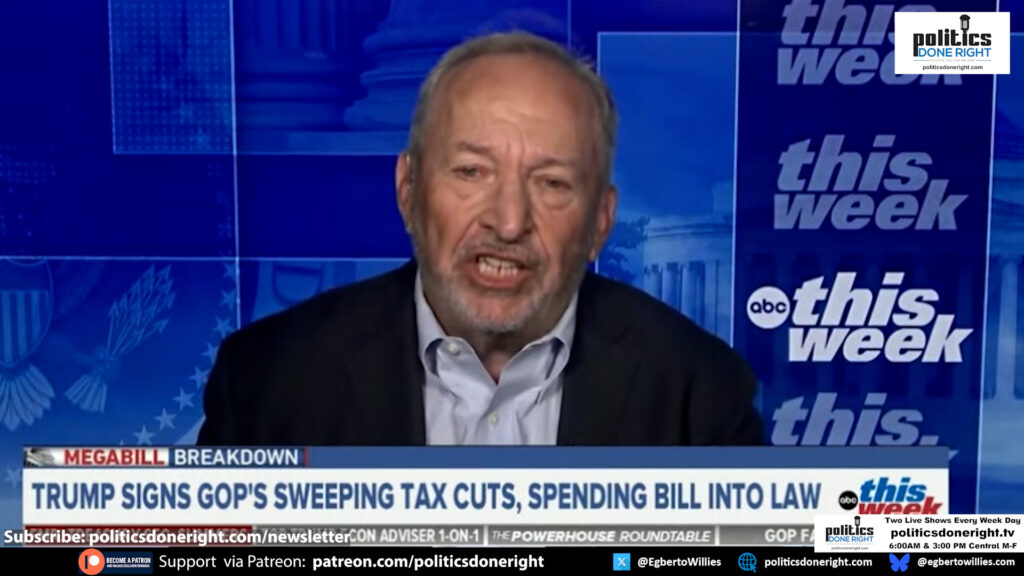
Economist Larry Summers, not a friend of real progressive policies, excoriates the Big Beautiful Bill as the most significant cut to the safety net ever and policies that will kill over 100,000 Americans.
Economist Larry Summers

Watch Politics Done Right T.V. here.

Podcasts (Video — Audio)
Summary
Former Treasury Secretary Larry Summers delivered a scathing critique of President Trump’s recently signed “One Big Beautiful Bill,” warning that the legislation represents the most significant cut to America’s safety net in history and could result in over 100,000 deaths over the next decade. “In my 70 years, I’ve never been as embarrassed for my country on July 4th,” said Summers in blasting Trump’s “Big Beautiful Bill” as dangerous and deadly. The sweeping tax and spending package, which Trump signed into law on July 4, 2025, has sparked intense debate about its economic implications and human costs.
Key Concerns Raised by Summers
- Public Health Impact: Summers called the legislation a “shameful act by our Congress and by our president that is going to set our country back.” The former Harvard president cited Yale Budget Lab estimates suggesting the healthcare cuts could lead to 100,000 deaths over a decade, equivalent to “2,000 days of death like we’ve seen in Texas this weekend.”
- Economic Consequences: Summers warned that the bill’s provisions would increase inflation, necessitate interest rate hikes by the Federal Reserve, and risk pushing the economy into recession. He emphasized that reduced subsidies for electricity and housing, combined with healthcare cutbacks, would create a cascade of economic problems.
- Wealth Distribution: The economist criticized the legislation for transferring wealth to the top 1% of Americans while cutting essential safety net programs. He questioned whether providing “a million dollars over 10 years to the top tenth of a percent” represents the highest priority for federal spending.
- Fiscal Responsibility: Larry Summers stated that the bill would likely not strengthen the economy and expressed concern over the amount it would add to the US debt. He characterized it as “piling more debt onto the economy than any piece of tax legislation in dollar terms that we have ever had.”
- Economic Growth Claims: Summers dismissed White House projections of $11 trillion in deficit reduction from economic growth as “respectfully nonsense,” arguing that economists without political agendas uniformly view the bill as economically harmful.
Progressive Perspective
The “Big Beautiful Bill” represents a fundamental betrayal of American values and priorities, transforming what should be a government committed to the common good into a mechanism for upward redistribution of wealth. The former Treasury secretary said the “overwhelming view” is that the legislation will harm the economy. This assessment from a respected mainstream economist underscores the bill’s dangerous departure from sound fiscal policy. The legislation’s assault on healthcare access, housing assistance, and other vital programs reveals the Trump administration’s willingness to sacrifice vulnerable Americans for the benefit of wealthy donors and corporations.
Premium Content (Complimentary)
The passage of President Trump’s “One Big Beautiful Bill” represents more than a policy disagreement—it constitutes a moral crisis that exposes the fundamental contradictions within American capitalism and the lengths to which conservative politicians will go to serve the interests of the wealthy at the expense of ordinary citizens. Larry Summers isn’t a fan of President Trump’s “One Big, Beautiful Bill.” The former Treasury secretary, who former President Bill Clinton appointed, told ABC News’ This Week that he had “never been as embarrassed for my country on July 4th” after Trump signed the sweeping legislation into law on Friday.
I am not a fan of Larry Summers, as he is an indoctrinated neoliberal. If he is objecting to a bill beneficial to corporations and the wealthy, it has to screw over the working class for him to slam the bill as he has/
The timing of the bill’s signing—on July 4th, America’s birthday—serves as a bitter irony that underscores how far the nation has strayed from its purported founding ideals of equality and justice. While Americans celebrated their nation’s independence, Trump effectively signed away the economic independence of millions of working families, binding them to a system that prioritizes corporate profits over human dignity.
Summers’ warning about 100,000 potential deaths over the next decade represents more than a statistical projection—it reflects the real-world consequences of treating healthcare as a commodity rather than a human right. Donald Trump’s bill will raise top-tier wealth, erode healthcare for poor people, and raise the deficit by $3 trillion. The Yale Budget Lab’s analysis reveals the brutal calculus behind conservative fiscal policy: human lives become acceptable casualties in the pursuit of tax cuts for the wealthy.
The bill’s approach to healthcare cuts exposes the fundamental cruelty of market-based solutions to social problems. When hospitals lose funding and pass costs to patients, when subsidies for electricity and housing disappear, and when Medicaid faces reductions, the resulting suffering disproportionately affects communities of color, rural Americans, and working-class families who lack the political power to protect themselves from these policy choices.
The legislation has significant implications for seniors, families, Medicaid recipients, immigrants, and other vulnerable populations. These “implications” represent real people facing impossible choices between medication and rent, between heating their homes and feeding their families. The euphemistic language of policy analysis obscures the human reality of what economists call “externalities”—the costs imposed on society by private profit-seeking.
The economic arguments surrounding the bill reveal the intellectual dishonesty that pervades conservative policy-making. Stephen Miran defended the “big, beautiful bill” against criticism from Larry Summers, accusing the Clinton-era Treasury secretary of “doom-mongering” that was not based on facts. This dismissal of expert analysis reflects a broader pattern in which conservative politicians attack credible economists and researchers who challenge their narratives, preferring politically convenient fantasies about economic growth to rigorous analysis of the distributional impacts.
The White House’s claim that the bill will generate $11 trillion in deficit reduction through economic growth represents a form of magical thinking that has repeatedly failed throughout American history. From supply-side economics in the 1980s to the tax cuts of the 2000s, conservative promises of self-financing tax cuts have consistently proven false, leaving future generations to bear the fiscal burden while wealthy Americans enjoy immediate benefits.
Congressional Republicans’ radical budget and tax bill includes several less-known provisions that will increase costs, fuel the Trump administration’s overreach, and waste taxpayer dollars. These hidden provisions reveal the anti-democratic nature of the legislative process, where complex bills containing numerous harmful measures are passed without adequate public scrutiny or debate.
The bill’s regressive tax structure exemplifies how American capitalism has evolved into a system of socialized losses and privatized gains. While working families face cuts to essential services, wealthy individuals and corporations receive substantial tax benefits that they did not earn through productive economic activity. This represents a fundamental violation of basic principles of fairness and economic justice.
The international implications of the United States’ fiscal irresponsibility cannot be ignored. Summers’ question—”How long can the world’s greatest debtor remain the world’s greatest power?”—highlights how domestic policy choices affect America’s global standing and ability to lead on international issues. When the United States prioritizes tax cuts for the wealthy over investments in infrastructure, education, and healthcare, it signals to other nations that American leadership rests on unsustainable foundations.
The political response to the bill reveals the urgent need for progressive organizing and electoral mobilization. Treasury Secretary Scott Bessent calls for an apology from former Treasury Secretary Larry Summers for comparing health care cuts to the deaths of people in the Texas floods. This demand for an apology rather than a substantive policy defense illustrates how conservative politicians prioritize political messaging over addressing the human consequences of their actions.
Progressive activists must recognize that the “Big Beautiful Bill” represents more than a single policy failure—it embodies a systematic assault on the social contract that has governed American society since the New Deal. The bill’s passage demonstrates that conservative politicians will abandon any pretense of governing for the common good when their wealthy donors demand favorable treatment.
The path forward requires sustained political engagement that goes beyond electoral cycles. Americans must build lasting institutions capable of challenging corporate power and demanding economic policies that prioritize human needs over profit margins. This means supporting candidates who reject corporate donations, advocating for progressive taxation, and organizing communities to resist the implementation of harmful policies.
The moral clarity of Summers’ critique—a mainstream economist declaring his embarrassment for his country—should inspire progressive activists to match his urgency with sustained political action. The “Big Beautiful Bill” may be law. Still, its implementation can be challenged, its provisions can be modified, and future generations of Americans can reject its underlying assumptions, committed to building a more just and equitable society.