


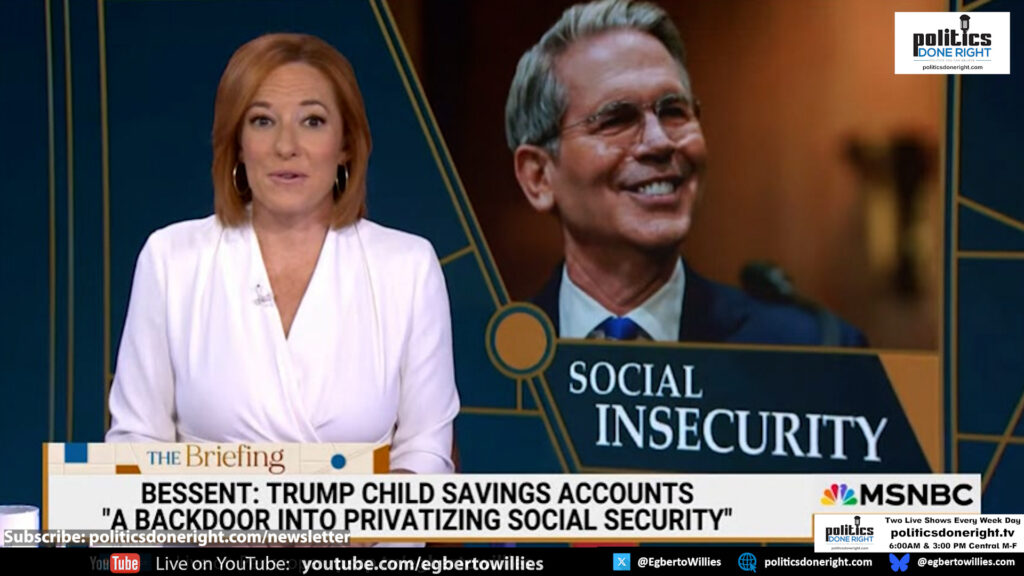
Trump’s billionaire Treasury Secretary Scott Bessent, despite repeated claims that they wanted to protect Social Security, is saying the quiet part out loud. They will gut Social Security if we allow them.
Privatizing Social Security

Watch Politics Done Right T.V. here.

Podcasts (Video — Audio)
Summary
Treasury Secretary Scott Bessent exposed the Trump administration’s true intentions when he admitted that the newly created “Trump Accounts” serve as “a back door for privatizing Social Security.” This candid admission reveals what progressives have long warned about—despite repeated promises to protect Social Security, the Republican agenda remains laser-focused on dismantling the program that millions of Americans depend on for retirement security.
- The Quiet Part Out Loud: Bessent’s slip-up at a Breitbart event revealed the administration’s covert plan to privatize Social Security through children’s savings accounts, confirming what progressives have been fighting against for years.
- Limited Access Program: The Trump Accounts program, which operates from 2025-2028, requires families to contribute up to $5,000 annually. This makes it accessible primarily to wealthy families, leaving working-class Americans behind.
- Wall Street Enrichment Scheme: The privatization push serves Wall Street’s interests, allowing financial firms to profit from retirement funds that should remain under public control and guaranteed protection.
- Historical Pattern of Attacks: This follows decades of Republican attempts to privatize Social Security, including Bush’s failed 2005 proposal that would have devastated retirees during the 2008 financial crisis.
- Broader Privatization Agenda: Social Security privatization represents part of a larger Republican strategy to privatize Medicare, healthcare, and other essential government services that should remain under democratic control.
Senator Elizabeth Warren correctly identified this as “just another Trump scam,” emphasizing that Social Security represents something Americans earn through their contributions and becomes “a solemn contract between the worker, the person who paid in, and the government.” The fight against privatization must continue because these programs belong to We the People, not corporate profiteers.
Premium Content (Complimentary)
Treasury Secretary Scott Bessent’s shocking admission that Trump Accounts function as “a back door for privatizing Social Security” represents a watershed moment in the ongoing battle for America’s economic future. This wasn’t a gaffe—it was the accidental revelation of a carefully orchestrated plan to dismantle one of the most successful anti-poverty programs in American history. “Donald Trump’s Treasury Secretary Scott Bessent just said the quiet part out loud: The administration is scheming to privatize Social Security,” as Democratic National Committee senior adviser Tim Hogan correctly observed.
The timing of Bessent’s admission proves particularly damning given Trump’s repeated campaign promises to protect Social Security. Speaking at a Breitbart News forum, Bessent hinted that the program serves as a ‘back door’ to privatize the long-standing federal retirement system. These remarks expose the fundamental dishonesty underlying the Republican approach to governance—promising protection while simultaneously engineering destruction through policy backdoors designed to benefit their wealthy donors at the expense of working Americans.
The mechanics of this scheme reveal its inherently classist nature. The Trump Accounts program provides a $1,000 initial federal deposit for children born between 2025 and 2028, followed by opportunities for parents to contribute up to $5,000 annually until the child reaches 18. This structure immediately excludes the vast majority of American families who cannot afford to set aside $5,000 per year for their children’s accounts. Meanwhile, wealthy families receive substantial tax advantages while building private accounts that Republicans can later point to as alternatives to Social Security benefits. This creates a two-tiered system where the rich accumulate privatized wealth while working families remain dependent on a Social Security system that Republicans are simultaneously working to undermine.
Senator Elizabeth Warren’s response captures the fundamental betrayal embedded in this approach: “Social security is not charity. Social security is something people earn by making their contributions, and it becomes a solemn contract between the worker, the person who paid in, and the government.” Warren understands what Republicans refuse to acknowledge—Social Security represents a sacred trust between Americans and their government, funded through decades of worker contributions and designed to provide guaranteed security in retirement. The privatization agenda seeks to break this contract and transfer these guaranteed benefits to Wall Street firms that profit from volatility and uncertainty.
The historical context makes this threat even more urgent. When George W. Bush attempted Social Security privatization in 2005, his proposal collapsed because Americans recognized the fundamental insecurity of tying retirement benefits to stock market performance. The 2008 financial crisis vindicated opponents of privatization—imagine the catastrophe if American retirees had watched their Social Security benefits evaporate alongside their 401(k) accounts during the market crash. Republicans never abandoned their privatization dreams; they simply learned to pursue them through less obvious means.
The broader privatization agenda extends far beyond Social Security into healthcare, education, and other essential services. Republicans have already begun dismantling Medicare through Medicare Advantage programs that funnel public dollars to private insurance companies while reducing benefits for seniors. The same profit-driven logic that seeks to privatize Social Security also drives efforts to privatize public schools, transportation infrastructure, and environmental protection. Each privatization scheme follows the same pattern—transfer public assets to private corporations, eliminate democratic accountability, and force Americans to pay more for worse service.
This systematic privatization represents a fundamental threat to democratic governance itself. When essential services become privatized, corporations gain veto power over policies that affect millions of Americans. Private companies operating Social Security accounts would have massive financial incentives to oppose benefit improvements or program expansions. They would fund lobbying campaigns and political candidates dedicated to protecting corporate profits rather than retiree security. The privatization of Social Security would create a powerful constituency opposed to the program’s success, fundamentally altering the political dynamics around retirement security.
The progressive response must recognize that this fight transcends Social Security alone. The battle against privatization represents a broader struggle over whether America will remain a democracy where government serves the people, or transform into a plutocracy where public resources serve private profit. Every government service that falls to privatization represents a victory for corporate power over democratic accountability. Progressives must frame this debate around fundamental values of economic security, democratic governance, and collective responsibility for the common good.
Americans understand these stakes instinctively. Polling consistently shows overwhelming support for Social Security across partisan lines, with majorities favoring benefit increases rather than cuts or privatization. The Republican strategy depends on implementing privatization through technical policy changes that obscure their true intentions—exactly what Bessent accidentally revealed. Progressive messaging must continue exposing these schemes while offering positive alternatives that strengthen Social Security through increased benefits, expanded coverage, and progressive financing reforms.
The fight against Social Security privatization ultimately represents a fight for America’s economic future. Will we maintain a system that guarantees dignity in retirement for all Americans, or will we abandon millions of workers to the uncertainties of financial markets and corporate profit-seeking? Bessent’s admission removes any doubt about Republican intentions. The choice facing Americans could not be clearer: defend Social Security as a public trust, or watch it become another profit center for Wall Street at the expense of working families who built America through their labor and deserve security in their golden years.