


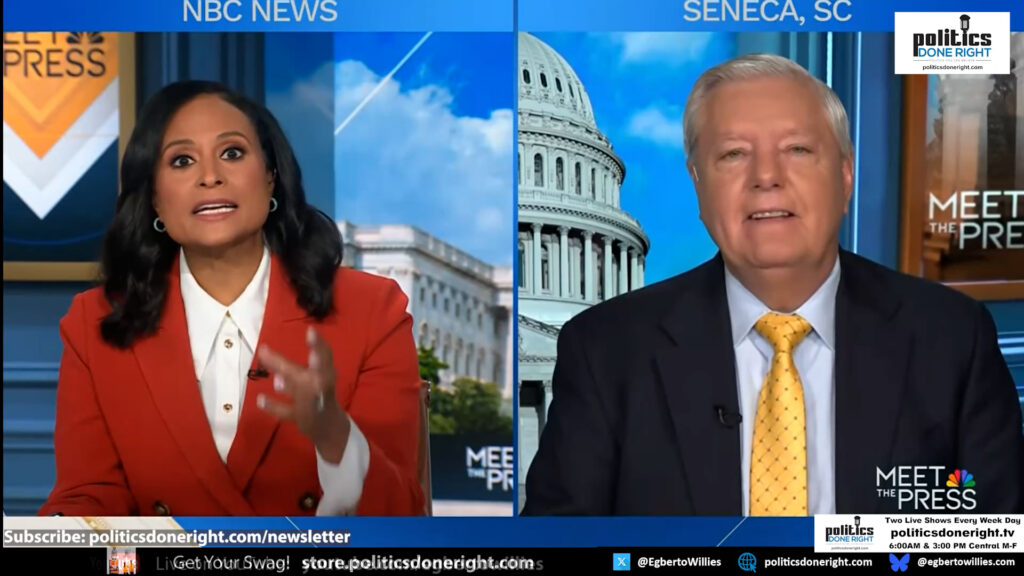
Lindsey Graham forgot there are videotapes of the times when he was not a Trump sycophant. Kristen Welker exposed him as a lying fraud with his own words about Russia’s involvement in the US election.
Meet The Press challenges Lindsey Graham

Watch Politics Done Right T.V. here.

Podcasts (Video — Audio)
Summary
Meet the Press host Kristen Welker delivered a masterclass in accountability journalism when she confronted Senator Lindsey Graham with his past statements about Russian election interference, exposing his current attempts to rewrite history and distract from more pressing scandals like the Epstein files.
- Graham contradicted his past statements – Despite previously declaring “The Russians did it” and that every committee member agreed Russia interfered, Graham now claims “new evidence” suggests Obama manufactured the intelligence findings.
- Welker came prepared with receipts – Unlike many mainstream media interviews that let Republicans spin unchallenged, Welker had video evidence of Graham’s past positions and expert testimony contradicting his current claims.
- The “new evidence” isn’t new at all – Graham’s supposedly shocking revelations come from a 2020 report that’s five years old and changes no established conclusions about Russian interference.
- Expert testimony debunks Graham’s claims – Former senior CIA officer Susan Miller, a Republican, called Graham’s allegations “completely false” and said intelligence professionals would have quit if asked to manufacture evidence.
- This appears to be deflection tactics – Graham’s sudden pivot to Obama conspiracy theories coincides suspiciously with renewed attention on Trump’s connections to Jeffrey Epstein.
The exchange demonstrates how Republican senators continue their relentless campaign to gaslight Americans about Russian interference in our democracy, even when confronted with their contradictory statements from just years earlier.
Premium Content (Complimentary)
The recent Meet the Press confrontation between host Kristen Welker and Senator Lindsey Graham represents more than just another Sunday morning political dust-up. It crystallizes the Republican Party’s systematic campaign to rewrite the history of Russian interference in American elections, revealing how far they’ll go to protect Donald Trump’s narrative—even when it means contradicting their own documented statements.
Graham’s performance showcased the textbook Republican playbook: when faced with inconvenient truths, simply declare old evidence “new,” manufacture controversy where none exists, and hope the media won’t call you out. Graham called for an investigation into the matter Sunday on NBC’s “Meet the Press,” stating, “If there is evidence of a crime being committed or suspected evidence of a crime being committed, create a special counsel to look at it.” This is despite multiple investigations already having thoroughly examined these claims.
The senator’s claims crumble under the slightest scrutiny. He alleges that Obama somehow pressured intelligence agencies to manufacture evidence of Russian interference. Yet, Graham tripped up on a supposedly “new” development in the Russian collusion investigation, suggesting that more evidence had emerged tying former President Barack Obama to the nearly 10-year-old national security scandal. The “bombshell” he references comes from a 2020 report—hardly breaking news that would justify reopening settled investigations.
What makes Graham’s revisionism particularly egregious is how it directly contradicts his own documented positions. In 2017, he stated unequivocally that “The Russians did it” and that every committee member agreed on Russian interference. Now, facing political pressure to align with Trump’s preferred narrative, he conveniently discovers “new evidence” that allegedly changes everything. This isn’t just political flip-flopping—it’s a deliberate assault on facts.
The timing of these allegations reveals their true purpose. As questions about Trump’s relationship with Jeffrey Epstein gain renewed attention, suddenly, Obama becomes the villain du jour. This classic misdirection technique allows Republicans to change the subject while positioning themselves as defenders of truth—all while promoting demonstrably false claims.
Welker’s prepared response demonstrates what accountability journalism looks like when it’s done right. She didn’t just accept Graham’s assertions at face value; she came armed with his previous statements and expert testimony that directly contradicted his current position. Former CIA officer Susan Miller’s testimony was particularly damning, noting that intelligence professionals would have resigned en masse if asked to manufacture evidence.
The broader implications extend far beyond one senator’s credibility crisis. Graham’s performance illustrates how the Republican Party has abandoned any pretense of consistency or truth-telling when it comes to protecting Trump. They’re willing to undermine confidence in our intelligence agencies, promote conspiracy theories, and gaslight the American public about documented foreign interference in our elections.
This represents a fundamental threat to democratic governance. When elected officials can simply declare inconvenient facts “fake” and promote alternative narratives without consequence, the shared foundation of truth that democracy requires begins to crumble. Graham’s willingness to contradict his statements from just a few years ago shows how completely the Republican Party has subordinated itself to Trump’s reality-distortion field.
The episode also highlights the media’s critical role in maintaining democratic accountability. Too often, mainstream outlets allow Republican officials to promote false narratives without challenge, treating blatant lies as just another “side” in a legitimate debate. Welker’s performance shows what happens when journalists come prepared and refuse to let politicians rewrite history in real-time.
Moving forward, Americans must recognize these gaslighting attempts for what they are: deliberate efforts to confuse and mislead the public about facts. When senators like Graham promote conspiracy theories that contradict their previous statements, they’re not seeking truth—they’re seeking to protect a political narrative at the expense of democratic norms.
The stakes couldn’t be higher. Russian interference in American elections isn’t a partisan talking point—it’s a documented threat to our democracy that requires serious, sustained attention. When Republican leaders promote conspiracy theories about this interference, they’re effectively providing cover for future attacks on our electoral system.
Graham’s Meet the Press meltdown should serve as a wake-up call about the depths of Republican bad faith on issues of national security. It’s not enough for Democrats and progressives to simply point out these contradictions—they must consistently demand accountability and refuse to let these historical revision attempts go unchallenged.
The progressive movement must continue pushing for media outlets to adopt Welker’s approach: come prepared with facts, refuse to accept blatant lies, and hold politicians accountable for their contradictory statements. Only through sustained pressure can we hope to restore some measure of truth to our political discourse and protect our democracy from those who would undermine it for partisan gain.