


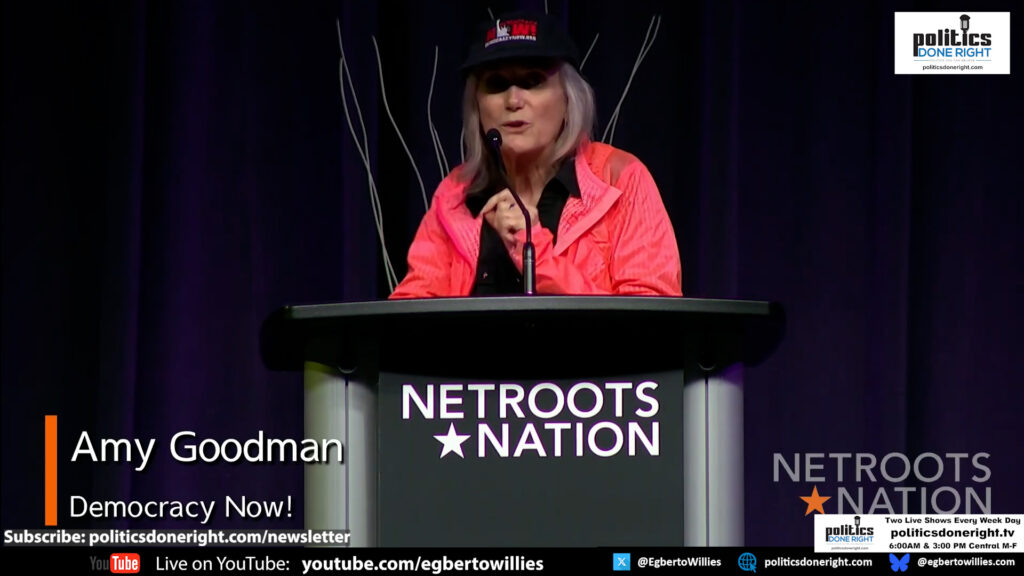
Democracy Now!’s Amy Goodman’s contrast of how Corporate Media reported America’s use of atomic bombs in Hiroshima and Nagasaki presents the perfect example of why Independent Media must be supported.
Amy was one of the keynote speakers at Netroots Nation 2025 (#NN25). The example she presented for the need for independent media was not only probative but piercingly effective.
Corporate Media vs.Independent Media reporting.

Watch Politics Done Right T.V. here.

Podcasts (Video — Audio)
Summary
The stark contrast between corporate and independent media coverage of the atomic bombings of Hiroshima and Nagasaki reveals the urgent need for journalism free from government and corporate influence. This analysis demonstrates how mainstream outlets systematically mislead audiences while independent journalists risk everything to deliver the truth that serves the public interest rather than power structures.
- Corporate Media Complicity: New York Times reporter William L. Laurence served as both journalist and War Department “special consultant,” receiving payment from both entities while writing Pentagon press releases and romanticizing atomic destruction
- Independent Media Courage: Australian journalist Wilfred Burchett defied military censorship to report firsthand on radiation sickness, describing victims with “skin melting off” and warning the world about the “atomic plague”
- Government Propaganda Campaign: The War Department deliberately suppressed radiation sickness reports, labeling them “Japanese propaganda” while promoting sanitized accounts through embedded reporters like Laurence
- Historical Patterns Continue: Modern corporate media continues bending to government and corporate interests, as evidenced by deals with political administrations and reluctance to challenge power structures.
- Solution Through Independent Funding: People-powered media outlets like Pacifica Radio, Democracy Now!, and local community stations provide unfiltered truth because their loyalty belongs to small-dollar contributors, not corporate advertisers or government officials
The American public deserves journalism that serves their need for truth rather than the interests of those in power. Independent media represents democracy’s essential fourth estate, providing the factual foundation citizens require to make informed decisions about war, peace, and governance.
Premium Content (Complimentary)
The haunting comparison between corporate and independent media coverage of America’s atomic bombing of Japan exposes a fundamental crisis that continues poisoning democratic discourse today. When New York Times science reporter William L. Laurence witnessed the Nagasaki bombing on August 9, 1945, he described the nuclear fireball as “a living thing, a new species of being” with shapes “so exquisitely formed that any sculptor would be proud to have created it.” His florid prose transformed mass destruction into aesthetic wonder, erasing the human cost of what would earn him his second Pulitzer Prize for reporting.
Yet Laurence’s reporting contained a devastating conflict of interest that corporate media concealed from American readers. The Times reporter had joined the War Department as a “special consultant” to the Manhattan Project in spring 1945, receiving dual paychecks while crafting Pentagon press releases alongside his newspaper articles. This arrangement epitomizes how corporate media serves power rather than people, transforming journalists into propagandists while maintaining the veneer of independent reporting.
The contrast with genuine independent journalism proves devastating. Australian reporter Wilfred Burchett defied General MacArthur’s media blockade of southern Japan, taking a grueling 30-hour train journey to witness Hiroshima’s aftermath firsthand. Where Laurence saw supernatural beauty, Burchett documented horrific reality: shadows of vaporized humans seared into walls, hospital patients with skin literally melting from their bodies, and mysterious radiation sickness causing purple hemorrhages and rapid hair loss. His dispatch began with words that should have shaken America’s conscience: “People are still dying mysteriously and horribly from an unknown something which I can only describe as the atomic plague.”
The Pentagon’s response reveals corporate media’s true function within power structures. Rather than investigating Burchett’s alarming reports, military officials dismissed radiation sickness as “Japanese propaganda” while deploying their embedded reporter Laurence to contradict the Australian’s eyewitness testimony. Laurence’s front-page New York Times story ran under the headline “U.S. ATOM BOMB SITE BELIES TOKYO TALES: TESTS ON NEW MEXICO RANGE CONFIRM THAT BLAST, AND NOT RADIATION, TOOK TOLL”, deliberately misleading Americans about atomic weapons’ true effects. This systematic deception prevented democratic debate about nuclear warfare by hiding its most terrifying consequences from the very citizens whose government wielded these weapons.
This pattern of corporate media subservience extends far beyond 1945, creating the conditions that enabled authoritarian resurgence in American politics. When mainstream outlets consistently prioritize access to power over accountability journalism, they fail their democratic function as democracy’s essential fourth estate. Corporate media’s financial dependence on advertising revenues and government sources creates inherent conflicts that independent outlets avoid through grassroots funding models.
The solution lies in supporting truly independent media that maintains loyalty to audiences rather than advertisers or officials. As Democracy Now! host Amy Goodman explains, “I really do think that if for one week in the United States we saw the true face of war, we saw people’s limbs sheared off, we saw kids blown apart, for one week, war would be eradicated” instead of the sanitized “video war game” that corporate outlets present. Independent media outlets like Pacifica Radio, founded in 1949 by war resistor Lou Hill specifically to create journalism “not run by corporations that profit from war,” demonstrate how people-powered funding enables genuine truth-telling.
The stakes could not be higher. When corporate media transforms nuclear holocaust into poetic spectacle while independent journalists risk everything to document radiation poisoning, the contrast illuminates democracy’s fundamental vulnerability to propaganda. Americans’ ability to make informed decisions about war and peace depends entirely on access to unfiltered information about policy consequences. Corporate media’s systematic failure to provide that information creates the ignorance that authoritarianism exploits.
Until Americans recognize mainstream media betrayal and actively support independent alternatives, they remain vulnerable to the same propaganda techniques that transformed military mass murder into aesthetic triumphs. Democracy requires citizens who understand reality, not consumers who accept carefully crafted illusions. Independent media alone provides the factual foundation upon which genuine self-governance depends.