


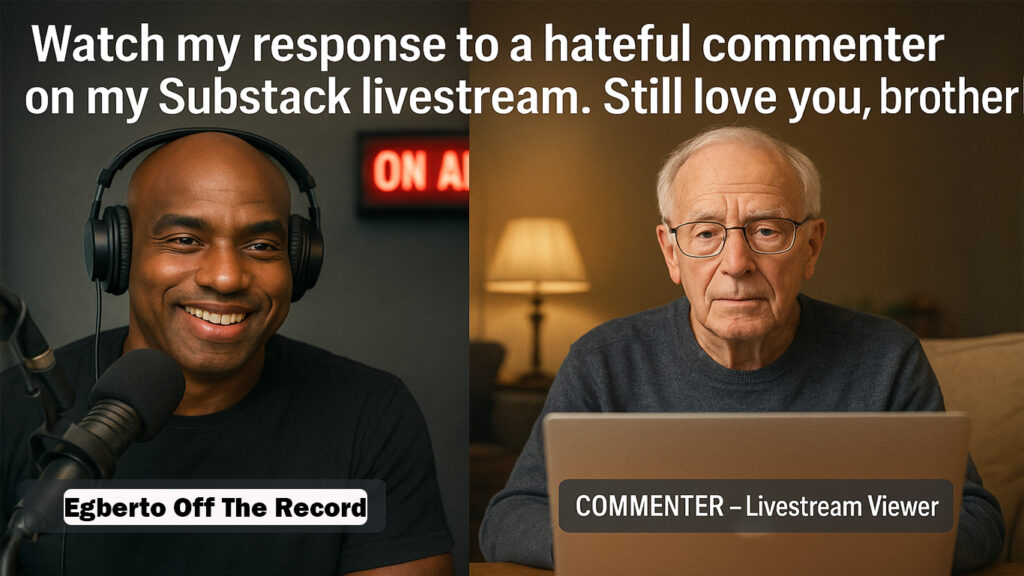
One of my hateful MAGA commenters who visits the program daily continued attacking. I finally decided to respond, not with hate but with a commentary that points out the genesis of his hate.
Hateful MAGA commenter.

Watch Politics Done Right T.V. here.

Podcasts (Video — Audio)
Summary
In a recent KPFT 90.1 FM broadcast multistreamed on his Substack livestream, I addressed a hostile MAGA commenter with compassion and clarity. Instead of reciprocating hate, I reframed the exchange as an opportunity to show tough love, expose right-wing disinformation, and underscore the progressive commitment to building community even across ideological divides.
- I addressed the MAGA critic as a “brother,” despite receiving hostility.
- Emphasized that right-wing propaganda manipulates people into hating progressives.
- Argued that hating back would only empower the “puppet masters” who spread lies.
- Maintained that progressive policies improve—not harm—the lives of everyday people.
- Urged viewers to spread the progressive message as the true vision of the majority for America.
This response models the progressive ethic: resist hate, engage with empathy, and dismantle the disinformation that poisons democracy. Progressives must remain rooted in solidarity, not bitterness, because change only comes through persistent and inclusive engagement.
Premium Content (Complimentary)
My response to a hostile commenter on the Egberto Off The Record Substack livestream, multistreamed from my KPFT 90.1 FM morning program, embodies the essence of progressive politics: compassion in the face of hate, truth in the face of propaganda, and persistence in the face of division. Instead of reacting defensively to MAGA-aligned hostility, I leaned into tough love, insisting that adversaries were still “brothers and sisters.” This is not naïveté—it is strategy and moral clarity. It reflects a more profound understanding that the real enemy is not the misinformed individual, but the system of manipulation that has hijacked their perception of reality.
The exchange began with the MAGA guy, a regular critic, dismissing my framing of solidarity. I did not respond with anger, but with acknowledgment: “It is okay for you to hate me… but I still love you, brother.” In that moment, I tried to set a tone that rejected the authoritarian logic of division. Authoritarian movements thrive on dehumanization—teaching followers that progressives are not neighbors, workers, or family members, but enemies of the nation. By calling my critic “brother,” I disrupted their script.
I further named the puppet masters behind this anger — the right wing. They lie about progressive values because their leaders are not motivated by patriotism but by profit. This framing cuts to the heart of neoliberal disinformation: billionaires and corporations benefit when ordinary people fight each other instead of demanding fairness. By convincing the MAGA bro to despise progressives, the powerful ensure that working people never unite against economic exploitation. As countless studies show, policies labeled “radical left” by Fox News—Medicare for All, higher taxes on billionaires, climate investments—enjoy majority support among Americans (see Pew Research Center and Data for Progress reports). Yet propaganda convinces people like MAGA sympathizers that these policies are “Marxist threats”, anathema to life-improving reforms.
I also emphasized the importance of refusing to hate in return. To do so hands victory to the manipulators. Hate would mean surrendering to the very system of division designed to keep progressives isolated. Instead, we must stay engaged, leaving open “a place to land” for those ready to break free from disinformation. This approach mirrors Dr. Martin Luther King Jr.’s insistence that love is a weapon against hate—not sentimentality, but a political stance that denies the oppressor control over the soul of the oppressed.
What makes this moment impactful is its radical ordinariness. A livestream exchange with a hostile commenter may seem minor in the grand scheme of politics, but it reflects the day-to-day work of building a progressive movement. Change does not only happen in Congress or at the ballot box; it happens in conversations where empathy punctures propaganda. Each exchange plants seeds of doubt in the narrative of hate, offering a counter-story rooted in solidarity and shared humanity. Moreover, while that conversation may seem to be between two, it is observed and digested by thousands.
For progressives, the lesson is clear: the struggle is not only about policies but also about communication. Right-wing media trains its audience to repeat terms like “Marxist” or “woke” without understanding their meaning. The task of progressives is to patiently deconstruct these words, showing how they obscure reality rather than reveal it. That is why I asked the MAGA hater, “What, specifically, in progressive policy harms you? It is a flip in the script, forcing the hater to confront the emptiness of slogans versus the tangible benefits of policies like universal healthcare, fair wages, and climate action.
The right wing dominates media ecosystems with lies and soundbites. Countering that requires ordinary people to amplify the truth. In a digital landscape where disinformation spreads faster than fact, grassroots progressive independent media is not supplemental—it is essential.
Ultimately, my response exemplifies what makes progressivism resilient: it does not mirror the cruelty of its opponents. It insists on building bridges even where others burn them. It sees through the manipulation that turns neighbor against neighbor. And it maintains hope that truth and solidarity can outlast propaganda. For democracy to survive, progressives must continue engaging—not by softening their values, but by refusing to dehumanize even those who dehumanize them.