


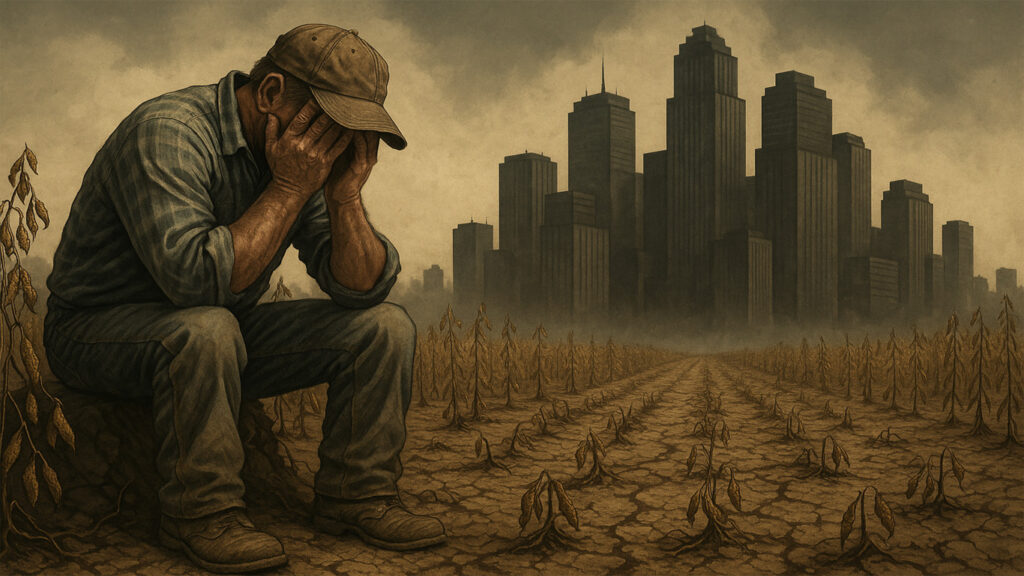
Trump’s tariffs sparked a crisis for U.S. farmers, enriching corporations while family farms vanish.
Save Family Farmers

Watch Politics Done Right T.V. here.

Podcasts (Video — Audio)
Summary
American farmers, especially soybean producers, face severe financial ruin due to Donald Trump’s reckless tariff policies. These tariffs triggered a trade war, cutting off U.S. access to crucial markets, such as China, and forcing many farmers into government dependency. Despite the mounting crisis, some farmers continue to support Trump, unaware they are being used to consolidate corporate power in agriculture.
- Trump’s tariffs devastated U.S. soybean exports, particularly to China, which consumes 61% of global soybeans.
- Farmers face losses as prices rise 20%, making U.S. crops uncompetitive against.
- Corporate farming benefits, while small family farms disappear under the crushing weight of debt and low margins.
- Many farmers ironically want government “welfare” subsidies they once opposed.
- Progressive education and outreach are vital to counter misinformation and corporate exploitation.
This crisis reveals the consequences of right-wing economic policies that prioritize the wealthy and corporations over working families. By educating and uniting rural and urban communities, progressives can challenge this exploitation and build an equitable food system.
Premium Content (Complimentary)
American farmers, once symbols of independence and rugged self-reliance, now find themselves trapped in a crisis of economic and political betrayal. The soybean fields of Kentucky, Iowa, and Tennessee are more than just plots of land—they are battlefields where the consequences of Donald Trump’s reckless tariff policies have come home to roost. These tariffs, imposed under the guise of economic nationalism, have devastated small farmers while enriching corporate agriculture and financial elites.
When Trump initiated his trade war with China by slapping a 30% tariff on Chinese imports, Beijing responded by halting all purchases of U.S. soybeans. This was catastrophic. Before the tariffs, 25% of America’s soybean crop was exported to China, a nation that consumes 61% of the world’s soybeans. Kentucky farmer Caleb Reagan Ridgeland described the devastation as a “five-alarm fire,” warning that 25% of total U.S. soybean sales had vanished overnight. With no buyers, farmers now face an oversupply crisis, as prices are 20% higher than those of competitors like Brazil, the world’s leading soybean exporter.
The consequences go far beyond soybeans. Farmers are caught between rising costs for supplies, fueled by inflation and tariffs, and shrinking markets for their goods. Many now depend on government subsidies to survive—what they once derided as “welfare.” This irony highlights a painful truth: while rural communities are lectured about “pulling themselves up by their bootstraps,” their very survival depends on taxpayer bailouts. A culture of corporate dependency has replaced the rugged individualism celebrated by conservative politicians.
This crisis is not an accident; it is part of a deliberate restructuring of the American agricultural system. Trump’s former Secretary of Agriculture openly admitted that “the day of the small farm is over,” signaling a shift toward corporate-controlled farming. Companies now dominate the market, forcing farmers into contracts that make them little more than low-wage laborers on land they no longer control. As food prices soar, these corporations rake in record profits while farmers see their margins shrink.
What makes this tragedy worse is the political manipulation behind it. Many farmers continue to support Trump, even as his policies destroy their livelihoods. This is not due to ignorance alone but to decades of right-wing propaganda that pits rural communities against urban ones. Farmers are told that their suffering is the fault of immigrants, environmentalists, or liberal elites—never the corporations and politicians actually responsible. This deliberate misinformation campaign mirrors the broader assault on truth in America’s political discourse.
Progressives face a difficult but vital task: engaging rural communities with empathy and truth. This requires not only policy solutions, such as fair trade practices and sustainable agriculture investments, but also deep and patient education. When people are indoctrinated—whether by sexism, racism, or economic lies—they must be shown a new way forward through persistent dialogue and solidarity. Rural hospitals closing, family farms disappearing, and entire communities collapsing are not isolated tragedies but interconnected symptoms of corporate greed and political betrayal.
The solution lies in unity. By connecting the struggles of rural farmers with those of urban workers, progressives can build a coalition that challenges corporate power. Independent media plays a crucial role here, countering the mainstream press’s failure to report truthfully on these issues. Outlets like Common Dreams and Politics Done Right provide the information necessary to counter the neoliberal agenda.
As this battle unfolds, one thing is clear: the fight for America’s farms is not just about crops or tariffs. It is about reclaiming democracy from the forces of corporate domination. Every acre of land lost to agribusiness represents a loss of freedom, community, and self-determination. Progressives must rise to this challenge, armed with facts, compassion, and an unwavering commitment to justice.