


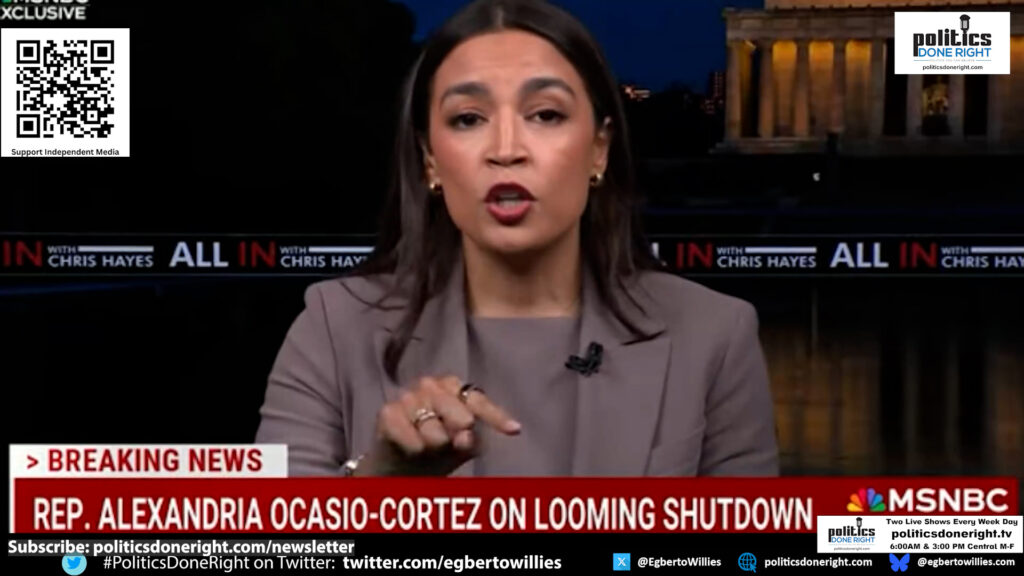
AOC reframes Chris Hayes’ shutdown debate, exposing GOP health care sabotage as life-or-death. Progressives must follow AOC’s lead: speak to bread-and-butter struggles, not technocratic abstractions.
AOC Schools Media

Watch Politics Done Right T.V. here.

Podcasts (Video — Audio)
Summary
Alexandria Ocasio-Cortez’s interview with Chris Hayes highlights the urgent stakes of the government shutdown debate. She reframes technocratic jargon about “tax credits” into the real-world crisis of soaring health care costs, doubling premiums, and life-or-death decisions for ordinary Americans. By cutting through elite framing, she shows how progressives must speak plainly about bread-and-butter issues to mobilize people against Republican efforts to dismantle Medicaid and gut public health protections.
- Translation for the People: AOC cut through the jargon of “tax credits” to explain how policy translates into unaffordable insulin, chemotherapy, and everyday health costs.
- Framing the Shutdown: She reframed the government shutdown not as a fight over obscure mechanisms, but as a struggle to protect Americans’ lives from the consequences of lost health coverage.
- Exposing GOP Tactics: She called out the use of rescissions—a backdoor tactic Republicans employ to claw back agreed-upon funding—as an abuse of power that undermines both healthcare and the rule of law.
- Media Critique: The segment exposed how mainstream media often frames policy as abstract while independent voices reveal the life-or-death stakes
- Progressive Messaging: The lesson: speak directly to people’s hunger, health, and survival—not “food insecurity” or “tax extenders”—to win public trust and votes.
This exchange shows why progressives like AOC are essential. She rejected the sterile language of Washington technocrats and gave voice to the lived reality of ordinary Americans. Instead of hiding behind policy jargon, she made it clear that the fight is about whether families live or die without access to healthcare. By demanding plain talk, transparency, and moral urgency, she modeled how Democrats can resist Republican sabotage and connect authentically with voters.
Premium Content (Complimentary)
The conversation between Alexandria Ocasio-Cortez and Chris Hayes illustrates a crucial lesson for today’s progressive movement: clarity and courage in messaging can make all the difference between public disengagement and civic empowerment. Too often, mainstream political debates are drowned in technocratic jargon—“tax credits,” “rescissions,” and “appropriation mechanisms”—that alienates everyday people and obscures the real stakes of policy decisions. Ocasio-Cortez rejected that framing and cut directly to the heart of the matter: if subsidies vanish, premiums double, and Medicaid is gutted, Americans will die.
Republicans, through deliberate legislative manipulation, have weaponized obscure tools like rescissions. These backdoor budgetary tricks allow them to claw back funding even after bipartisan agreements. This tactic, while sounding like an abstract procedural quibble, is in reality a direct assault on the public’s health care security. As AOC explained, the government shutdown debate is not about numbers on a spreadsheet—it is about whether a mother can afford chemotherapy for her child, whether a diabetic can pay for insulin, and whether Americans must choose between debt and death. By placing the focus squarely on human suffering, she reframed the conversation in moral rather than technocratic terms.
Her intervention also exposes the failures of corporate media. Even in the hands of a generally well-intentioned host like Chris Hayes, the framing risked reducing the conversation to narrow, elite concerns. When mainstream outlets approach policy through insider language, they alienate viewers who most need clarity. AOC’s approach mirrors what progressive communicators have long argued: the public responds when leaders speak in plain language about concrete impacts. Talk about “food insecurity,” and people’s eyes glaze over; talk about Americans “starving and being hungry,” and the moral urgency becomes unavoidable. This rhetorical choice bridges the divide between “bread-and-butter folks” and “technocrats.”
The broader lesson here is that progressive politicians must not cede the narrative to Republicans or to mainstream media gatekeepers. They must seize every opportunity to ground policy in human terms. If health care subsidies are cut, people die. If Medicaid is gutted, families collapse under crushing debt. If corporate giveaways are prioritized, inequality deepens, and working people suffer. Progressives must be unapologetic about making these truths explicit.
This is especially urgent in the era of Donald Trump and his allies, who have made chaos a key part of their political strategy. Trump’s threats to dismantle the federal workforce, gut the Department of Justice, and bend the law to his will are not isolated moves—they are part of a systematic campaign to weaken democratic institutions while enriching elites. In this climate, AOC’s insistence on tying health care to rule-of-law protections is vital. Protecting subsidies is not just about affordability—it is also about resisting authoritarian abuse.
Independent media plays a pivotal role here. Corporate outlets are too often complicit in watering down or misdirecting the conversation. Independent voices must fill the gap by providing unvarnished truth, funded not by corporate advertisers but by small-dollar contributions from engaged citizens. When people invest in their own media, they ensure loyalty to the public interest, not corporate power.
In sum, AOC’s interview should be studied as a model of progressive communication. She answered the question asked, but also expanded the frame to address what Americans truly care about: survival, dignity, and justice. This is how progressives can break through media noise, counter Republican sabotage, and inspire the electorate. The stakes could not be higher: in the fight over health care, the outcome is not just political—it is life and death.