


Trump’s net approval collapses across demographics as voters reject economic spin and harsh immigration tactics.
Trump Approval Craters

Watch Politics Done Right T.V. here.

Podcasts (Video — Audio)
Summary
The numbers are collapsing, and they are collapsing fast. New polling shows Donald Trump’s approval sinking across virtually every demographic, with independents and young voters leading the exodus. The decline reflects public frustration with economic instability, inhumane and violent immigration tactics, and a widening credibility gap between rhetoric and lived reality.
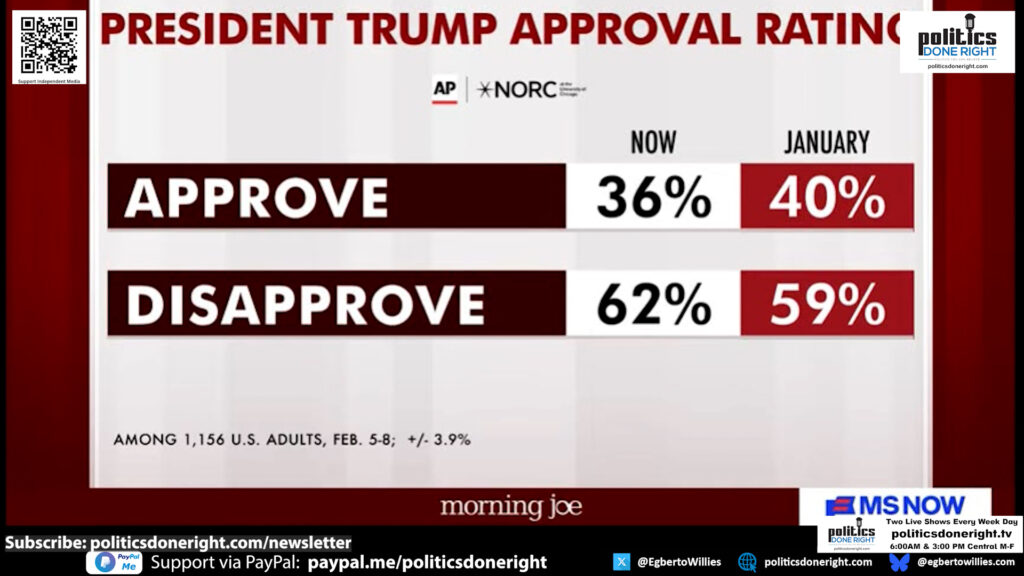
- The latest AP-NORC poll shows Trump’s approval at 36%, down four points in a single month.
- Multiple polls (Harvard-Harris, Rasmussen, YouGov/Economist) show more voters now say Joe Biden did a better job.
- CNN polling analysis notes Trump’s net approval on the economy is 26 points lower than at this point in his first term and 53 points lower among independents.
- Young voters (18–29) show a stunning -40 net approval rating, a 51-point swing from the start of the term.
- Immigration crackdowns and expanding detention facilities are proving politically toxic, even among some Republicans.
The story is not complicated. When policies hurt working families and rhetoric ignores economic pain, voters respond. Polls do not collapse in a vacuum; they reflect consequences.
Premium Content (Complimentary)
The polling freefall now unfolding is not an accident. It is the predictable result of governance rooted in grievance politics rather than material improvement in people’s lives. The numbers are stark. According to the AP-NORC poll cited, the president’s approval stands at 36%, dropping four points in just one month. That is not a fluctuation. That is erosion.
Multiple surveys reinforce the pattern. Harvard-Harris, Rasmussen, and YouGov/Economist polling show a growing share of voters now say Joe Biden did a better job as president. When retrospective comparisons begin favoring a predecessor whom critics relentlessly attacked as weak or ineffective, something fundamental has shifted in public perception.
The economic numbers tell part of the story. CNN polling analysis cited indicates the president’s net approval on the economy is 26 points lower than at this stage in his first term and 53 points lower among independents. That collapse among independents matters profoundly. Independents are not ideologically anchored to one party. They respond to performance. When grocery bills remain high, housing remains unaffordable, and job security feels uncertain, slogans about “the best economy ever” ring hollow.
Reputable economic data underscores why voters feel uneasy. The Bureau of Labor Statistics has shown persistent price pressures in essentials like food and shelter over the past year. Even when headline inflation moderates due to energy price fluctuations, consumers judge the economy based on checkout lines, not press briefings. Voters experience economics emotionally and materially.
Immigration policy compounds the damage with expanding detention facilities and brutal and inhumane enforcement tactics. Public trust erodes when communities perceive heavy-handed approaches that lack transparency. Americans consistently express support for border management alongside humane treatment and due process. When enforcement appears punitive or secretive, political backlash follows.
The most striking data may come from young voters. The YouGov/Economist poll cited shows a -40 net approval among 18–29-year-olds, representing a 51-point swing from the start of the presidency. Young voters are historically sensitive to issues of economic opportunity, climate action, racial justice, and civil liberties. If they perceive regression on those fronts, they disengage or mobilize in opposition.
This moment also reveals the power—and failure—of media ecosystems. There are deep partisan divides in trust toward institutions. When segments of the electorate receive curated narratives that contradict empirical data, polarization intensifies. Yet reality eventually intrudes. Grocery prices, rent checks, and healthcare bills cannot be spin-managed indefinitely.
The collapse in approval is therefore less about partisan hostility and more about credibility. When a leader insists inflation is low while families struggle, or declares unprecedented prosperity amid stagnant wages, voters recognize the dissonance. Political loyalty can buffer some of that tension, but not indefinitely. The sycophants will find excuses, but they are neither the majority or the plurality.
What does this mean structurally? It means policy matters. It means that performative politics cannot substitute for material improvement. It means that voters across demographics—young people, independents, suburban voters—are recalibrating based on lived experience rather than partisan branding.
Polls do not vote. But polls signal momentum. When approval sinks across “every demographic,” it indicates dissatisfaction cutting beyond ideological bases. The remaining 36% approval suggests a hardened core. Yet governance requires broader coalitions.
Democracy responds to consequences. When policies fail to deliver economic security or social stability, the electorate signals discontent. The numbers now reflect that reckoning. Democrats, Independents, and Moral Republicans must not squander today’s reality.