


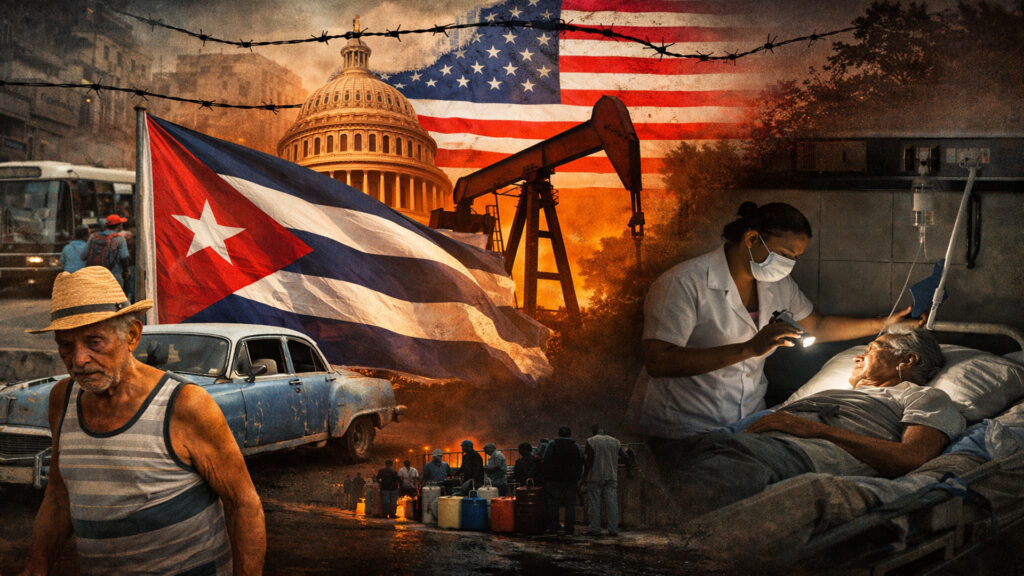
Cuba’s economic collapse is not simply ideology at work. Decades of U.S. sanctions, oil restrictions, and pressure on Venezuela have strangled the island’s economy and deepened human suffering.
The Cuba Crisis Isn’t Ideology

Watch Politics Done Right T.V. here.

Podcasts (Video — Audio)
Summary
Economic warfare is still warfare. For more than six decades, the United States has imposed and expanded sanctions that have constricted Cuba’s access to markets, capital, and energy. The crisis engulfing the island today is not the result of ideology; it is the predictable outcome of systemic economic isolation designed to squeeze a nation into submission. The tightening of oil sanctions — including measures affecting Venezuela’s ability to supply Cuba — has intensified blackouts, transportation collapse, and healthcare strain. When a country that claims to defend life deliberately imposes policies that deepen scarcity and suffering, moral questions must follow.
- Cuba’s economic hardship stems largely from sustained U.S. embargo and sanctions policies, not merely from internal governance choices.
- Extraterritorial sanctions penalize countries and companies that attempt to trade with Cuba, isolating the island beyond bilateral restrictions.
- Oil restrictions and pressure on Venezuela have crippled Cuba’s energy supply, leading to blackouts, fuel shortages, and economic paralysis.
- Sanctions disproportionately harm ordinary citizens, straining healthcare, transportation, food supply, and daily survival.
- A nation that professes reverence for life must confront the humanitarian consequences of policies that weaponize deprivation.
The path forward requires honesty about the human cost of economic coercion. Collective punishment does not build democracy; it builds suffering.
Premium Content (Complimentary)
For decades, Cuba has been portrayed through a prism of ideological conflict — as if its economic struggles were born solely of its own internal choices. But the truth, as revealed by history and recent developments, is starkly different: Cuba’s economy is not failing because of socialism; it is being systematically undermined by sustained U.S. economic aggression that reaches far beyond the island’s shores. From the imposition of a comprehensive trade embargo in the 1960s to the recent escalation of Venezuelan oil starvation and extraterritorial penalties, U.S. policy toward Cuba has consistently weaponized economics to stifle a sovereign nation and inflict suffering on its people.
The narrative of a failed Cuban economy often obscures the reality of an enduring embargo that has throttled growth, deterred foreign partners, and isolated the island from global markets. According to United Nations estimates and economic analyses, the embargo has cost Cuba’s economy tens of billions of dollars, while U.S. extraterritorial sanctions discouraged international trade and investment. These measures did not arise from abstract grievances; they were enacted with precise geopolitical intention: to pressure Havana into political submission by inflicting material hardship on ordinary Cubans. As critics have observed, sanctions have historically been designed to bring about “hunger, desperation, and the overthrow of government,” a strategy admitted in historical U.S. policy documents and visible in sanctions practices.
The current crisis gripping Cuba illustrates the human cost of such tactics. In early 2026, U.S. policies escalated when an executive order threatened tariffs on any nation that supplies Cuba with oil, a lifeline for an economy that produces only about 40% of its own fuel. The result has been catastrophic: rolling blackouts, fuel shortages crippling public transportation, and deepening scarcity in health care and basic services. The United Nations has warned of a worsening humanitarian collapse driven by these energy shortages.
This crackdown is deeply interlinked with U.S. actions in neighboring Venezuela. The halt in Venezuelan oil shipments — once traded for Cuban engineers, doctors, and security personnel — has magnified Cuba’s plight. For years, Cuba supplied Venezuela with vital human capital in exchange for heavily subsidized crude. With that flow cut off, Cuba’s economy is hit from both inside and outside, squeezed by sanctions and deprived of one of its last reliable sources of energy.
The strategic logic behind these maneuvers is chilling when examined through the lens of compassion and human rights. How can a nation that claims to uphold the sanctity of life justify policies that punish an entire population, constrict access to critical resources, and risk the suffering and deaths of countless civilians? Hospitals facing fuel shortages, children going without consistent nutrition, and ordinary families walking miles for basic transportation are not incidental casualties; they are the direct consequences of economic policies that treat suffering as leverage. In November 2025, a United Nations human rights expert urged the United States to lift its sanctions against Cuba precisely because they are severely impacting health care, education, and nutrition, particularly among low-income communities.
The moral calculus of these sanctions raises urgent questions about the ethics of economic coercion. Sanctions are often portrayed as a humane alternative to military intervention, but in practice, they become a form of collective punishment that disproportionately harms the most vulnerable. The United States’ current posture towards Cuba — amplifying pressure through trade restrictions and threatening third-party suppliers with punitive tariffs — reinforces a geopolitical strategy that prioritizes regime change over human welfare.
In this moment of crisis, it is essential to recognize that the hardships faced by the Cuban people are not the inevitable results of ideology or economic mismanagement alone; they are the product of deliberate policies rooted in decades of geopolitical antagonism. For listeners committed to a more humane and just foreign policy, acknowledging this reality should compel a reevaluation of sanctions as a tool of international engagement.
The suffering witnessed today — power outages that paralyze hospitals, fuel shortages that ground transport, and scarcities that undermine daily life — are not distant consequences of abstract political systems. They are consequences of choices: choices made in capitals far from Havana, choices that leverage deprivation as a weapon, choices that place geopolitical objectives above human dignity. As the world watches and debates these outcomes, the American public must confront the human face of economic warfare and demand policies grounded in solidarity, respect for sovereignty, and an unwavering commitment to human rights.