


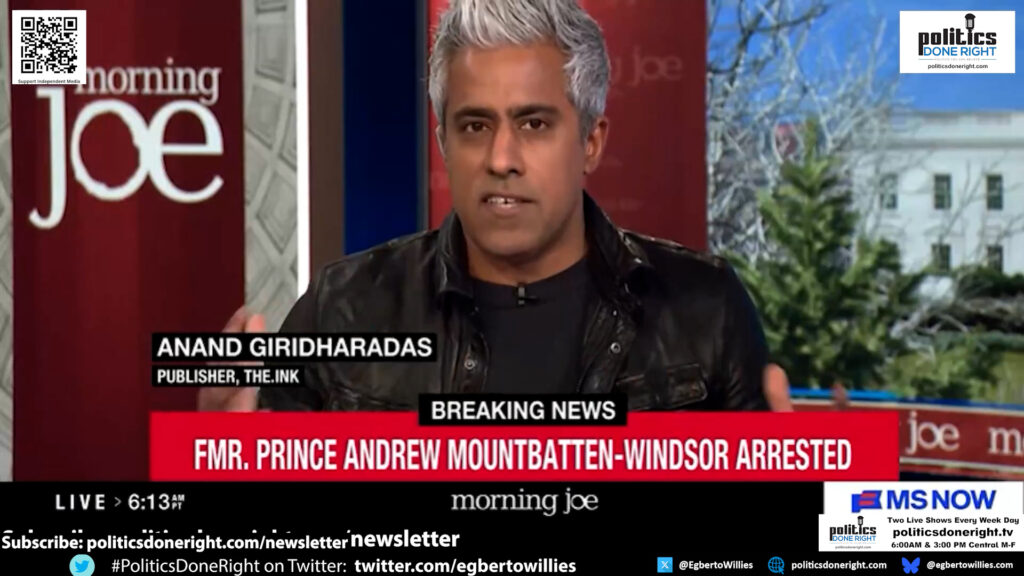
Anand Giridharadas reveals how the “Epstein class” protected power and privilege across parties while victims waited for justice.
The Epstein Class

Watch Politics Done Right T.V. here.

Podcasts (Video — Audio)
Summary
Anand Giridharadas exposes a deeper truth: the Epstein scandal is not just about one predator but about a protected elite network that shields its own. For decades, powerful men across party lines allowed secrecy, redactions, and delay to protect a class of wealth and influence that operates above accountability. The failure to fully release Epstein-related documents did not begin or end with one administration. It reflects a bipartisan unwillingness to confront a system that privileges billionaires, royalty, and political insiders over abused women and the public’s right to know. Giridharadas calls this structure the “Epstein class”—a transpartisan elite united by power, indifference, and solidarity with each other rather than loyalty to democracy.
- The scandal implicates a broader elite network, not just one man.
- Redactions and secrecy reflect systemic protection of wealth and status.
- Political leaders across parties failed to expose the full truth.
- Media institutions often soften scrutiny when elites are involved.
- The same indifference that enabled abuse also distorts healthcare, economics, and public policy.
The Epstein story lays bare a truth progressives have long understood: concentrated wealth breeds concentrated impunity. Accountability will not come from deference to elite institutions; it will come from sustained public pressure demanding transparency and justice.
Premium Content (Complimentary)
Anand Giridharadas delivers a piercing indictment of what he calls the “Epstein class”—a network of power that transcends party, nationality, and ideology. It’s clear that the outrage surrounding Jeffrey Epstein does not stem solely from the monstrous crimes of one individual. It stems from the revelation that a governing class protected him, socialized with him, and insulated itself from consequence for decades.
The Epstein case reflects a structural disease. Wealth and proximity to power created a shield. Prosecutorial leniency in 2008 allowed Epstein to evade federal charges despite substantial evidence of abuse. That plea deal, later ruled unlawful by a federal judge, demonstrated how influence bends justice. This was not partisan favoritism; it was class favoritism.
Giridharadas identifies the pattern. Each day, the media isolates micro-stories—royalty photographed with Epstein, billionaires donating to political committees, redacted files—without confronting the unifying truth: elite solidarity protects elite wrongdoing. Concentrated wealth distorts democratic accountability, whether through campaign finance, regulatory capture, or prosecutorial discretion. The Epstein scandal becomes a grotesque illustration of that distortion.
The indifference Giridharadas describes runs deeper than criminal complicity. It defines how institutions treat ordinary people. When healthcare systems prioritize shareholder returns over patient care, when wages stagnate while executive compensation soars, when financial markets become moral alibis for exploitation, society witnesses the same underlying ethos: power first, people last. As I have written before, income inequality has widened dramatically over the past four decades, with gains overwhelmingly captured by the top percentile. That inequality correlates with political influence.
The “Epstein class” is not limited to criminal acts. It represents a worldview. It assumes that wealth entitles one to insulation from scrutiny. It normalizes secrecy. It relies on a mainstream media ecosystem that too often hesitates to confront billionaires with the same intensity directed at the powerless. Media scholars have critiqued this dynamic for years, noting the impact of corporate consolidation on investigative priorities.
The bipartisan dimension matters. Multiple administrations failed to ensure complete transparency. Accountability demands consistency. Progressives who critique right-wing authoritarianism must also demand transparency from Democratic leadership. Justice cannot depend on partisan convenience.
This scandal also reveals something hopeful. Giridharadas suggests that public awareness has sharpened. Across ideological lines, ordinary people recognize that elite networks operate by different rules. That recognition creates an opportunity. When citizens stop fighting culture-war battles scripted by elites and instead challenge structural inequality, democratic renewal becomes possible.
Independent journalism plays a central role. When corporate outlets shy away from confronting wealthy donors or powerful board members, independent platforms funded by small-dollar supporters fill the gap. History proves that sustained public pressure—from Watergate to the Panama Papers—forces institutions to release hidden truths.
The fight is not about salacious detail. It is about structural accountability. It is about ensuring that no billionaire, prince, hedge fund manager, or political operative stands above the law. It is about dismantling a culture of deference that allows abuse to metastasize.
The Epstein case forces a reckoning. Either democracy remains subordinate to oligarchy, or citizens demand systemic reform—stronger transparency laws, independent prosecutors, media accountability, and campaign finance overhaul. Progressives understand that concentrated wealth and concentrated power erode freedom.
The “Epstein class” survives on silence and distraction. It collapses under sunlight. The public must insist on that light.