


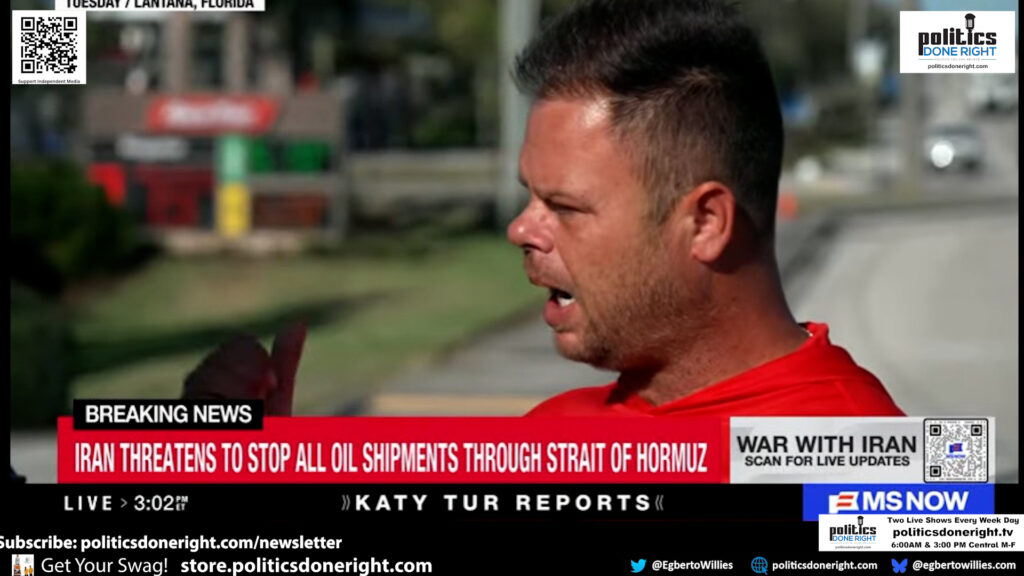
A devoted MAGA voter openly regrets his vote and says life felt calmer and more affordable before. Economic reality challenges political loyalty.
MAGA Voter Regrets Trump Vote

Watch Politics Done Right T.V. here.

Podcasts (Video — Audio)
Summary
A striking political moment emerges when a committed MAGA voter openly expresses regret and nostalgia for the stability of the previous administration. The interview reveals how everyday economic realities—gas prices, cost of living, and perceived instability—can pierce partisan loyalty and force political reconsideration. The exchange demonstrates that political narratives collapse when lived experience contradicts campaign promises. The voter’s frustration highlights how economic insecurity often reshapes political identity more effectively than partisan messaging.
- A devoted Trump voter openly admits regret and expresses nostalgia for the previous administration’s stability.
- Rising fuel prices and the cost of living have become the primary catalyst for political disillusionment.
- The voter states that life felt calmer and more economically manageable previously.
- Economic frustration exposes the gap between campaign promises and governing reality.
- The moment illustrates how everyday voters can shift political views when policies affect their daily survival.
The exchange demonstrates a larger political truth: ideology often collapses when confronted with lived economic hardship. When voters who once supported populist promises begin reassessing their choices, it signals that economic realities can break through propaganda. A democracy benefits when citizens evaluate leadership based on tangible outcomes rather than slogans. The moment represents more than a single voter’s regret—it reveals the cracks forming inside a political movement built on promises that fail to improve ordinary lives.
Premium Content (Complimentary)
American politics frequently operates as a battle of narratives. Campaign slogans promise transformation, economic revival, and restored national strength. Yet reality eventually confronts rhetoric. When everyday voters begin questioning those promises, the political ground shifts beneath the architects of those narratives. A revealing moment occurs when a committed MAGA voter openly admits regret and expresses nostalgia for the relative calm and economic stability of the prior administration. That admission carries significance far beyond one individual’s opinion.
The voters’ complaints revolve around the most powerful force in politics: everyday economics. Gas prices, cost of living, and financial security shape the lived experiences of working people. When politicians promise dramatic economic relief and fail to deliver, those promises transform into political liabilities. In the interview, the voter directly references campaign assurances that energy prices would fall dramatically, noting instead that the price at the pump rose significantly.
Economic frustration frequently breaks through partisan identity because it affects daily survival. A voter may tolerate ideological disagreements, cultural rhetoric, or partisan conflict, but persistent economic hardship forces reconsideration. The statement that life previously felt calmer and less financially burdensome reflects a deeply personal evaluation of governance.
Economic conditions strongly influence voter behavior. Inflation and cost-of-living concerns routinely rank among the most influential factors shaping public opinion and electoral outcomes. When voters believe government policies worsen their financial security, partisan loyalty weakens rapidly. In fact, absent the economic collapse of 2008, a man named Barack Hussein Obama would likely not have become president.
This moment also exposes the fragile foundation of populist political movements. Populist rhetoric often relies on dramatic promises: lowering prices, restoring prosperity, ending conflicts quickly, or confronting foreign adversaries. Yet governing requires navigating complex economic systems, international supply chains, and geopolitical realities. When those complexities collide with simplistic campaign messaging, disillusionment inevitably follows.
The voter’s statement that life once felt calmer carries another important implication. Political polarization and constant crisis messaging create a sense of instability. Political communication strategies frequently rely on fear and outrage to mobilize supporters. However, constant crisis rhetoric eventually exhausts the public. Stability becomes politically valuable.
The conversation also reveals a deeper structural problem in American democracy: the failure of mainstream media institutions to consistently interrogate economic claims made by political leaders. Concentrated corporate media ownership can narrow the range of perspectives presented to the public. When coverage prioritizes spectacle over economic analysis, voters often lack the information necessary to evaluate policy outcomes effectively.
Independent journalism, therefore, is imperative to maintain our democracy. It creates space to examine the lived consequences of political decisions rather than simply amplifying partisan talking points. When a voter publicly reassesses their political allegiance, that moment becomes valuable civic evidence. It demonstrates that democratic accountability still functions when citizens evaluate leadership based on results.
Progressive political analysis often emphasizes material conditions rather than ideological branding. Wages, healthcare costs, housing affordability, energy prices, and economic security determine whether policies succeed or fail in the eyes of ordinary people. When voters conclude that leadership worsens those conditions, political realignment becomes possible.
This particular moment reflects the early stages of such reconsideration. A voter who once believed populist promises now measures leadership against daily economic reality and finds the results lacking. The significance lies not in partisan triumphalism but in the democratic process itself. Citizens are evaluating governance through experience rather than slogans.
American democracy depends on that evaluation. When voters reassess their choices, demand accountability, and reject narratives that fail to improve their lives, political power shifts back toward the public. The interview captures a small but meaningful example of that process unfolding in real time.