


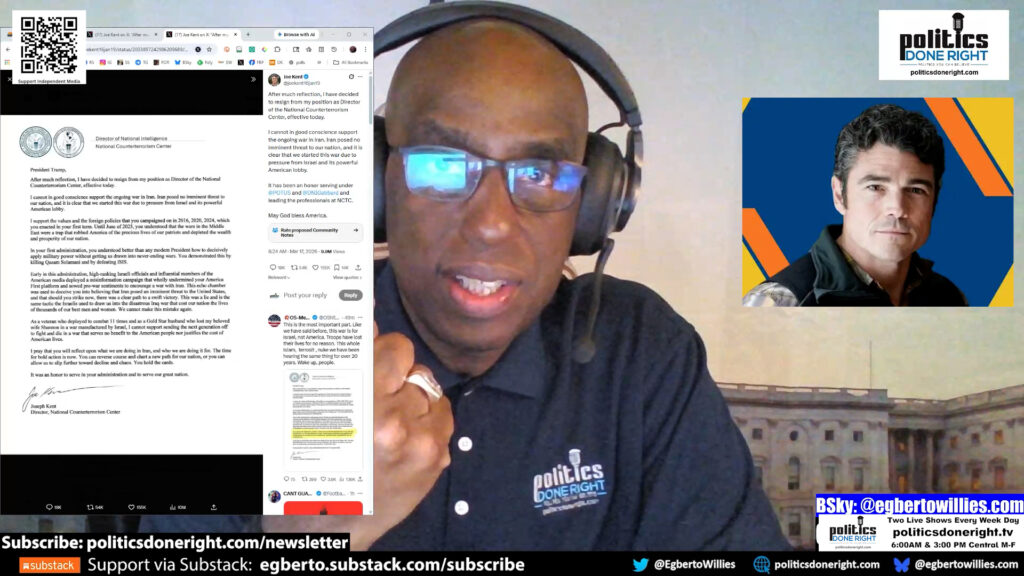
A stunning resignation exposes how misinformation and lobbying drove Trump’s Iran war. The real story challenges everything Americans were told.
America’s Media Crisis: Reveals Iran War

Watch Politics Done Right T.V. here.

Podcasts (Video — Audio)
Summary
A Trump loyalist finally breaks ranks—and exposes the truth about a war that never should have happened.
Joseph Kent, Trump’s Director of the National Counterterrorism Center, resigns and admits what many suspected: the Iran war was not about imminent danger but political pressure and manufactured consent.
- Kent states clearly that Iran posed no imminent threat to the United States.
- He reveals that Israeli leadership and pro-war lobbying networks pushed a narrative to justify military action.
- The administration relied on an echo chamber of misinformation to manufacture urgency for war.
- Despite his admission, Kent himself has a record of election denial and promotion of conspiracy theories, exposing hypocrisy within the administration.
- The war is described as a costly and deadly conflict draining U.S. resources and lives for geopolitical interests, not national defense.
This resignation exposes a deeper systemic failure—an administration driven not by facts or national interest, but by ideology, pressure, and propaganda. It reinforces the urgent need for an informed public and independent media willing to challenge power.
Premium Content (Complimentary)
The resignation of the Director of the National Counterterrorism Center, Joseph Kent, marks more than a bureaucratic shake-up—it exposes the dangerous machinery that continues to drive U.S. foreign policy into unnecessary wars. When a figure embedded within the Trump apparatus admits that Iran posed no imminent threat, the narrative collapses. What remains is a familiar and troubling truth: war was chosen, not required.
The statement makes something unmistakably clear. This was not a defensive response to an immediate danger. It was a calculated escalation shaped by external pressure and internal ideological alignment. The admission that Israeli leadership and influential lobbying forces helped manufacture the justification reflects a long-standing critique raised by foreign policy scholars. Institutions such as the Center for Strategic and International Studies (CSIS) have repeatedly documented that threat inflation and intelligence framing often precede military interventions, particularly in the Middle East.
This is not new. The United States witnessed similar dynamics during the lead-up to the Iraq War. Intelligence was selectively interpreted. The media amplified official narratives without sufficient scrutiny. Political actors prioritized alignment over truth. The result was catastrophic—hundreds of thousands dead, trillions spent, and a region destabilized for generations. The same pattern now appears to be repeating itself.
What makes this moment particularly revealing is the source. This is not a progressive critic or anti-war activist speaking out. This is a deeply ideological insider—a figure tied to election denialism and conspiracy networks—suddenly acknowledging reality. That contradiction matters. It underscores how unsustainable the narrative has become when even its architects begin to fracture.
Yet, no one should mistake this for redemption. The same official who now claims moral clarity participated in a system that normalized disinformation. He helped create the very environment where truth becomes optional, and loyalty overrides facts. His resignation does not absolve him—it indicts the entire structure.
The financial cost alone should alarm every American. Wars of this scale drain billions of dollars daily, diverting resources away from healthcare, education, infrastructure, and climate resilience. According to research from Brown University’s Costs of War Project, post-9/11 conflicts have cost the U.S. over $8 trillion. Every new conflict compounds that burden. Every missile fired represents schools unfunded, communities neglected, and futures compromised.
But the human cost is even more devastating. Civilian casualties, displaced populations, and long-term regional instability are the predictable outcomes of military escalation. These are not unintended consequences—they are inherent to the strategy itself. War, especially one built on false pretenses, cannot deliver security. It delivers chaos.
Equally troubling is the role of corporate media. Many Americans already feel that mainstream outlets too often fail to challenge power. Media consolidation has narrowed the range of perspectives presented to the public. When profit and access drive coverage, critical analysis suffers. The result is a less-informed population more susceptible to manipulation.
Independent media becomes essential in this environment. It provides space for dissenting voices, contextual analysis, and accountability. It reminds the public that democracy requires more than participation—it requires understanding.
Ultimately, this moment demands more than outrage. It demands action. It requires voters to recognize patterns, reject manufactured consent, and hold leaders accountable. Wars do not begin in a vacuum. They are enabled by silence, justified by misinformation, and sustained by apathy.
Breaking that cycle starts with awareness. It continues with engagement. And it culminates at the ballot box.