


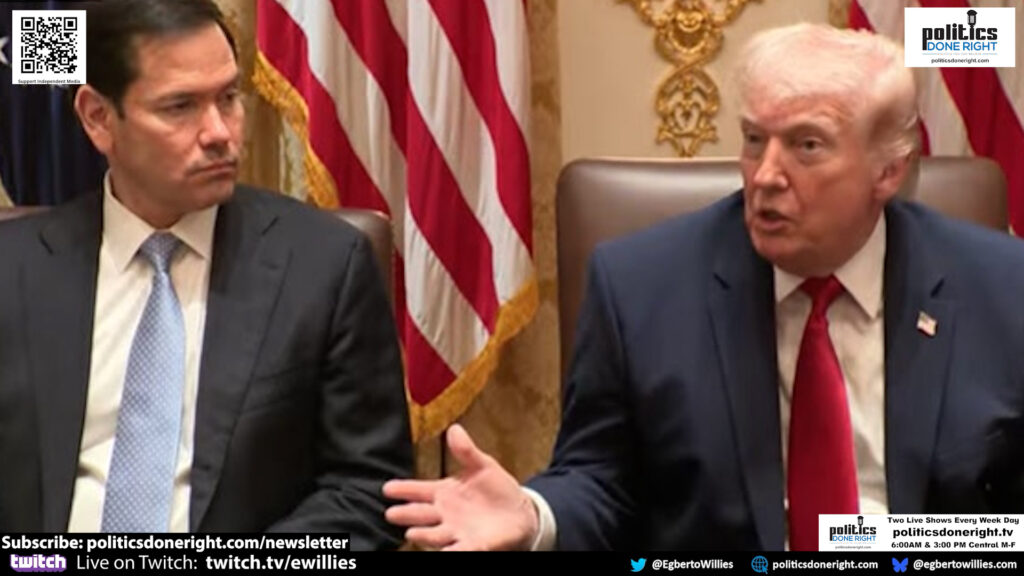
Trump openly discusses controlling oil in Venezuela and Iran, raising urgent questions about sovereignty, empire, and U.S. foreign policy.
Thief: Trump to control Iran and Venezuela’s oil?

Watch Politics Done Right T.V. here.

Podcasts (Video — Audio)
Summary
A stunning admission reveals a worldview that treats nations as property rather than sovereign entities.
Exposed is a moment where Donald Trump openly discusses taking control of another country’s oil while boasting about profits derived from Venezuela after its leadership was removed. The rhetoric does not hide behind diplomacy—it embraces domination, suggesting that military power can be used not for defense but for acquisition. The framing of oil as a “joint venture” with the United States reveals a deeper truth: this is not about democracy or humanitarian concern, but about control, extraction, and profit. The narrative then pivots to polling, noting that a single favorable survey likely reflects desperation and hope from a population that has endured economic hardship—hardship exacerbated by U.S. policy itself. The moral question becomes unavoidable: who granted the United States authority to dictate another nation’s leadership or seize its resources?
- Trump openly suggests controlling Iran’s oil while boasting about U.S. gains in Venezuela.
- The language used reflects domination, not diplomacy or partnership.
- Claims of Venezuelan economic improvement are tied to U.S. control of revenue streams.
- A single favorable poll likely reflects hope amid economic suffering, not ideological support.
- The core issue is sovereignty—no nation has the moral right to control another’s resources.
This moment lays bare a dangerous precedent: if power alone justifies intervention, then democracy becomes a slogan rather than a principle. The erosion of sovereignty anywhere threatens justice everywhere. A progressive lens demands rejecting empire in all its forms and reaffirming that no nation has the right to dominate another under the guise of policy or profit.
Premium Content (Complimentary)
This segment is more than rhetoric—it exposes a governing philosophy rooted in power, extraction, and control. When a sitting president openly discusses the possibility of taking another country’s oil and celebrates profits derived from intervening in a sovereign nation, the conversation moves beyond politics and into moral territory.
This is not ambiguity. This is not misinterpretation. This is clarity.
The framing of Venezuela as a “joint venture” with the United States represents a profound shift away from international norms. Nations are not corporations. Their resources are not commodities to be seized by those with the most powerful military. Yet, the language used makes clear that the United States is being positioned not as a partner, but as a dominant stakeholder—one that extracts value while determining how much, if any, returns to the people of that country.
Reputable global frameworks such as the United Nations Charter emphasize sovereignty and non-intervention as foundational principles of international law. These principles exist precisely to prevent powerful nations from imposing their will on weaker ones. When a leader casually dismisses those norms, the implications extend far beyond a single country. It signals to the world that might makes right.
And that is the essence of empire.
The reference to polling in Venezuela adds another layer to this narrative. Yes, one poll suggests that Trump enjoys a level of favorability in the country. But context matters. Venezuela has endured years of economic collapse, inflation, and instability. Populations facing economic distress often express support for actors they believe might bring relief—even when those actors contributed to the crisis.
Sanctions, blockades, and economic pressure have played a documented role in Venezuela’s hardship. Studies from organizations like the Center for Economic and Policy Research have highlighted how external economic pressure can exacerbate domestic crises, leading to widespread suffering. In that context, a favorable poll does not represent ideological alignment. It represents hope—hope that conditions might improve, regardless of the source.
Hope, however, is not consent.
History offers repeated examples of populations temporarily supporting outside intervention under the weight of desperation. Yet those moments rarely translate into long-term legitimacy. Instead, they often lead to cycles of dependency, resentment, and instability. The short-term perception of improvement cannot justify the long-term erosion of sovereignty.
There is a broader and more unsettling question: if the United States claims the right to control Venezuela’s oil today and considers doing the same in Iran tomorrow, where does it stop? The logic becomes self-perpetuating. Any nation with valuable resources becomes a target. Any government that resists becomes an obstacle to be removed.
That is not democracy. That is extraction backed by force.
Progressive analysis insists on confronting this reality directly. It rejects the idea that economic or strategic interests justify overriding the autonomy of other nations. It recognizes that true stability comes not from domination, but from cooperation grounded in mutual respect.
The moral argument is simple, even if its implications are profound: no country has the right to control another country’s resources or dictate its government. That principle must hold universally, or it holds nowhere.
Because once that line is crossed, the distinction between democracy and empire disappears.
And history shows, without exception, that empires—no matter how powerful—eventually face the consequences of their own overreach.