


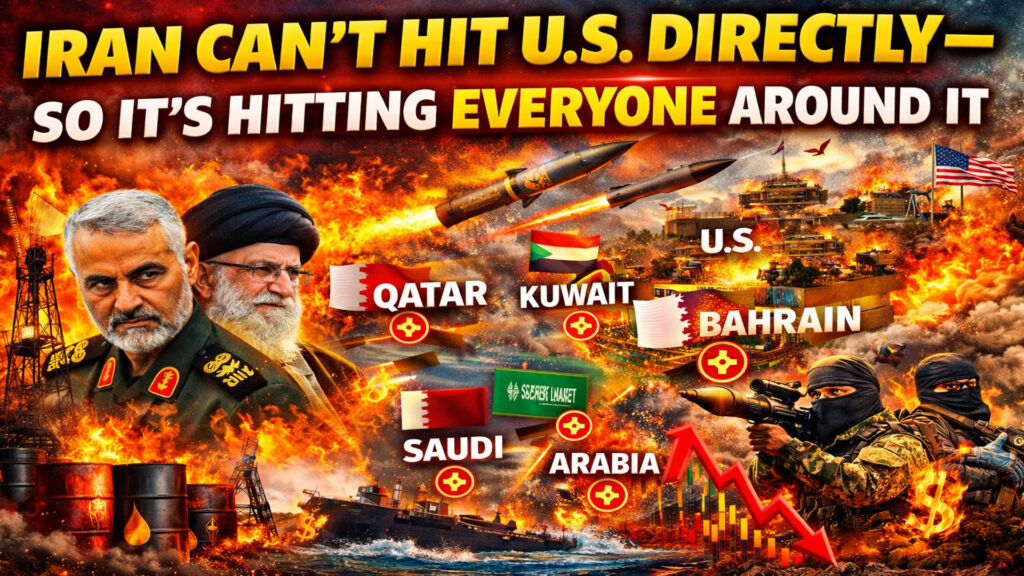
Iran strikes Gulf nations, oil hubs, and U.S. bases across the region. The result: rising oil prices, global instability, and a war spreading through allies.
Iran Can’t Hit U.S. Directly, But …

Watch Politics Done Right T.V. here.

Podcasts (Video — Audio)
This piece lays bare the dangerous trajectory of U.S.–Israel policy toward Iran—one rooted in historical intervention and now accelerating through targeted assassinations of top Iranian leaders. It examines how these actions invite asymmetric retaliation, destabilize global markets, and risk a catastrophic war with no imminent justification.
The analysis challenges the dominant narrative by exposing the economic and human consequences of escalation—from energy shocks and food insecurity to the potential erosion of U.S. financial dominance. It argues that this war is not inevitable but chosen—and that its fallout will extend far beyond the battlefield.
Summary
The current escalation between the United States, Israel, and Iran is not an isolated conflict—it is the culmination of decades of intervention, retaliation, and strategic miscalculation. The systematic assassination of Iranian political and military leaders marks a dangerous shift toward normalized extrajudicial warfare. These actions risk triggering asymmetric retaliation across the Middle East, destabilizing global markets, and undermining international norms.
- The 1953 overthrow of Mohammad Mossadegh laid the foundation for today’s tensions.
- Recent assassinations of top Iranian leaders signal a doctrine of regime destabilization.
- Iran’s regional networks (Lebanon, Iraq, Yemen, Syria) provide avenues for retaliation.
- Disruptions to oil, fertilizer, and trade routes threaten global economic stability.
- Intelligence insiders confirm no imminent Iranian nuclear threat, exposing the war’s weak justification.
This is not a defensive conflict—it is a preventable catastrophe. The costs will be measured not only in lives lost but in global instability that will affect billions.
Premium Content (Complimentary)
History does not merely linger in the background of U.S.–Iran tensions—it defines the present. Any honest analysis must begin with an unambiguous acknowledgment: the modern Iranian state did not emerge in a vacuum. It arose from a violent interruption of democratic self-determination engineered by Western powers. In 1953, the United States, through the CIA, working in tandem with the United Kingdom’s MI6, orchestrated the overthrow of Prime Minister Mohammad Mossadegh because he nationalized Iran’s oil industry. That act crushed a democratic trajectory and replaced it with the Shah’s repressive regime—laying the groundwork for the 1979 revolution and the rise of the current theocratic state.
That historical crime matters today because it exposes the continuity of interventionist thinking. The same mindset that toppled Mossadegh now manifests in a far more dangerous form: the normalization of assassination as policy.
In recent weeks, that policy has escalated dramatically. Israel—often with U.S. backing or coordination—has carried out a sweeping campaign of targeted killings that has effectively decapitated large segments of Iran’s political and military leadership. Among those assassinated are:
- Ayatollah Ali Khamenei, Iran’s Supreme Leader, was killed in a coordinated U.S.–Israeli strike
- Ali Larijani, head of Iran’s Supreme National Security Council
- Esmail Khatib, Iran’s Intelligence Minister
- Gholamreza Soleimani, commander of the Basij paramilitary forces
- Ali Shamkhani, senior security adviser and key nuclear policymaker
- Mohammad Pakpour, IRGC commander
- Abdolrahim Mousavi, Chief of Staff of Iran’s Armed Forces
- Aziz Nasirzadeh, Defense Minister
These are not fringe actors. These are the core of a sovereign state’s leadership—civilian, military, and intelligence. Reports indicate that dozens of additional senior IRGC commanders, intelligence officials, and nuclear program figures have also been killed in coordinated strikes across Iran. In just days, Israel has not merely targeted individuals; it has attempted to dismantle the governing structure of an entire nation.
And the escalation has not stopped. Recent reporting confirms that multiple top Iranian figures—including Khatib, Larijani, and Soleimani—were killed within a 24-hour period, underscoring the intensity of the campaign. Experts warn that such a strategy, while tactically disruptive, often produces the opposite of its intended effect: greater instability, hardened resistance, and prolonged conflict.
This is the doctrine now in play: leadership decapitation as a substitute for diplomacy.
But Iran is not without recourse. It lacks the United States’ global reach, yet it possesses a network of regional assets capable of imposing serious costs. These include:
- Lebanon: Hezbollah, with a vast missile arsenal capable of striking deep into Israel
- Iraq: Militias such as Kata’ib Hezbollah and other Popular Mobilization Forces are targeting U.S. bases
- Yemen: Houthi forces capable of disrupting Red Sea shipping lanes and global trade
- Syria: Iranian-aligned militias operating near Israeli and U.S. positions
- Persian Gulf: Capacity to threaten or disrupt the Strait of Hormuz, a chokepoint for global energy
These are not theoretical tools. They have already been used. Iranian retaliation has included missile strikes, attacks on regional infrastructure, and threats to energy facilities across Gulf states, with real consequences for global oil markets. When Iran cannot strike the United States directly, it strikes the oil that sustains it—the logistical, economic, and geopolitical web that underpins Western power.
This is asymmetrical warfare in its purest form.
And this is where the architects of escalation reveal a dangerous blindness. They assume that superior firepower guarantees control. It does not. It guarantees a reaction. Every assassination, every strike, every act of unilateral violence expands the battlefield. It transforms localized conflict into systemic instability—economic, political, and humanitarian.
The normalization of assassination also destroys any remaining pretense of international norms. When the United States and Israel claim the right to eliminate leaders they oppose, they establish a precedent that others can follow. Blowback is not hypothetical. It is inevitable.
Near the heart of this crisis lies a profound and damning contradiction. The justification for this war rests on the claim of imminent threat. Yet even insiders have undermined that narrative. Joseph Kent made it clear that an Iranian attack on the West—or the use of a nuclear weapon—was not imminent. That admission alone dismantles the moral and strategic case for escalation.
What remains, then, is a war of choice.
And it is a catastrophic one.
This unnecessary war will cost thousands of innocent Iranian lives, innocent Israelis, and innocent Americans. But the devastation will not stop there. The economic shockwaves alone could kill hundreds of thousands more globally. Fertilizer shortages—tied directly to energy disruptions—will threaten agricultural production. Fuel shortages will cascade through transportation, manufacturing, and daily life. Food prices will spike, hitting the world’s poorest populations first and hardest.
At the systemic level, prolonged conflict will accelerate the erosion of U.S. economic dominance. As instability spreads and confidence weakens, the dollar’s position as the world’s reserve currency will face increasing pressure. Nations will seek alternatives. The very foundation of American financial power could begin to fracture under the weight of perpetual war.
This is not a strength. It is strategic self-harm masquerading as dominance.
A rational approach would recognize the limits of force. It would acknowledge history—not as an academic exercise, but as a guide to avoiding repetition. It would reject assassination as a policy and diplomacy as a sign of weakness. And it would understand that in a deeply interconnected world, war is never contained.
The lesson remains as clear as it is ignored: empires that refuse to learn from their interventions do not control the future—they destabilize it.