


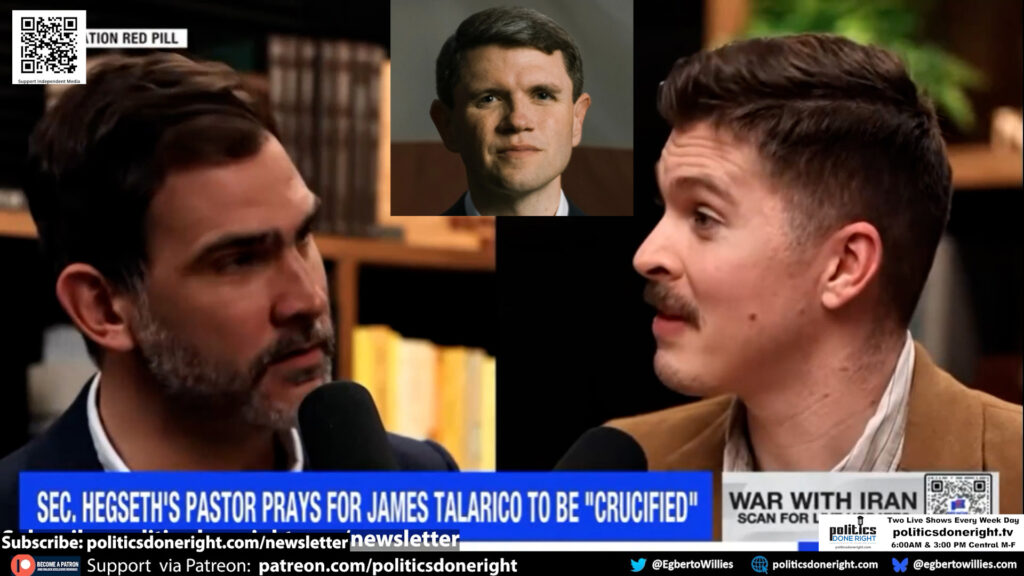
A pastor’s shocking remarks targeting James Talarico expose the dangerous rise of Christian nationalism and political extremism in America.
Pastor hates on Talarico

Watch Politics Done Right T.V. here.

Podcasts (Video — Audio)
Summary
A disturbing moment exposes how extremist rhetoric cloaked in religion fuels political violence and moral hypocrisy.
The video captures a chilling exchange in which a right-wing pastor associated with Defense Secretary Pete Hegseth expresses a desire for Texas lawmaker James Talarico’s death, albeit framed in theological language. The pastor attempts to soften the statement by invoking “spiritual rebirth,” yet the underlying message remains unmistakably violent and dangerous. Talarico responds not with anger but with compassion, stating that love—not hate—defines his faith. The segment then broadens into a critique of white Christian nationalism, arguing that such rhetoric is not fringe but deeply embedded in segments of the political right. It also connects this extremism to a broader failure of mainstream media to hold power accountable, emphasizing the critical role of independent media in exposing these realities.
- A right-wing pastor openly expresses a wish for a political opponent’s death, masked as a religious transformation.
- The rhetoric reflects a broader ideology associated with white Christian nationalism.
- James Talarico responds with a message rooted in love and nonviolence.
- The segment links extremist messaging to influential conservative figures and movements.
- It argues that mainstream media failures enable the spread of such dangerous ideologies.
This episode lays bare a fundamental contradiction: those claiming moral authority through religion often deploy rhetoric that contradicts its core teachings. The moment underscores the urgency of confronting extremist narratives, defending democratic values, and supporting independent journalism that refuses to sanitize or ignore the truth.
Premium Content (Complimentary)
The video is more than an isolated controversy; it reveals a systemic problem that continues to threaten both democratic norms and the moral fabric of public discourse. When a pastor—someone entrusted with spiritual guidance—invokes death, even metaphorically, against a political figure, it signals a dangerous fusion of religion and authoritarian politics. That fusion, often described as white Christian nationalism, has grown increasingly visible in recent years, shaping rhetoric, policy, and political identity.
This ideology does not merely distort religion; it weaponizes it. Scholars at institutions like the Public Religion Research Institute (PRRI) have documented how Christian nationalism correlates strongly with support for political violence and anti-democratic attitudes. The rhetoric in this video aligns with those findings. It frames political disagreement not as a democratic exercise but as a moral battle requiring eradication—spiritual or otherwise—of the opponent.
What makes this moment particularly revealing is the contrast between the pastor’s rhetoric and James Talarico’s response. Talarico rejects the language of hatred and instead centers love, echoing the teachings attributed to Jesus in the Gospels. That response exposes a stark divide: one side embraces power and dominance cloaked in religious justification, while the other emphasizes compassion, humility, and coexistence. This is not merely a political difference; it is a fundamental disagreement about the meaning of faith itself.
The normalization of such rhetoric did not emerge in a vacuum. It reflects years of escalating polarization, amplified by media ecosystems that reward outrage and ideological purity. Research from the Pew Research Center has shown that Americans increasingly consume news within ideological silos, reinforcing existing beliefs and reducing exposure to opposing viewpoints. Within these silos, extreme rhetoric becomes normalized, even celebrated.
Mainstream media bears responsibility here as well. Too often, corporate outlets prioritize access and ratings over accountability, presenting extremist voices as just another side of a political debate. This “both-sides” framing obscures the reality that calls for violence—even veiled ones—are not legitimate political positions. They are threats to a democratic society.
Independent media, as highlighted in the video, plays a critical corrective role. Free from corporate pressures and advertiser constraints, it can confront uncomfortable truths and challenge narratives that powerful institutions prefer to ignore. This independence becomes essential in an era when misinformation and propaganda can spread rapidly through social media and partisan networks.
The broader implications extend beyond a single pastor or a single statement. When political movements tolerate or even embrace such rhetoric, they create an environment where violence becomes thinkable, then justifiable, and eventually actionable. History offers sobering examples of how dehumanizing language precedes real-world harm. The lesson remains clear: words matter, especially when spoken by those in positions of influence.
At the same time, the response to this moment offers a path forward. Talarico’s message of love demonstrates that resistance to extremism does not require mirroring its tactics. Instead, it demands a reaffirmation of democratic values, human dignity, and ethical consistency. That approach does not guarantee immediate victory, but it builds the moral foundation necessary for lasting change.
Ultimately, this episode serves as both a warning and a call to action. It warns of the dangers posed by ideological movements that conflate faith with power and dehumanize their opponents. It calls on citizens, journalists, and leaders to reject that framework and to insist on a politics grounded in truth, accountability, and empathy.
Democracy cannot survive on neutrality in the face of extremism. It requires active engagement, critical thinking, and a willingness to confront uncomfortable realities. In that sense, moments like this—disturbing as they are—also provide an opportunity: to expose what lies beneath the rhetoric and to build a more just and inclusive political culture in response.