


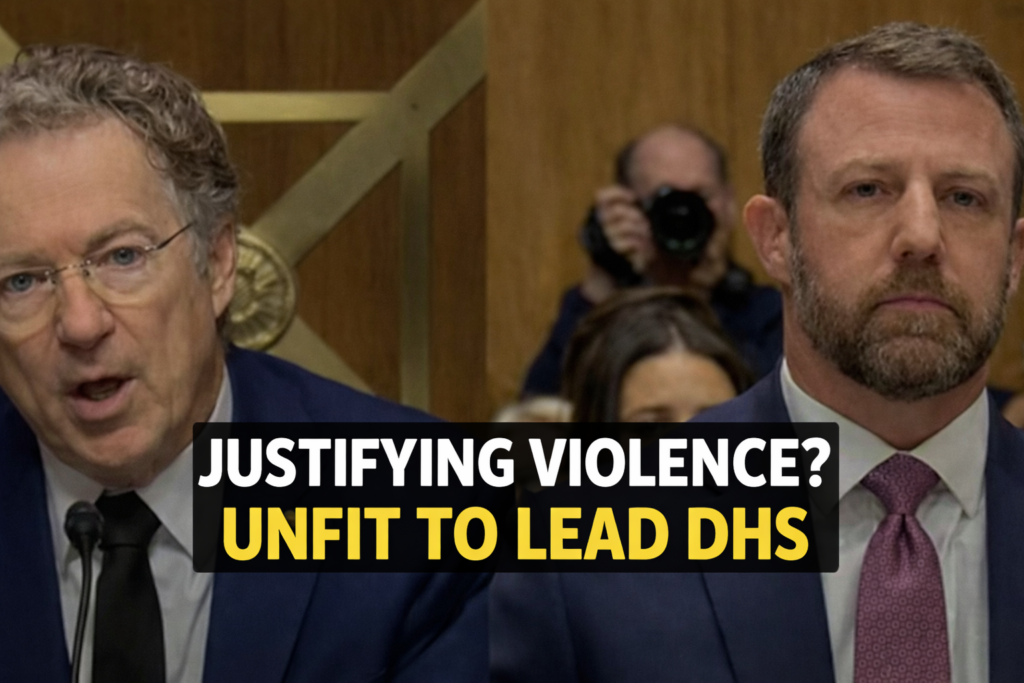
A heated Senate clash reveals troubling acceptance of political violence by DHS nominee Markwayne Mullin. Rand Paul raised urgent concerns about his leadership and accountability.
Rand Paul Slams DHS Nominee Markwayne

Watch Politics Done Right T.V. here.

Podcasts (Video — Audio)
Summary
A Republican confrontation exposes something deeper than partisan conflict—it reveals a normalization of political violence that should alarm every American.
In a tense Senate hearing, Senator Rand Paul forcefully challenged the nominee for leadership at the Department of Homeland Security, Senator Markwayne Mullin, calling out statements that appeared to justify violence against political opponents. The exchange did not merely highlight personal grievance; it exposed a dangerous erosion of democratic norms, in which rhetoric increasingly excuses harm rather than condemns it. The moment underscored a broader crisis: when those seeking to lead institutions tasked with enforcing law and order display tolerance for violence, the integrity of those institutions—and the safety of the public—comes into question.
- A DHS nominee faced sharp criticism for appearing to justify violence against a fellow senator.
- The confrontation highlighted the real, physical consequences of political rhetoric and incitement.
- Concerns were raised about whether someone tolerant of violence can lead agencies like ICE and Border Patrol.
- The incident reflects a broader pattern of aggressive behavior and the normalization of intimidation in politics.
- It reinforces the need for leaders to explicitly reject violence and model democratic accountability.
This moment serves as a warning. A democracy cannot survive when violence becomes acceptable discourse among its leaders. The responsibility now falls on the public to demand better—to insist on leadership grounded in accountability, empathy, and respect for human life rather than intimidation and force.
Premium Content (Complimentary)
One does not need to agree with a politician’s ideology to recognize when a line has been crossed. In this case, that line was not merely approached—it was trampled. What unfolded in that Senate hearing was not simply political theater; it was a revealing snapshot of a system where the boundaries of acceptable behavior continue to erode under the weight of power, partisanship, and a growing tolerance for violence.
The confrontation centered on Senator Markwayne Mullin, the nominee for the Department of Homeland Security, an agency responsible for overseeing immigration enforcement, border security, and national safety. That responsibility carries immense weight. It requires leadership grounded in restraint and discipline, and in a clear moral rejection of violence except under the strictest legal and ethical standards. Yet, what emerged instead was a troubling record of rhetoric that appeared to excuse, or at least rationalize, violence against a political opponent.
Senator Rand Paul’s response was not merely emotional—it was deeply human. He recounted, in painful detail, a violent assault that left him hospitalized with broken ribs and a damaged lung. This was not abstract policy debate; it was lived experience. And when that experience is met not with empathy but with dismissal or justification, it reveals something fundamentally broken in political culture.
Political violence in the United States is not hypothetical. The attempted assassination of Representative Gabby Giffords, the shooting at a congressional baseball practice that nearly killed Representative Steve Scalise, and numerous other incidents demonstrate a clear pattern: rhetoric matters. Words shape perception, and perception shapes action. When leaders suggest that violence is understandable—or worse, justified—they create an environment where such acts become more likely.
Inflammatory political rhetoric correlates with increased threats and acts of violence. There has been a rise in political violence and threats in recent years, particularly in highly polarized environments. This is not a coincidence; it is a consequence.
What makes this moment particularly dangerous is the institutional context. The Department of Homeland Security is not a symbolic entity—it is a powerful enforcement apparatus with more than 250,000 employees. Its agents operate with significant authority, often in high-stress situations that require careful judgment. Leadership sets the tone. If that leadership signals that aggression, intimidation, or retaliation are acceptable responses, it risks cascading effects throughout the agency.
This is not merely about one nominee or one hearing. It is about a broader pattern in which individuals who display aggressive or even violent tendencies are elevated to positions of power. It reflects a political ecosystem that increasingly rewards confrontation over collaboration, dominance over dialogue.
Compounding the problem is the role of corporate media. Too often, these incidents are treated as isolated spectacles rather than symptoms of systemic decay. The focus shifts to personalities, soundbites, and partisan framing, rather than the underlying issue: the normalization of violence in political discourse. When media outlets fail to connect these dots, they contribute to public desensitization.
Independent media, by contrast, plays a critical role in challenging this normalization. It has the capacity to contextualize events, to draw connections, and to hold power accountable without the constraints of corporate interests. In a democracy, that function is not optional—it is essential.
Ultimately, the question is not whether one agrees with any particular senator or nominee. The question is whether the country is willing to accept a political culture where violence is excused, minimized, or weaponized. If the answer is yes, then the consequences will not remain confined to hearing rooms or campaign rallies. They will manifest in communities, in institutions, and in the daily lives of citizens.
Democracy demands more. It demands leaders who understand that power carries responsibility—not just to govern, but to set a moral example. It demands a public that refuses to normalize the unacceptable. And it demands vigilance, because once the line between rhetoric and violence is blurred, restoring it becomes exponentially more difficult.
The path forward is clear, even if it is not easy. Reject the normalization of violence. Demand accountability from those who seek power. Support independent voices that prioritize truth over spectacle. And most importantly, recognize that democracy is not self-sustaining—it requires active participation to survive.