


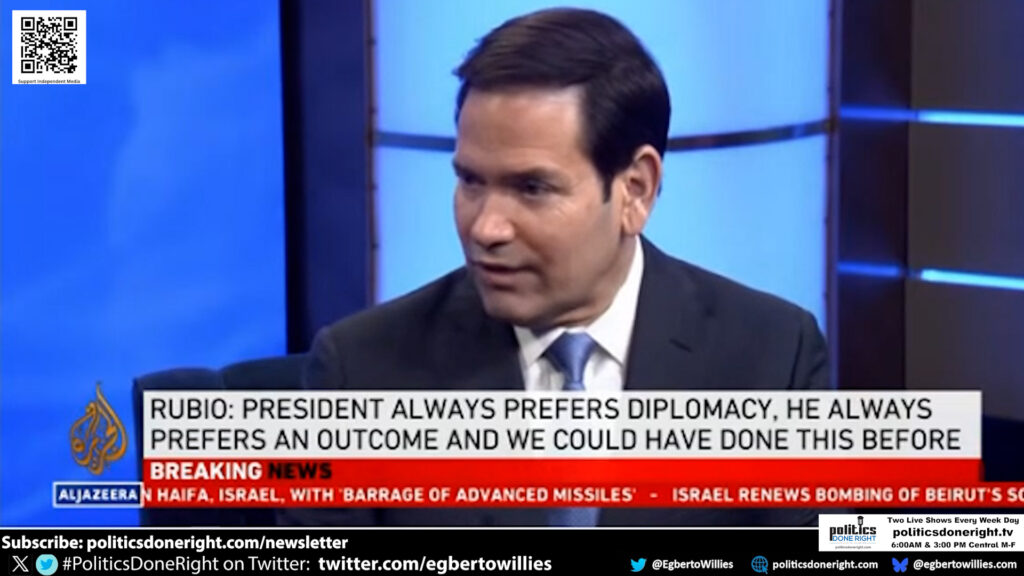
Rubio says Iran should invest in its people, but U.S. military spending vs healthcare reveals deep hypocrisy and misplaced moral authority.
Rubio Tells Iran to Invest in People

Watch Politics Done Right T.V. here.

Podcasts (Video — Audio)
Summary
The commentary exposes a glaring contradiction: U.S. leaders demand that Iran invest in its people instead of weapons, while the United States itself prioritizes military spending over social well-being. The critique reveals a deeper pattern of projection, hypocrisy, and misplaced moral authority.
- Rubio argues Iran should redirect military spending toward domestic welfare and economic opportunity
- The U.S., however, spends more on its military than the next several countries combined, while underinvesting in healthcare and social programs
- The claim that Iran would irrationally use nuclear weapons ignores geopolitical realities and basic self-preservation logic
- The United States remains the only country to have used nuclear weapons in war, undermining its moral authority
- The rhetoric reflects projection—accusing others of behaviors historically demonstrated by the U.S. government
This argument dismantles the illusion of American exceptionalism. It calls for introspection: a nation that lectures others must first reconcile its own priorities. True leadership demands consistency, not selective morality.
Premium Content (Complimentary)
The commentary cuts through the noise of geopolitical theater and exposes a truth many prefer to ignore: the United States often projects its own failures onto its adversaries. When Marco Rubio argues that Iran should invest in its people instead of weapons, the statement initially sounds reasonable. But when placed against the backdrop of U.S. policy, it becomes an indictment of American hypocrisy.
The United States spends more than $800 billion annually on its military—far exceeding any other nation. Some estimates, when including broader defense-related expenditures, push that figure closer to or beyond $1 trillion. Meanwhile, millions of Americans struggle with inadequate healthcare, unaffordable housing, and insufficient social safety nets.
So when U.S. officials suggest that another nation should redirect its resources toward its people, the critique lands with a thud. It reveals not leadership, but contradiction. The argument does not fail because investing in people is wrong—it fails because the messenger refuses to apply that same standard domestically.
The rhetoric surrounding nuclear weapons deepens the contradiction. The claim that Iran cannot be trusted with nuclear capability rests on the assumption that it would behave irrationally or aggressively. Yet history tells a different story. The United States remains the only country to have used nuclear weapons against civilian populations, in Hiroshima and Nagasaki. This fact alone complicates any assertion of moral superiority. The idea that Iran would deploy such weapons in a way that ensures its own devastation defies both strategic logic and historical precedent.
The commentary correctly identifies this as a projection. Projection occurs when a nation attributes its own tendencies or history to others. In this case, the United States assumes that because it has demonstrated a willingness to use overwhelming force—including nuclear weapons—it must prevent others from acquiring similar capabilities. While nonproliferation is a legitimate global goal, it becomes problematic when enforced selectively and without self-reflection.
Moreover, the broader critique touches on how narratives are constructed for public consumption. Political messaging often relies on simplifying complex geopolitical realities into moral binaries: good versus evil, responsible versus reckless. But these narratives obscure the structural forces at play—economic interests, military-industrial incentives, and political power dynamics. When leaders present adversaries as irrational threats, it becomes easier to justify aggressive policies while avoiding scrutiny of domestic shortcomings.
The commentary challenges that framing. It invites the audience to question why a nation with vast resources continues to prioritize military dominance over human development. It asks why healthcare remains a privilege rather than a right, why infrastructure lags, and why economic inequality persists in the wealthiest country on Earth.
Ultimately, this is not a defense of Iran’s government or its policies. It is a demand for intellectual honesty. If the United States wants to lead, it must do so by example—not by issuing prescriptions it refuses to follow. Leadership requires consistency, accountability, and a willingness to confront uncomfortable truths.
The critique lands because it reframes the conversation. It shifts the focus from what “they” should do to what “we” must address. It exposes how easy it is to externalize problems rather than confront them internally.
And that is the real takeaway: before a nation lectures others about investing in its people, it must prove that it values its own.