


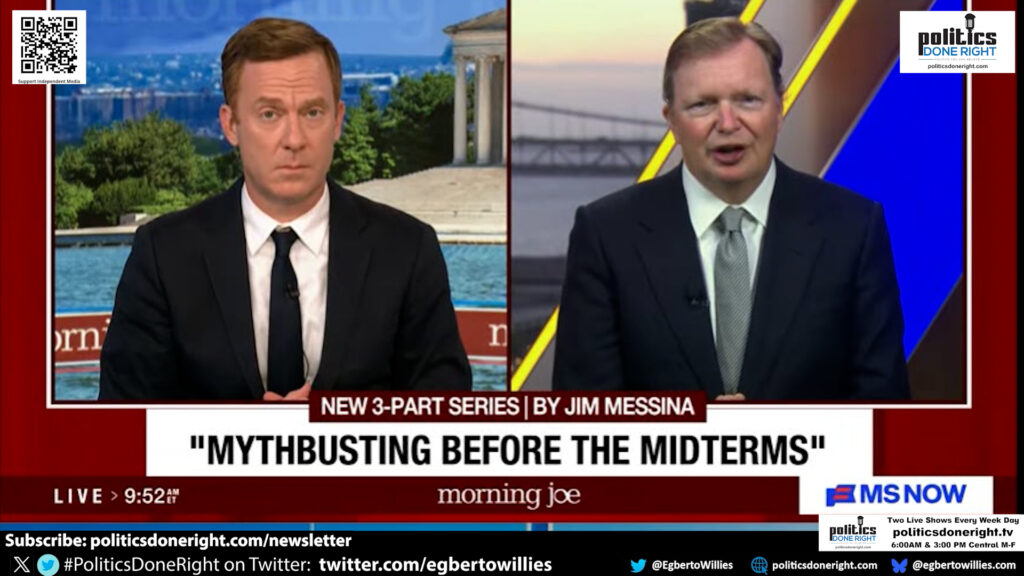
Jim Messina offers Democrats advice—but ignores how dismantling Obama’s grassroots machine weakened the party’s ability to persuade and win voters.
Jim Messina vs Grassroots

Watch Politics Done Right T.V. here.

Podcasts (Video — Audio)
Summary
A familiar Democratic strategist resurfaces with advice—but the record tells a different story.
- Jim Messina helped lead Barack Obama’s campaigns but later transformed the grassroots engine into a top-down operation.
- Obama for America functioned as a massive persuasion machine that exceeded even the Tea Party’s reach.
- Media bias amplified conservative movements while minimizing progressive mobilization on the ground.
- Messina now argues Democrats must focus on persuasion and messaging balance—but ignores how his own changes weakened that capacity.
- The real issue is not tactical tweaks; it is the abandonment of grassroots organizing in favor of consultant-driven politics.
Democrats do not suffer from a lack of strategy—they suffer from a lack of courage to trust people over elites. Winning requires rebuilding authentic grassroots power, not recycling insider advice that helped dismantle it.
Premium Content (Complimentary)
The political class has a habit of rewriting history, and nowhere is that more evident than when former insiders return to offer “lessons learned.” Jim Messina’s reemergence as a Democratic strategist dispensing advice exposes a deeper problem within the party: a refusal to confront how its own leadership hollowed out one of the most powerful grassroots movements in modern political history.
Messina played a central role in Barack Obama’s campaigns, and during that period, something remarkable happened. Obama for America became not just a campaign apparatus, but a persuasion machine—one that reached across ideological lines and mobilized millions. It did not simply turn out voters; it changed minds. Republicans openly declared their support for Obama. Communities that had long felt disconnected from politics suddenly saw themselves as participants.
That model worked because it centered people. It trusted them. It empowered them.
Then Washington absorbed it.
Obama for America morphed into Organizing for America, losing its grassroots energy and becoming another institutional extension of the Democratic establishment. The shift may have preserved short-term electoral success—Obama won reelection in 2012—but it undermined the movement’s long-term sustainability. By 2016, the infrastructure that once energized millions had been reduced to a shadow of itself.
Messina’s current critique—that Democrats need to focus on persuasion and diversify media outreach—is not entirely wrong. But it misses the structural issue. The Democratic Party did not stop persuading voters because it misunderstood tactics. It stopped persuading voters because it abandoned the very grassroots networks that made persuasion possible.
Instead, the party leaned into consultants, high-dollar donors, and top-down messaging. Campaigns became transactional rather than relational. Voters became data points rather than participants.
The consequences are visible everywhere. Turnout strategies fail to inspire. Messaging feels disconnected. And voters—especially those struggling economically—sense that the party no longer speaks with them, but at them.
Research consistently shows that cost-of-living concerns dominate voter priorities. Yet addressing those concerns requires more than repeating “inflation” in campaign ads. It requires building trust through sustained engagement—something only grassroots organizing can achieve. Not once did I hear Messina mention Zohran Mamdani, the recently elected New York mayor, who gave a clinic on what the Democratic Party needs to win even in areas where they normally wouldn’t. He overcame all headwinds from both the Republican and Democratic parties.
Messina’s framework remains rooted in a neoliberal mindset that prioritizes optimization over transformation. It assumes the system works if only campaigns run more efficiently. But voters increasingly reject that premise. They do not want better messaging about a broken system; they want a system that works for them.
The lesson is clear. The Democratic Party does not need to “moderate” its message or chase mythical swing voters with diluted policies. It needs to reconnect with people on the ground—workers, communities, and movements that already understand what is at stake.
That means investing in organizers, not consultants. It means building year-round infrastructure, not election-cycle operations. It means trusting that when people feel heard and empowered, they will not only vote—they will persuade others.
Movements like Occupy and contemporary grassroots uprisings demonstrate this potential. When people organize at scale, media narratives struggle to contain them. The problem is not that progressive movements lack energy; it is that institutional politics often fails to harness it.
The future of Democratic success will not come from recycled strategies packaged by insiders and elitist consultants who do not have any understanding of the working class. It will come from rediscovering what made Obama’s initial movement powerful: authenticity, participation, and a willingness to challenge entrenched power.
Anything less is not strategy—it is repetition of failure.