


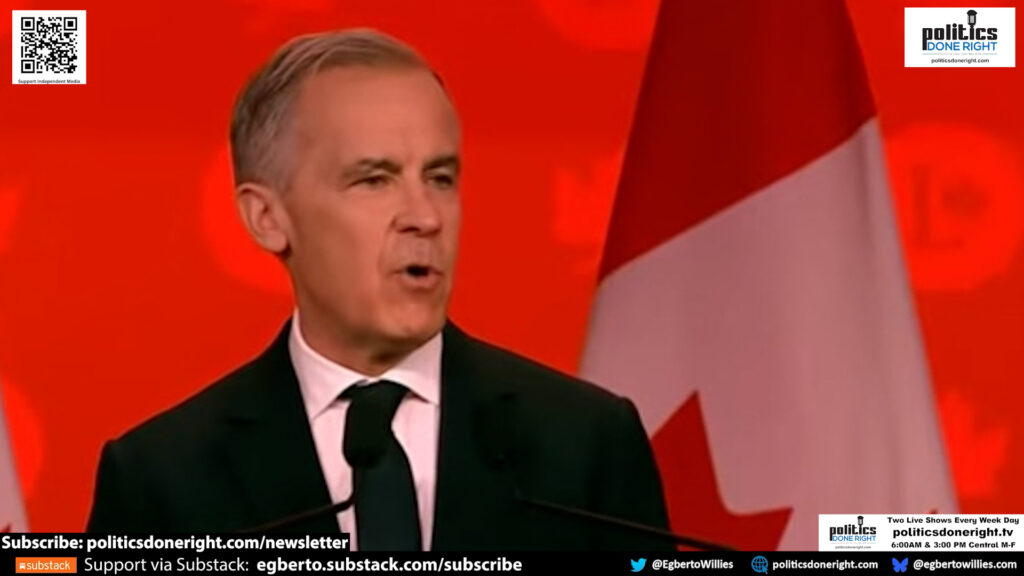
Mark Carney calls out Trump as Canadians boycott U.S. goods and travel, boosting Liberal power and signaling global pushback against destabilizing leadership.
Carney Roasts Trump

Watch Politics Done Right T.V. here.

Podcasts (Video — Audio)
Summary
A global rebuke exposes what many in the United States refuse to say out loud. In a striking moment Canada just delivered a lesson in leadership—and in consequences. In a defining moment, Mark Carney stood firm, mocked Donald Trump without hesitation, and rallied Canadians around unity and economic self-determination as the Liberal Party of Canada secured parliamentary control.
- Carney rejected “politics as usual” and framed the moment as a national turning point.
- Canadians responded with grassroots economic resistance—boycotting U.S. goods and travel.
- The Liberal Party capitalized on that unity to consolidate power in parliament.
- Carney demonstrated that strength—not appeasement—is the only effective response to authoritarian behavior.
- The shift signals global consequences for U.S. leadership failures, as allies act independently.
Canada’s response exposes a stark truth: when leadership in the United States falters, the world does not wait—it adapts, resists, and moves on. The moment demands accountability at home and clarity abroad.
Premium Content (Complimentary)
Canada’s political shift under Mark Carney represents more than a domestic electoral outcome; it signals a global recalibration of power, trust, and democratic resilience. In a moment defined by rising authoritarian tendencies and erratic governance south of the border, Canada chose clarity, unity, and strategic resistance. That choice reverberates far beyond its borders.
Carney did not mince words. He understood that confronting Donald Trump required more than diplomatic niceties—it required moral clarity and political courage. By openly mocking Trump and exposing his weaknesses, Carney demonstrated something increasingly rare in global politics: a willingness to call out destabilizing leadership without fear. That posture did not weaken Canada; it strengthened it.
Political science research, including work from institutions like the Brookings Institution, has long shown that democracies function best when leaders reinforce norms rather than erode them. Trump’s presidency, marked by attacks on institutions and alliances, disrupted those norms. Carney’s response represents a corrective—a reassertion that democratic leadership must be grounded in accountability and collective strength.
What makes Canada’s reaction particularly powerful is that it did not stop at rhetoric. It translated into action. Citizens made deliberate economic choices: choosing Canadian wine over Californian, domestic travel over Florida vacations. These were not isolated gestures; they were coordinated acts of civic resistance. Economists often refer to this as “consumer sovereignty,” where individuals use market behavior to express political will. The Economic Policy Institute has highlighted how consumer behavior can influence broader economic and political outcomes, especially in interconnected economies.
Canada leveraged that principle effectively. By reducing dependence on U.S. goods and tourism, Canadians exercised economic pressure—quietly but decisively. That pressure carries real consequences. States that rely on Canadian tourism and trade feel the impact immediately. It becomes a feedback loop: political decisions in Washington produce economic consequences in American communities.
Carney recognized this leverage and articulated it clearly. He framed Canada not as a passive neighbor but as an active agent shaping its destiny. “We are the masters of our destiny,” he declared—a line that encapsulates both national pride and strategic intent.
This moment also exposes a deeper issue within the United States. While foreign leaders confront Trump directly, many domestic political actors remain hesitant. That hesitation reflects structural and cultural challenges—polarization, media fragmentation, and entrenched power dynamics. Yet, as Canada demonstrates, collective action remains possible when leadership aligns with public sentiment.
The implications extend globally. Allies watch closely. When the United States undermines democratic norms, it weakens its own influence. Countries like Canada fill that vacuum—not by seeking dominance, but by asserting independence. The result is a more multipolar democratic landscape, where leadership is earned through consistency and credibility rather than assumed.
There is also a moral dimension that cannot be ignored. The frustration is that foreign leaders must speak truths that many Americans avoid. That frustration reflects a broader crisis of accountability. When citizens tolerate behavior that contradicts democratic values, they invite external correction—whether through economic pressure, diplomatic isolation, or reputational decline.
Carney’s approach offers a blueprint. He combined rhetoric with action, unity with strategy, and national pride with global awareness. He did not simply oppose Trump; he mobilized a country to respond collectively. That is leadership.
Ultimately, Canada’s stance underscores a simple but powerful reality: democracy is not self-sustaining. It requires vigilance, courage, and participation. When those elements align, even a middle power can reshape the conversation—and force larger nations to confront their own contradictions.