


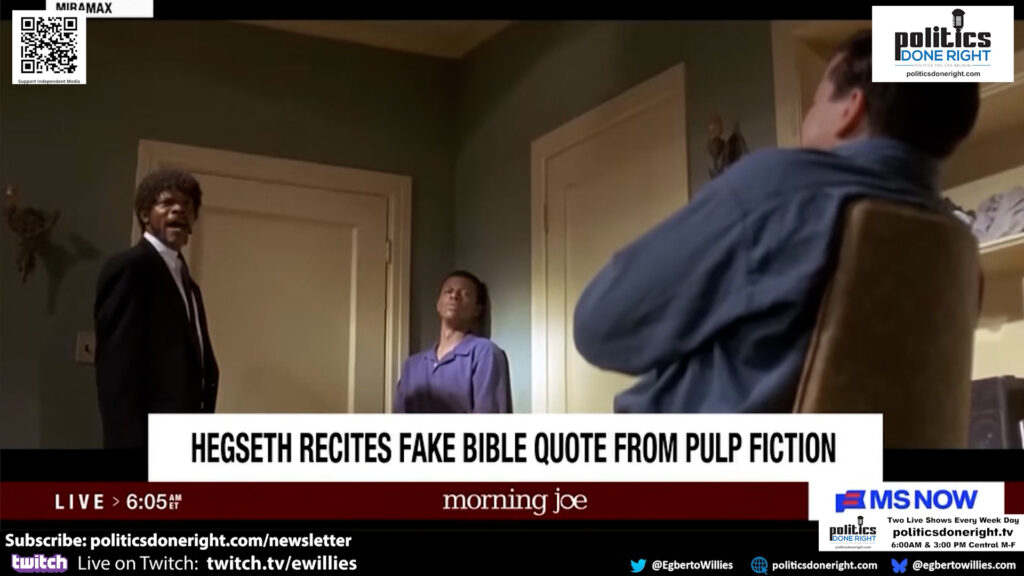
A Pentagon prayer turns surreal as Pete Hegseth quotes Pulp Fiction as scripture. This moment reveals deeper concerns about leadership, war rhetoric, and political theater.
Hegseth’s Pulp Fiction Bible Blunder

Watch Politics Done Right T.V. here.

Podcasts (Video — Audio)
Summary
A revealing moment exposes a deeper problem: performative seriousness masking real incompetence. The segment dissects how Pete Hegseth attempted to invoke scripture but instead quoted a stylized monologue from Pulp Fiction, originally delivered by Samuel L. Jackson in a scene crafted by Quentin Tarantino.
- The defense official recited a Hollywood script while presenting it as biblical authority.
- The quote—often mistaken for a Bible verse, Ezekiel 25:17—is largely fictional.
- The moment occurred during a Pentagon prayer, amplifying concerns about judgment and credibility.
- The broader critique links this unseriousness to reckless military posturing and war rhetoric.
This episode is not just embarrassing; it signals a dangerous erosion of seriousness in matters of war and peace. When leadership substitutes theatrics for substance, the public must question not only competence but the underlying values driving policy.g structural survival first, then returning to ideological battles once stability is restored.
Premium Content (Complimentary)
The video lays bare a troubling truth about modern governance: the fusion of spectacle and statecraft has reached a point where even the most serious institutions risk becoming caricatures of themselves. When a high-ranking defense official like Pete Hegseth stands before a Pentagon prayer service and delivers what he presents as scripture—only for it to be revealed as a cinematic monologue from Pulp Fiction—the issue extends far beyond a simple mistake. It becomes a metaphor for a governing philosophy that confuses performance with competence.
The quote in question, widely associated with Ezekiel 25:17, is not an accurate rendering of the biblical text. Instead, it is a stylized reinterpretation popularized by Samuel L. Jackson’s character, written by Quentin Tarantino. The actual biblical verse is brief and far less dramatic. The importance of context and accuracy in scriptural references, especially when used in public or political discourse, should not be discounted. Misusing such texts does more than distort religion—it undermines trust in leadership.
This moment would be laughable if it were not so consequential. The Pentagon is not a stage, and national security is not a screenplay. Yet the incident fits into a broader pattern where political actors increasingly rely on symbolism, emotional manipulation, and pop culture references to project strength. The danger lies in how this approach masks a lack of substantive policy or strategic clarity.
Public trust in government declines when leaders appear uninformed or disengaged from reality. Similarly, growing skepticism about leadership competence, particularly in matters involving war and foreign policy. These trends are not abstract—they directly affect democratic stability. While Hegseth uses the Bible to complement his lethality narrative, in reality, the administration was forced to surrender tactically. We must note that Trump has implicitly ceded control of the Strait of Hormuz to Iran. He has empowered Iran.
Even more concerning is how this unseriousness intersects with militarism. Military actions are increasingly framed like video games or cinematic experiences, reducing complex geopolitical conflicts to digestible, emotionally charged narratives. This kind of framing desensitizes the public to the real human and economic costs of war. When bombs and missiles become part of a spectacle, accountability diminishes.
The progressive critique here is straightforward: governance demands rigor, empathy, and intellectual honesty. It requires leaders who understand the gravity of their decisions and respect the institutions they represent. When officials blur the line between fiction and reality, they not only embarrass themselves—they erode the very foundations of democratic accountability.
This moment also reflects a broader cultural issue. The rise of infotainment has conditioned audiences to expect politics to entertain rather than inform. Politicians, in turn, adapt by prioritizing viral moments over substantive engagement. But national security is not a viral clip. It is a domain where errors carry irreversible consequences.
Ultimately, this incident should serve as a wake-up call. It challenges the public to demand more from those in power—to insist on competence over charisma, substance over spectacle. Democracy depends on an informed and engaged citizenry willing to hold leaders accountable, especially when those leaders reveal, through moments like this, just how unprepared they may be for the responsibilities they hold.