


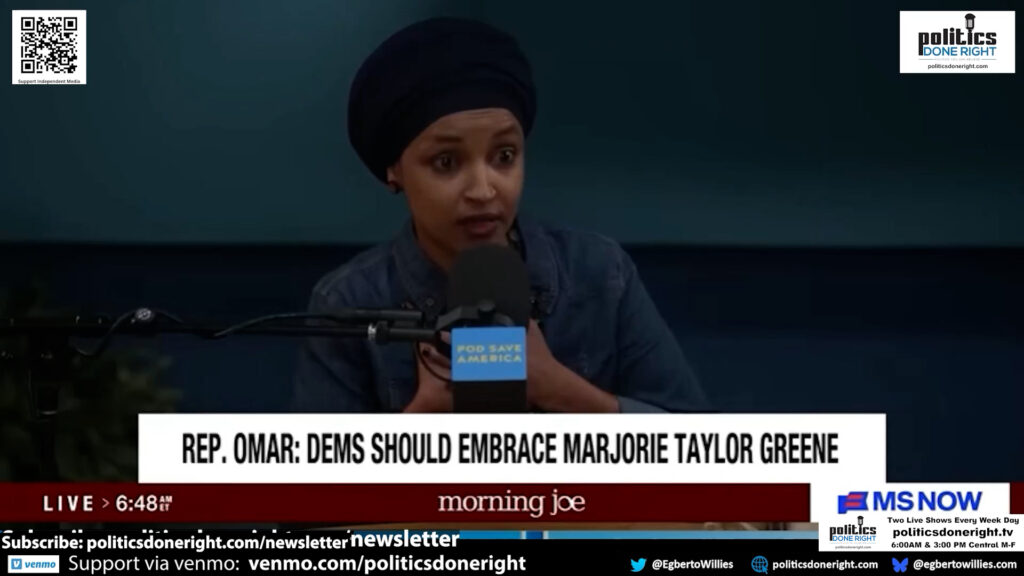
Ilhan Omar calls for Democrats to engage MAGA defectors like MTG to confront Trump. Is coalition-building the key to protecting democracy?
Ilhan Omar & MTG

Watch Politics Done Right T.V. here.

Podcasts (Video — Audio)
Summary
A surprising but strategic political opening emerges. The commentary examines a provocative argument: that Democrats should pragmatically engage defectors from MAGA politics, even figures as polarizing as Marjorie Taylor Greene, if they break with Donald Trump and acknowledge the broader danger he poses.
- Ilhan Omar suggests giving political “space” to former allies who now reject Trump’s influence.
- The argument does not claim ideological alignment but emphasizes coalition-building against an existential threat.
- The commentary frames Trump as destabilizing democratic norms and institutions.
- It highlights the importance of political “atonement” for former supporters who publicly break away.
- It argues progressives already win on economic policy but lose when debates shift to cultural wedge issues.
This perspective insists that defeating authoritarian tendencies requires tactical alliances, even with unlikely partners. It argues that democracy demands maturity—prioritizing structural survival first, then returning to ideological battles once stability is restored.
Premium Content (Complimentary)
The political moment demands clarity, courage, and—perhaps most controversially—strategic flexibility. When Ilhan Omar suggests that Democrats should embrace defectors from the MAGA movement, including figures like Marjorie Taylor Greene, she is not being naïve. She articulates a hard political truth: coalitions win power, and power determines whether democracy survives long enough for ideological debates to matter.
The commentary makes this case forcefully. It frames Donald Trump not merely as a political opponent but as an existential threat to democratic governance. Democratic erosion often accelerates when political actors normalize anti-democratic behavior. When individuals inside a movement begin to break ranks and acknowledge that danger, ignoring them becomes a strategic mistake.
Political history reinforces this point. Major democratic shifts—from civil rights legislation to anti-war coalitions—required uneasy alliances. The idea that progressives must work only with ideological allies ignores how power actually functions. If a former Trump ally publicly rejects authoritarian behavior, that act carries influence within constituencies progressives often cannot reach. The commentary recognizes this reality and demands that Democrats do the same.
Importantly, the argument does not absolve past behavior. It calls for “atonement,” a recognition that those who enabled harmful policies must acknowledge their role. Voters respond to perceived authenticity and accountability. When former allies admit error, they create an opening for broader persuasion. Closing that door out of ideological purity weakens the larger democratic project.
Persistent progressive challenge: Messaging. The commentary argues that progressives already dominate on economic issues, with policies such as raising wages, expanding healthcare, and strengthening labor rights consistently finding majority support. Yet those issues often lose salience when political discourse shifts to cultural flashpoints.
This dynamic reflects a deliberate strategy. Conservative political operatives frequently elevate divisive social issues to fragment working-class coalitions. By contrast, economic policies tend to unify broad segments of the population. The commentary insists that progressives must refuse to let debates center exclusively on wedge issues. That does not mean abandoning marginalized communities; it means integrating those concerns into a broader economic justice framework rather than making them the sole battleground.
The call to engage figures like Greene, therefore, operates on two levels. First, it recognizes the immediate necessity of confronting authoritarian tendencies. Second, it highlights the long-term need to reshape political discourse around material conditions that affect most Americans. These goals do not contradict each other; they reinforce one another.
Critics will argue that engaging former MAGA figures risks legitimizing harmful ideologies. That concern carries weight. But the commentary counters that refusing engagement does not weaken those ideologies—it isolates progressives from the very voters they must persuade. Democracy does not function as a purity contest. It functions as a negotiation among competing interests, where outcomes depend on coalition size and strategic alignment.
The deeper lesson here is about political maturity. A functioning democracy requires the ability to distinguish between immediate threats and long-term disagreements. If authoritarianism gains ground, debates over healthcare, wages, and climate policy become secondary to the survival of democratic institutions themselves. By contrast, once those institutions remain intact, ideological battles can proceed within a stable framework.
In that sense, Omar’s argument reflects a broader progressive tradition—one that prioritizes structural change while remaining flexible in tactics. It acknowledges that politics often involves working with imperfect allies to achieve necessary outcomes. That reality may feel uncomfortable, but discomfort does not negate its necessity.
Ultimately, the commentary challenges progressives to think beyond reflexive opposition. It urges them to recognize opportunity in unexpected places and to build the broadest possible coalition against forces that threaten democratic stability. That approach does not dilute progressive values; it protects the conditions under which those values can be realized.