


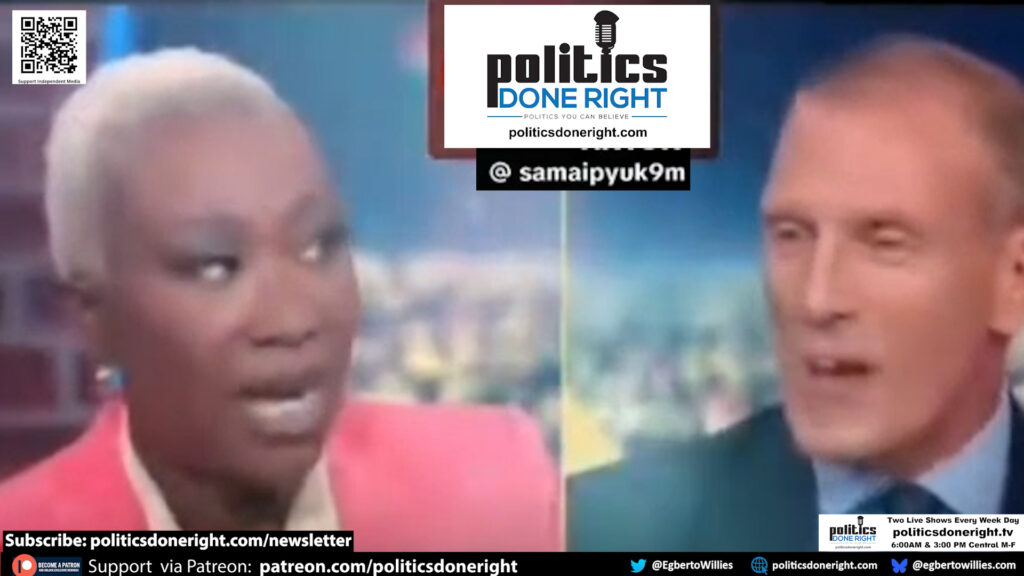
Joy-Ann Reid dismantles GOP Iran war talking points, exposing U.S. intervention, oil politics, and nuclear myths with facts and history.
Iran War Myths Crushed

Watch Politics Done Right T.V. here.

Podcasts (Video — Audio)
Summary
A sharp dismantling of convenient myths exposes how power, not principle, drives U.S. foreign policy.
The commentary highlights how Joy-Ann Reid forcefully challenged shallow narratives about Iran, replacing them with historical context and accountability that pundits often avoid.
- The Iran hostage crisis and anti-U.S. sentiment did not emerge in a vacuum but from the U.S.-backed overthrow of a democratically elected Iranian leader.
- U.S. foreign policy has long been shaped by economic interests, particularly control over oil resources, rather than democratic ideals.
- Claims that Iran is perpetually “weeks away” from nuclear weapons have persisted for decades without materializing, undermining credibility.
- The dismantling of the nuclear agreement under the Trump administration escalated tensions despite Iran’s prior compliance.
- Framing dissent as unpatriotic silences critical thinking and shields powerful interests from scrutiny.
This analysis rejects simplistic patriotism in favor of informed citizenship. It insists that understanding history is not betrayal—it is the foundation of real loyalty to the people, not to power.
Premium Content (Complimentary)
The performance of patriotism often masks a deeper unwillingness to confront uncomfortable truths. In this case, the discussion cuts through decades of propaganda and exposes a pattern that many Americans are rarely encouraged to examine: the role of U.S. intervention in creating the very conflicts it later condemns. The intervention by Joy-Ann Reid represents more than a media moment—it serves as a necessary corrective to a political culture that thrives on selective memory.
The historical foundation matters. In 1953, the United States, alongside British intelligence, orchestrated the overthrow of Iran’s democratically elected Prime Minister, Mohammad Mossadegh. According to the Central Intelligence Agency’s declassified documents, this coup was largely driven by Western oil interests, particularly those tied to British Petroleum. This intervention installed the Shah, whose authoritarian rule—backed by U.S. military and intelligence support—repressed Iranian citizens for decades.
That context alone dismantles the simplistic claim that hostility toward the United States stems from irrational hatred of “freedom.” Research from institutions like the Council on Foreign Relations and the Brookings Institution consistently shows that foreign policy grievances, not abstract ideology, drive much of the resentment toward U.S. actions abroad.
The nuclear issue further exposes the disconnect between rhetoric and reality. The Joint Comprehensive Plan of Action (JCPOA), negotiated under Barack Obama, significantly curtailed Iran’s nuclear program in exchange for sanctions relief. The International Atomic Energy Agency repeatedly verified Iran’s compliance. Yet the agreement was unilaterally abandoned by Donald Trump, despite opposition from global allies and arms control experts.
This decision did not make the world safer. Instead, it removed constraints on Iran’s nuclear activities and escalated tensions in the region. Analysts at the Arms Control Association have argued that abandoning the deal undermined diplomatic credibility and increased the likelihood of conflict.
Equally troubling is the persistence of alarmist narratives. For decades, political figures have claimed that Iran is “weeks away” from acquiring nuclear weapons. Yet assessments from U.S. intelligence agencies, including those summarized by the Office of the Director of National Intelligence, have repeatedly found no evidence that Iran is actively building a nuclear weapon. These exaggerated claims serve a purpose: they justify militarization and distract from policy failures.
What emerges is a pattern of power protecting itself. When critics question these narratives, they are often accused of disloyalty. But this framing reveals more about those wielding it than those resisting it. True patriotism demands accountability. It requires citizens to question whether policies enacted in their name actually serve their interests—or those of entrenched economic and political elites.
Economic analysis supports this critique. The Economic Policy Institute has documented how militarized foreign policy often diverts resources away from domestic priorities like healthcare, education, and infrastructure. Meanwhile, defense contractors and multinational corporations reap enormous profits.
The commentary ultimately reframes the debate. It rejects the false binary of “support the policy or betray the country.” Instead, it asserts that informed dissent strengthens democracy. When citizens understand the historical roots of conflict, they become less susceptible to manipulation and more capable of demanding policies that prioritize peace, diplomacy, and human well-being.
This is not about choosing sides in a geopolitical struggle. It is about choosing truth over myth, accountability over blind allegiance, and people over profit. That is the kind of patriotism that builds a more just and sustainable future.