


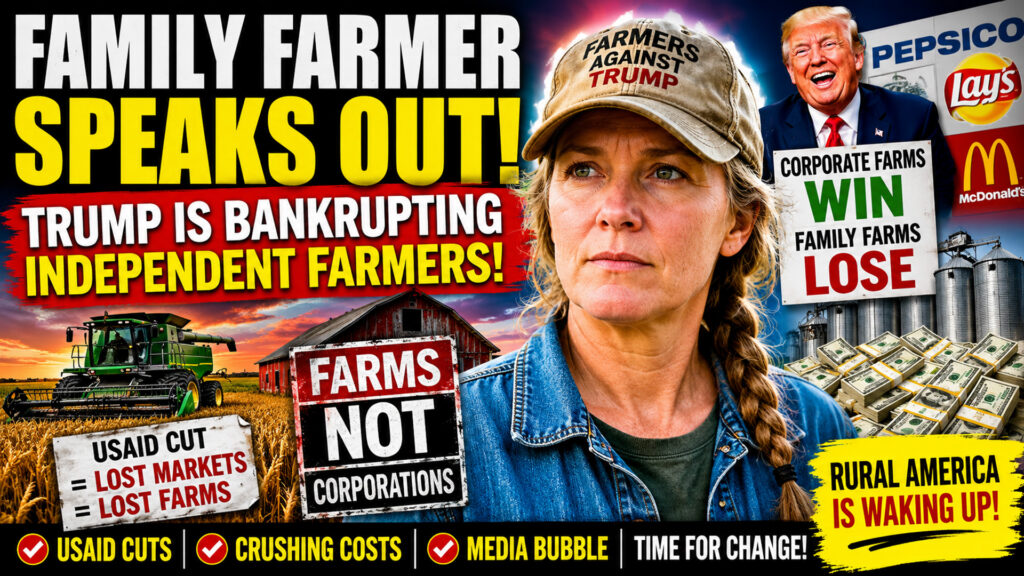
Ann, a North Dakota farmer with 16,000 acres, explains how Trump’s policies and corporate agriculture are driving family farms toward bankruptcy and consolidating power.
Farmer: Trump is bankrupting us

Watch Politics Done Right T.V. here.

Podcasts (Video — Audio)
Summary
A farmer tells the truth. When Ann, a fourth-generation North Dakota farmer who manages 16,000 acres and 900 head of Black Angus cattle, called in to explain what Trump’s policies are doing to real family farms, she shattered the myth that all rural Americans support right-wing politics. Her testimony exposed how the elimination of USAID contracts, soaring fuel and fertilizer prices, and the dominance of corporate agriculture are pushing independent farmers toward bankruptcy. Even more importantly, she revealed how rural communities are trapped in a right-wing information bubble dominated by Fox News and conservative talk radio. Her message was unmistakable: family farmers need free markets, universal healthcare, and representatives who serve ordinary Americans rather than oligarchs and dark-money interests.
- Ann and many family farmers never supported Trump and understood his policies would devastate agriculture.
- USAID contracts provided critical markets for crops; canceling them left farmers with debt and no buyers.
- Corporate farms and politically connected investors benefit while independent farmers face bankruptcy.
- Rural voters often receive information almost exclusively from Fox News and right-wing radio.
- Democrats must organize in rural America and build relationships with working farmers and ranchers.
Ann’s story proves that rural America is not monolithic. Millions of farmers and small-town residents want the same things as urban workers: healthcare, fair markets, honest government, and economic security. The challenge is not ideology—it is communication. When Democrats and progressive movements stop stereotyping rural communities and start listening, they can build a coalition powerful enough to defeat authoritarianism and restore democracy for everyone.
Premium Content (Complimentary)
Family Farmers Are Sounding the Alarm. Democrats Must Listen Before Corporate America Owns It All.
When a fourth-generation North Dakota farmer managing 16,000 acres and 900 head of Black Angus cattle calls into an independent progressive program to plead for Americans not to abandon family farmers, the country should listen.
Ann did not offer partisan spin. She delivered a firsthand account of what happens when public policy serves oligarchs instead of working people.
Her message was devastating.
The farmers being helped by Donald Trump are not independent producers who grow wheat, soybeans, corn, and sunflowers while raising cattle. They are large corporate operations tied to multinational food companies like PepsiCo and McDonald’s. Meanwhile, farmers like Ann—who signed contracts with United States Agency for International Development to provide food abroad—took out loans to plant crops and now face bankruptcy after those contracts were abruptly eliminated.
This is not accidental.
This is how wealth concentrates.
When farmers cannot make loan payments, banks and politically connected investors buy their land at distressed prices. Rural communities hollow out. Ownership consolidates. Local democracy weakens. Working people lose control over the very resources that sustain life.
Ann understands exactly what is happening. She described a future in which independent farmers become contract laborers on land their families once owned. She compared the trajectory to post-Soviet Russia, where oligarchs accumulated vast wealth by acquiring public and private assets during periods of economic dislocation.
That comparison should disturb every American.
Family farmers have historically represented one of the strongest pillars of independent economic power in the United States. They own productive assets, employ local workers, and keep wealth circulating within their communities. When they disappear, democracy itself becomes more fragile.
Ann also revealed a truth that establishment Democrats often ignore: rural voters are not inherently reactionary. Many are trapped in a closed information ecosystem.
Farmers wake up to Fox News during breakfast, spend long hours listening to conservative talk radio in tractors, and return home to more cable propaganda. They do not spend their days on social media. They are working from before sunrise until after sunset.
That means progressive politics cannot depend solely on digital messaging.
People must physically go into rural communities, build trust, share data, and listen.
Ann is already doing this herself. She is talking directly with neighbors who now regret voting for Trump and plan to support Democrats in upcoming elections.
That should have Democratic strategists racing to North Dakota.
Instead, too many consultants in Washington, New York, and Los Angeles continue to rely on demographic assumptions and expensive ad buys while neglecting face-to-face organizing and local and national independent media. Campaigns spend hundreds of millions of dollars on television and digital ads while failing to invest in authentic messengers like Ann.
This is political malpractice.
Her demands are neither radical nor unreasonable.
She wants free markets instead of monopolistic control.
She wants universal healthcare because she and her husband pay roughly $4,000 every month for inadequate insurance without comprehensive dental, vision, or medication coverage.
She wants dark money—including foreign influence and corporate financing—removed from American politics.
She wants younger leaders who understand the future rather than protecting entrenched interests.
In other words, she wants what most working Americans want.
Her story aligns with research from the USDA Economic Research Service, which documents increasing farm consolidation and declining numbers of midsize family farms. Farm Aid has long warned that corporate concentration and unfair markets threaten independent agriculture. The Kaiser Family Foundation consistently shows that healthcare costs remain a severe burden for self-employed Americans, including farmers. The Economic Policy Institute has documented how monopoly power and concentrated wealth undermine workers and communities nationwide.
Ann’s testimony makes clear that the divide in America is not rural versus urban.
It is people versus concentrated power.
Family farmers, factory workers, teachers, nurses, and service employees all confront the same economic system that privatizes gains and socializes losses.
The path forward requires solidarity.
Democrats and progressives must stop treating rural America as a lost cause. They must invest in independent media, grassroots organizers, and trusted local voices who can break through the right-wing echo chamber.
Ann feeds America.
Her family works the land.
Her story deserves national attention.
If the country ignores voices like hers, Wall Street and multinational corporations will own not only the media and the political system, but also the farms that feed the nation.
If Americans listen, they can still build an economy that rewards those who do the work rather than those who manipulate the rules.
That is the fight.
And farmers like Ann are ready to lead it.