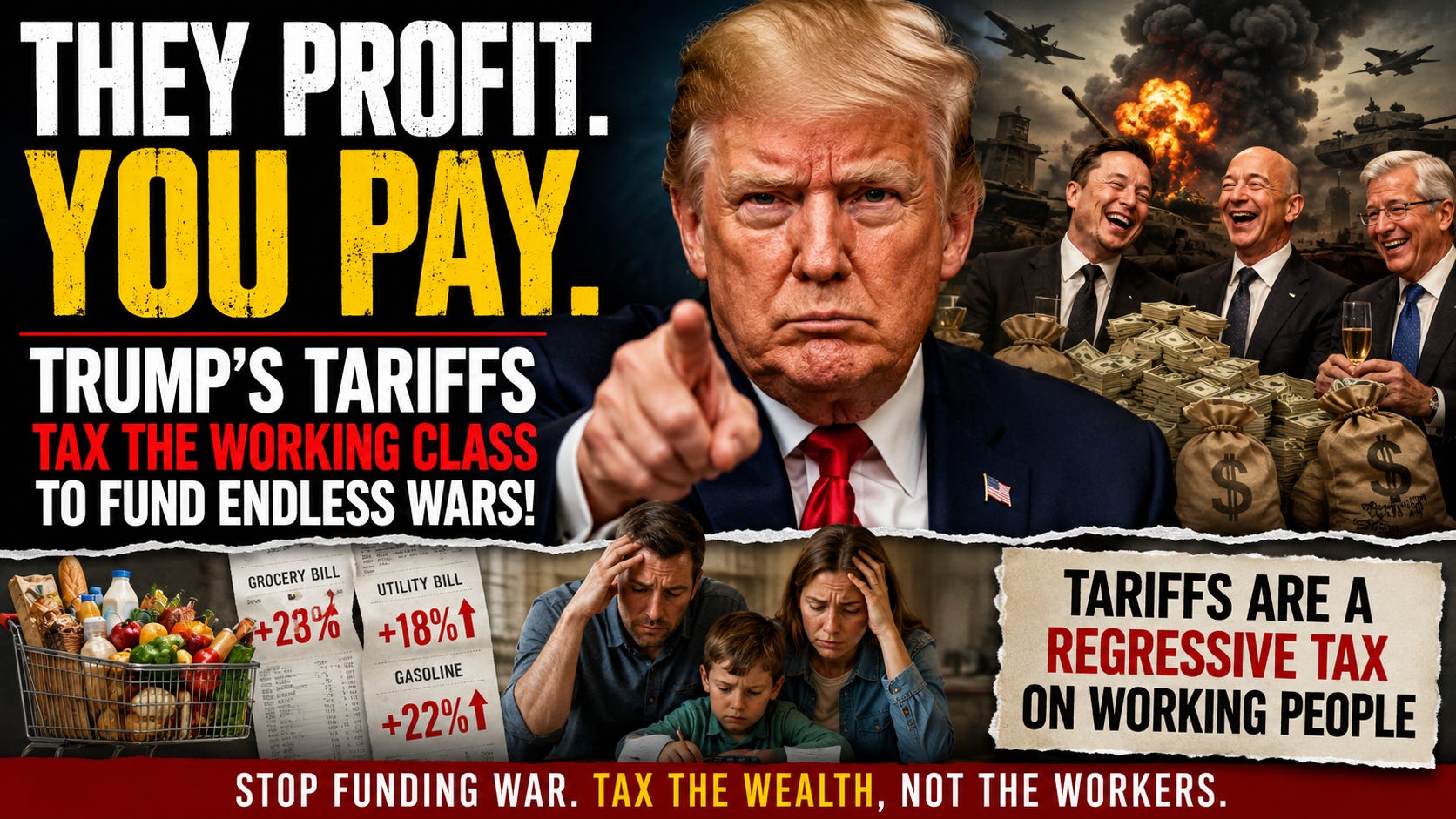
Trump promised tariffs would rebuild manufacturing. Instead, workers face higher prices, lost factory jobs, and a costly Iran war that rewards corporate profiteers.


Summary
Trump sells tariffs as a patriotic tool for rebuilding American manufacturing. Unfortunately, working families experience them as another tax embedded in the price of everyday goods. At the same time, Trump’s widening war with Iran consumes tens of billions of public dollars while enriching weapons manufacturers, oil companies, military contractors, and investors. These policies connect to a broader system that repeatedly uses propaganda, fear, and selective outrage to persuade ordinary people to finance policies that primarily reward the wealthy.
- Tariffs do not charge foreign governments. American importers pay them and commonly pass much of the cost to consumers through higher prices. Current Trump tariffs amount to an estimated average tax increase of roughly $700 per household.
- The promised manufacturing revival has not materialized. By June 2026, the United States had approximately 75,000 fewer manufacturing jobs than when Trump returned to office in January 2025.
-
Trump’s Iran war has become a fiscal sinkhole. The Pentagon estimated that the war had already cost $37.5 billion by July 21, while the administration sought tens of billions more.
-
War-driven energy disruptions punish consumers and reward producers. Escalation pushed oil above $100 per barrel, raising transportation and production costs while creating windfalls for oil and gas interests.
-
The burden falls disproportionately on working people. Lower- and middle-income households spend a larger share of their income on clothing, household supplies, transportation, food, and other tariff-sensitive necessities.
Trump is not making foreign countries pay for his economic and military agenda. He is making American workers pay at the cash register, the gasoline pump, and through the federal budget. A just government would tax war profiteers, restrain military escalation, and invest those resources in healthcare, housing, education, infrastructure, and working-class prosperity.
PLEASE BECOME A PAID SUBSCRIBER TODAY
Countering billionaires—and soon trillionaires—is hard, probing work. They flood the zone with propaganda, policy distortions, and economic fallacies rooted in the Powell Memo and financed by concentrated wealth. We work every day to answer that machinery with truth, context, and critical thinking. But independent media cannot survive on conviction alone. It needs support from people who understand the stakes. Please become a paid subscriber today. Your support keeps this work alive, expands its reach, and helps build a media ecosystem that serves people, not plutocrats. This is not charity. It is an investment in truth, democracy, and the public good.
Premium Content (Complimentary)
Trump’s Tariff Tax Makes Working Americans Finance a Profitable War
Donald Trump wants Americans to believe that tariffs punish foreign countries, rebuild domestic manufacturing, and restore national greatness. That sales pitch collapses under scrutiny. Tariffs operate as taxes collected from American importers, and businesses routinely recover those costs by charging consumers more. Trump has effectively constructed a national sales tax while presenting it as economic nationalism.
The latest estimates place the average household burden from Trump’s 2026 tariffs at roughly $700 annually. That figure does not strike every family equally. A millionaire can absorb higher prices without changing dinner plans, delaying medical care, or falling behind on rent. A working family cannot. When tariffs increase the cost of clothing, electronics, appliances, auto parts, building materials, and household necessities, they consume a larger share of modest incomes. That makes the tariff system fundamentally regressive.
Trump claims that this pain will produce a manufacturing renaissance. The employment numbers tell another story. The United States had approximately 75,000 fewer manufacturing jobs in June 2026 than it had when Trump took office in January 2025. Manufacturing employment also remained below its June 2025 level. Tariffs have increased costs for American factories that depend on imported parts, metals, machinery, and components, undermining some of the very producers Trump claims to protect.
Meanwhile, Trump has plunged the nation deeper into war with Iran. The Pentagon reported that the conflict had already cost $37.5 billion by July 21, 2026. The administration then sought tens of billions more as American forces continued their attacks and depleted expensive weapons stockpiles. Every missile launched represents public money that cannot repair a school, expand a clinic, replace a bridge, or reduce a family’s medical debt.
That sacrifice does not create shared hardship. It creates private profit.
Defense contractors receive new orders to replace missiles, drones, aircraft components, and other weapons. Oil producers benefit when war threatens global supplies and drives crude prices upward. Investors holding the right stocks celebrate while workers confront higher gasoline, utility, shipping, and grocery bills. As the transcript argues, those who profit from war rarely receive the bill for it. Instead, government leaders transfer the cost downward to the population through taxes, inflation, austerity, and reduced public investment.
The Iran conflict pushed oil prices above $100 per barrel as attacks and threats disrupted shipping and heightened fears about the Strait of Hormuz. American drilling companies did not suddenly face equivalent increases in the cost of extracting oil from West Texas. Yet the global price shock allowed producers and refiners to collect more money from consumers. War created the excuse; working people supplied the cash.
It is clear that corporations have pricing power that determines the cost of everything. It does not matter that it does not cost a penny more to produce. This is an unfair and extractive economic system based on the greed of the few.
Tariff revenue does not enter a special account labeled “Iran war.” It flows into the federal government’s general revenues. Still, the broader economic arrangement remains unmistakable: Trump expands military spending while relying more heavily on taxes embedded in consumer prices. He protects the fortunes of wealthy investors and corporations while demanding sacrifice from families already struggling with housing, healthcare, food, and transportation costs. In other words, as corporations get tax breaks, war spoils, and more, the working class pays the bill with their taxes and underpaid labor.
The country should pursue the opposite policy. Congress should impose windfall-profit taxes on corporations exploiting wartime price spikes. It should raise taxes on billionaires, close loopholes used by multinational corporations, and prevent defense contractors from converting permanent war into permanent revenue. It should also reclaim Congress’s constitutional war powers and refuse another open-ended military catastrophe.
America does not lack resources. It suffers from political choices that direct those resources upward. Trump’s tariffs and war policies reveal those choices with brutal clarity: the wealthy profit, the working class pays, and propaganda calls the arrangement patriotism.