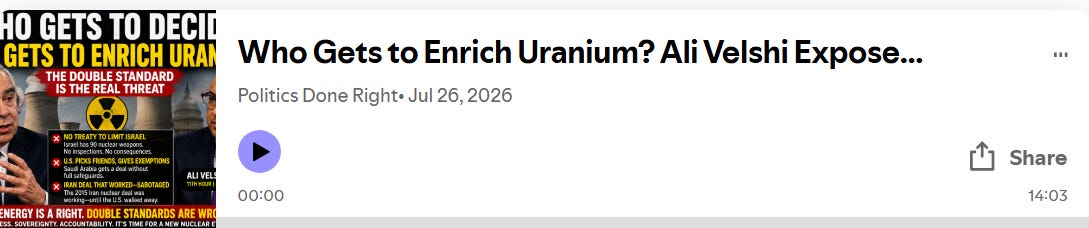
Ali Velshi asks who decides which nations may enrich uranium, exposing Washington’s unequal treatment of Iran, Saudi Arabia and nuclear-armed Israel.


Summary
Ali Velshi’s interview with former Energy Secretary Ernest Moniz exposed the contradiction at the center of global nuclear policy. Moniz explained verification, inspections, and safeguards, but he struggled when Velshi asked the decisive question: Who gets to decide which sovereign countries may enrich uranium? The answer cannot rest on whether Washington considers a government friendly, obedient, or strategically useful. Velshi indirectly challenges a system in which the United States imposes strict rules on adversaries while negotiating exceptions for allies.
- Peaceful nuclear development is an internationally recognized right. Article IV of the Nuclear Non-Proliferation Treaty recognizes the right of participating countries to research, produce, and use nuclear energy for peaceful purposes, provided they comply with their nonproliferation obligations.
- Enrichment presents real dangers, but Washington applies its safeguards selectively. The new U.S.-Saudi nuclear agreement reportedly creates a possible pathway toward domestic enrichment without requiring the same enhanced IAEA inspection system demanded of Iran.
-
The United States weakened its own credibility by abandoning agreements. Washington withdrew from the working Iran nuclear arrangement in 2018 and completed another withdrawal from the Paris Agreement on January 27, 2026. The JCPOA was not a Senate-ratified treaty, but abandoning it still damaged confidence in American commitments.
-
Israel remains the glaring regional exception. Israel does not belong to the NPT and therefore operates under only limited, facility-specific IAEA safeguards. SIPRI estimates that Israel possesses roughly 90 nuclear warheads while maintaining official nuclear ambiguity.
-
Nuclear powers also carry disarmament obligations. Article VI of the NPT requires parties to pursue good-faith negotiations toward ending the nuclear arms race and achieving nuclear disarmament. Nonproliferation cannot remain a permanent system of discipline for weaker states while powerful states modernize their arsenals.
The answer cannot be nuclear proliferation for everyone. It must be one enforceable standard for everyone: sovereign access to peaceful nuclear energy, rigorous international inspections, regional accountability, and serious disarmament by the states that already possess the world’s most destructive weapons.
PLEASE BECOME A PAID SUBSCRIBER TODAY
Countering billionaires—and soon trillionaires—is hard, probing work. They flood the zone with propaganda, policy distortions, and economic fallacies rooted in the Powell Memo and financed by concentrated wealth. We work every day to answer that machinery with truth, context, and critical thinking. But independent media cannot survive on conviction alone. It needs support from people who understand the stakes. Please become a paid subscriber today. Your support keeps this work alive, expands its reach, and helps build a media ecosystem that serves people, not plutocrats. This is not charity. It is an investment in truth, democracy, and the public good.
Premium Content (Complimentary)
Who Gets to Decide Who Enriches Uranium?
Ali Velshi asked the question that shattered the polite language surrounding international nuclear policy: Who gets to decide who gets to enrich uranium?
Former Energy Secretary Ernest Moniz offered technically informed answers about centrifuges, inspections, transparency, and the International Atomic Energy Agency. Those issues matter. Uranium enrichment can supply fuel for civilian reactors, but the same infrastructure can move a nation closer to weapons capability. Any responsible international system must monitor nuclear materials and prevent their diversion into bombs.
Yet Moniz never adequately confronted the political question beneath the technology. The current system does not merely distinguish between safe and unsafe nuclear activity. It frequently distinguishes between Washington’s friends and Washington’s enemies.
Velshi identifies that contradiction clearly. Moniz helped negotiate the 2015 Iran nuclear agreement, which placed extraordinary restrictions and verification requirements on Iran’s program. He acknowledged that limited enrichment could coexist with nonproliferation when paired with intrusive inspections. But Washington later abandoned that agreement, reimposed sanctions, and taught Iran and every other country a dangerous lesson: compliance with an agreement does not guarantee that the United States will continue honoring it. The JCPOA was a political agreement rather than a Senate-ratified treaty, but the diplomatic damage from leaving it remains real.
Now Washington has signed a civil nuclear agreement with Saudi Arabia that reportedly creates a pathway toward domestic enrichment without automatically requiring the IAEA Additional Protocol—the enhanced inspection framework that gives investigators greater access to undeclared locations and information. The Department of Energy promotes the arrangement as an economic and strategic partnership, while arms-control specialists warn that it weakens safeguards previously treated as essential.
That is not principled nonproliferation. It is selective nonproliferation.
Countries that possess uranium should not require America’s ideological permission to build peaceful nuclear industries. Article IV of the Nuclear Non-Proliferation Treaty recognizes participating countries’ right to peaceful nuclear research, production, and use, as long as they honor their nonproliferation commitments. The treaty does not grant an unrestricted license to produce weapons-grade material, but neither does it appoint the United States emperor of the world’s uranium supply.
The international community should establish transparent, universal rules. Every civilian enrichment program should face strong monitoring. Every country should account for nuclear material. Every suspected weapons program should face credible investigation. But those rules must apply equally to Iran, Saudi Arabia, Brazil, Israel, the United States, and every other state.
Israel exposes the hypocrisy most dramatically. Israel remains outside the NPT and maintains nuclear ambiguity, while independent experts estimate that it possesses about 90 nuclear warheads. The IAEA applies only item-specific safeguards to Israel rather than the comprehensive inspection regime required of non-nuclear NPT members. Yet Washington routinely discusses Middle Eastern proliferation as though Israel’s arsenal does not exist.
The United States must also approach this issue with humility. It remains the only country to have used nuclear weapons in war, and American atmospheric testing exposed communities to radioactive fallout. Congressionally requested public-health research documented nationwide exposure from weapons testing and examined its long-term consequences.
The solution is not to encourage every country to build a bomb. That road leads toward catastrophe. The solution is to end nuclear apartheid: one standard for allies, another for enemies, and permanent privileges for existing nuclear powers.
A credible system would guarantee peaceful nuclear access, require robust inspections, confront Israel’s undeclared arsenal, restore dependable diplomacy, and force nuclear-armed states to meet their own Article VI disarmament obligation.
Respect, reciprocity, and enforceable international law will produce more security than imperial commands ever could.