A deadly Syracuse fire and years of violations expose a larger problem: financialized housing can reward revenue growth while tenants struggle for heat, safety, and repairs.


Summary
The story of Syracuse’s Nob Hill Apartments is not merely a tale about a negligent landlord. It exposes what happens when society allows essential human needs to be used as financial instruments. Once investors view homes primarily as assets engineered for returns, rent becomes revenue, maintenance becomes an expense to suppress, and tenants risk becoming little more than entries on a spreadsheet. That is precisely the warning raised in the segment: when financial engineering controls housing, healthcare, and other necessities, human beings cease to occupy the center of the system.
- Nob Hill was purchased in 2018 for $58.5 million by a joint venture involving Sinatra & Co., Windsor Capital Group, and Basalt Capital. The buyers explicitly described it as a “value-add” investment with strong revenue-growth potential.
- Conditions deteriorated dramatically. A February 2026 court decision documented failures involving heat, hot water, sewage, security, elevators, garbage, pests, and other habitability problems.
-
New York Attorney General Letitia James says Nob Hill accumulated 413 city and state code violations from 2019 through 2026, with 69 unresolved as of June 2026.
-
A February 28, 2026 fire killed two tenants and displaced residents. Tenant advocates said malfunctioning smoke detectors and emergency lighting remained concerns after the fire.
-
The same incentive problem appears in privatized healthcare. HHS investigators found Medicare Advantage insurers overturned 95% of appealed skilled-nursing prior-authorization denials, raising concerns that medically necessary care had initially been denied.
Housing should house people. Healthcare should heal people. When Wall Street inserts profit-maximizing intermediaries between citizens and necessities, the system begins to measure success by financial extraction rather than human well-being. Public policy must reverse that priority.
PLEASE BECOME A PAID SUBSCRIBER TODAY
Countering billionaires—and soon trillionaires—is hard, probing work. They flood the zone with propaganda, policy distortions, and economic fallacies rooted in the Powell Memo and financed by concentrated wealth. We work every day to answer that machinery with truth, context, and critical thinking. But independent media cannot survive on conviction alone. It needs support from people who understand the stakes. Please become a paid subscriber today. Your support keeps this work alive, expands its reach, and helps build a media ecosystem that serves people, not plutocrats. This is not charity. It is an investment in truth, democracy, and the public good.
Premium Content (Complimentary)
The catastrophe at Syracuse’s Nob Hill Apartments illustrates a fundamental defect in an economy that increasingly converts necessities into financial instruments. A home should provide shelter, safety, stability, and dignity. But once financiers acquire an apartment complex principally to generate higher returns, the resident can disappear behind the spreadsheet.
That is the central lesson of Nob Hill.
In 2018, a joint venture involving Sinatra & Co. Real Estate, Windsor Capital Group, and Basalt Capital purchased the 761-unit complex for $58.5 million. At the time, Sinatra described Nob Hill as an attractive “value-add investment opportunity” capable of producing “strong revenue growth.”
Those words deserve attention because they reveal the economic lens through which housing can be viewed. Investors see an asset. Residents see a home.
The distinction becomes dangerous when increasing the asset’s financial return conflicts with maintaining the human beings living inside it.
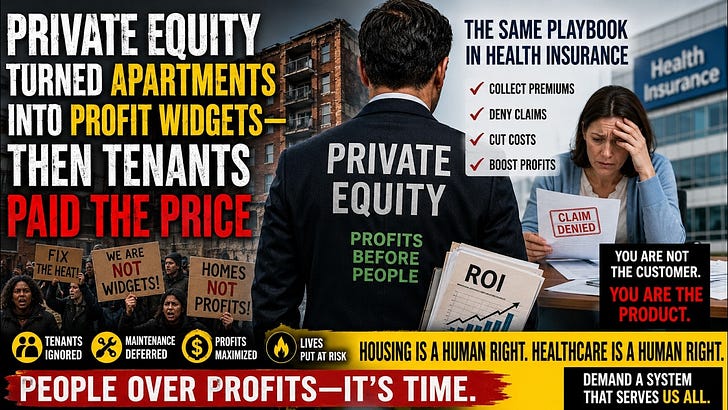
The segment captures that transformation perfectly: rent becomes revenue, repairs become costs, maintenance workers become overhead, and essential systems become expenses that reduce investor returns. Eventually, human beings become widgets in somebody else’s financial model.
Nob Hill demonstrates why that warning matters.
A February 2026 Syracuse City Court ruling described residents living with failed heat and hot water, sewage flooding, broken security systems, trash, pests, and deteriorated common areas. One tenant testified that sewage and fecal matter flooded her apartment and that she spent days cleaning it herself.
The City of Syracuse had already sued the owners in 2025 over chronic code violations and more than $340,000 in accrued fines. By July 2026, New York Attorney General Letitia James and Syracuse Mayor Sharon Owens filed another lawsuit alleging years of hazardous conditions and tenant-rights violations. The attorney general reported 413 city and state code violations between 2019 and 2026.
Then came the human cost.
A February 28 fire killed two residents and displaced others. Residents subsequently complained that smoke detectors and emergency lighting had failed.
This cannot be reduced to one apartment complex. ProPublica previously documented how private-equity-backed firms became major multifamily landlords and how their financial strategy can reward rent increases, cost-cutting, aggressive eviction practices, and rapid increases in property income before resale.
That same structural conflict appears in American healthcare.
Doctors, nurses, hospitals, pharmacists, and therapists provide healthcare. Insurance companies primarily finance and administer access to it. When insurers earn more by controlling expenditures, the patient and the corporation can have fundamentally different objectives.
A June 2026 HHS inspector general investigation provides a startling example. Medicare Advantage organizations denied 12% of skilled nursing facility admission requests reviewed in June 2024. Patients appealed only 18% of those denials. Yet when they did appeal, insurers overturned an extraordinary 95% of them. The watchdog warned that some beneficiaries had apparently been initially denied medically necessary care.
Meanwhile, KFF estimates Medicare will pay private Medicare Advantage plans about 14% more per enrollee in 2026 than traditional Medicare would spend for comparable beneficiaries—roughly $76 billion in additional federal spending.
The parallel is unmistakable.
The tenant asks: Can the heat be fixed?
The patient asks: Can the treatment be approved?
The investor asks, “Can the asset produce a higher return?”
Those questions expose the conflict.
Markets can efficiently produce many ordinary goods. But shelter and healthcare are not ordinary consumer products. People cannot decide that rent is too expensive and simply stop needing a home. They cannot reject an unaffordable medical system by choosing never to become sick.
That gives corporations controlling these necessities extraordinary power.
The answer is not resignation. Government can aggressively enforce habitability standards, strengthen tenant protections, expose opaque ownership structures, expand nonprofit, cooperative, and public housing, and punish owners who profit while violating safety codes. Healthcare policy can remove wasteful intermediaries and move toward universal coverage that spends healthcare dollars primarily on healthcare.
The principle could not be simpler: homes should exist primarily to house people, and healthcare should exist primarily to heal them. Any economic system that reverses those priorities deserves to be changed.