


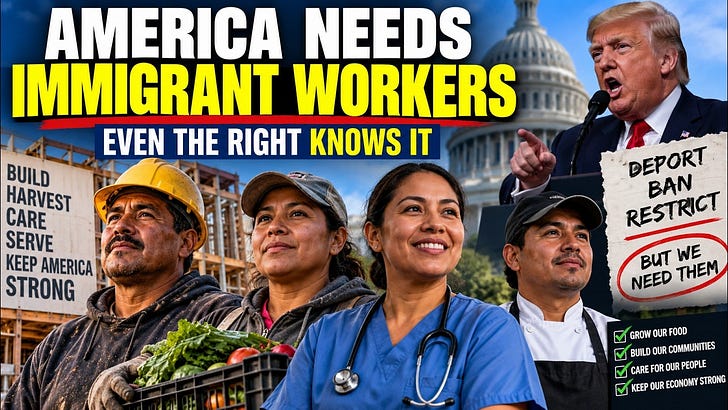
Farmers, builders and hospitality employers need immigrant labor. The right’s demagoguery cannot erase the workforce reality sustaining America’s economy.


Summary
America’s immigration debate exposes a glaring contradiction: politicians can demonize immigrants for applause, but the economy still depends heavily on immigrant labor—including workers who are legally authorized to live and work in the United States. Current federal data and even actions by the Trump administration show that farms, construction firms, hotels, food processors, and other employers cannot simply wish these workers away.
- The Bureau of Labor Statistics reports that foreign-born workers made up 19.1% of the U.S. civilian labor force in 2025, with especially significant representation in service, construction, maintenance, transportation, production, and material-moving occupations.
- The Trump administration’s October 2025 rule ended automatic extensions of many employment authorization documents, meaning workers who renew their permits on time can still lose authorization while waiting for government processing.
- Sen. Jacky Rosen warned in April 2026 that the change could affect more than 3.5 million legally authorized workers, including roughly 600,000 construction workers and more than half a million hospitality workers.
- Even the Trump administration has had to concede the labor reality. In June 2026, USDA welcomed guidance making clear that qualifying dairy operations can use H-2A guest workers, explicitly acknowledging persistent agricultural labor shortages.
- Republican lawmakers have also pushed for broader H-2A access, describing foreign guest workers as effectively indispensable to agriculture—an extraordinary admission from a political movement built around anti-immigrant rhetoric.
The progressive answer is neither worker exploitation nor mass deportation. America needs a functional immigration system that provides legal status, dependable work authorization, strong labor protections, union rights, fair wages, and pathways to permanence. The economy already depends on immigrant workers. Public policy should start telling the truth.
PLEASE BECOME A PAID SUBSCRIBER TODAY
Countering billionaires—and soon trillionaires—is hard, probing work. They flood the zone with propaganda, policy distortions, and economic fallacies rooted in the Powell Memo and financed by concentrated wealth. We work every day to answer that machinery with truth, context, and critical thinking. But independent media cannot survive on conviction alone. It needs support from people who understand the stakes. Please become a paid subscriber today. Your support keeps this work alive, expands its reach, and helps build a media ecosystem that serves people, not plutocrats. This is not charity. It is an investment in truth, democracy, and the public good.
Premium Content (Complimentary)
America’s immigration debate keeps running into a fact that demagoguery cannot erase: this country needs immigrant workers. The right can chant about mass deportation, criminalize migrants in campaign speeches, and build an enforcement state designed to frighten communities. But when farms cannot harvest crops, contractors cannot staff projects, hotels cannot fill shifts, and dairies cannot keep operating, the rhetoric crashes into economic reality.
That reality is visible in the government’s own labor data. The Bureau of Labor Statistics reported that foreign-born workers made up 19.1 percent of the U.S. civilian labor force in 2025. They were especially concentrated in service jobs; natural resources, construction and maintenance; and production, transportation and material-moving occupations. Foreign-born men also had a substantially higher labor-force participation rate than native-born men. Those numbers do not distinguish immigration status, but they demolish the fantasy that immigrant labor sits on the margins of the American economy. It is woven into the economy’s basic functioning.
The contradiction becomes even sharper when the discussion turns to people who are already legally authorized to work. In October 2025, the Department of Homeland Security ended automatic extensions for many employment authorization document renewals. That means a worker can follow the rules, file on time, remain legally present, and still be forced off the job simply because the government has not processed the renewal quickly enough. Senator Jacky Rosen warned on the Senate floor in April 2026 that more than 3.5 million legally authorized workers could be affected, including roughly 600,000 construction workers and more than half a million hospitality workers.
That is not law and order. It is bureaucratic self-sabotage.
The right’s own behavior proves it. The Trump administration spent years selling a politics of immigrant exclusion, yet in June 2026 it backed guidance allowing dairy operations greater access to the H-2A agricultural guest-worker program when employers can demonstrate qualifying temporary or seasonal need. USDA openly acknowledged that labor availability remains a significant challenge for dairy farmers. Republican lawmakers likewise pressed the administration to improve H-2A access, calling foreign guest workers indispensable to agriculture. When ideology threatens profits and production, suddenly the same political movement that demonizes immigrants discovers nuance.
The economic stakes extend far beyond agriculture. Construction already faces chronic labor shortages. Industry reporting found that about one-third of construction trades workers are immigrants, while contractors describe a shrinking labor pool that raises project costs. Hospitality, food processing, childcare, and other labor-intensive sectors also depend on workers whose authorization can be disrupted by administrative delays or abrupt policy changes. Fewer available workers do not magically create an army of replacement labor. They delay projects, reduce production, strain remaining employees, and push costs upward. Consumers ultimately pay for that political theater.
A progressive immigration policy should reject both exploitation and xenophobia. The answer is not to create a disposable underclass of guest workers who can be underpaid or intimidated because their legal status depends on an employer. A federal judge recently ordered the Trump administration to redo changes to H-2A wage rules after finding its approach unlawful, underscoring why worker protections matter as much as worker availability. Nor is the answer to terrorize long-settled workers, mixed-status families, asylum seekers, or lawful workers with indiscriminate enforcement.
America needs durable legal pathways, faster work-permit processing, strong labor protections, union rights, prevailing-wage enforcement, and a realistic path to permanent status for people already contributing to their communities.
The larger lesson is simple. Immigration is not merely a border story. It is a labor story, a housing story, a food story, a care-economy story, and a cost-of-living story. Right-wing demagogues know this whenever farmers, hotel owners, builders, and business groups demand workers. They simply do not want their voters connecting the dots.
America does not become stronger by driving needed workers into the shadows or off the job. It becomes stronger by legalizing work, protecting workers, and building an immigration system around economic reality and human dignity.


