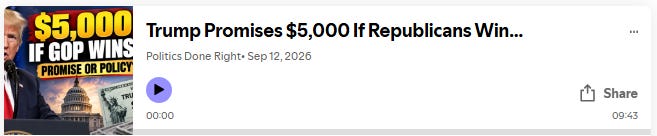
Trump says adults could get $5,000 if Republicans keep Congress. Here’s why the promise matters politically—and what the law, budget math and economists actually say.


Summary
President Donald Trump’s promise of a $5,000 “Trump dividend” if Republicans retain control of the House and Senate deserves serious scrutiny because campaign promises can influence turnout even when their legal, fiscal, and practical foundations remain uncertain. The segment argues that dismissing the offer as obviously unrealistic risks misunderstanding how voters process simple, tangible economic messages. Trump made the promise publicly at the Republican midterm convention in Dallas, while providing few implementation details. Independent reporting estimates the total cost at roughly $1.2 trillion to $1.35 trillion and confirms that Congress would have to authorize the expenditure.
- Trump explicitly conditioned the proposed $5,000 payment on Republicans retaining both chambers of Congress.
- The segment’s central warning is that political professionals should not assume voters will automatically discount an improbable promise; it compares the psychology to buying a lottery ticket for a small chance at a large payoff.
-
The proposal would likely require congressional authorization because Congress controls federal spending.
-
Legal experts cited by Reuters and PolitiFact say the broad campaign promise likely does not constitute illegal vote-buying because payment would not depend on how any particular person voted, but it is not far removed from a bribe.
-
Funding remains unresolved. Tariff revenue cited by administration officials is far below the estimated cost, while economists warn that borrowing to finance a payment exceeding $1 trillion could add to inflationary and interest-rate pressures.
The most defensible takeaway is not that the payment is legally a bribe, but that a simple $5,000 campaign promise can become a powerful political message. Opponents who want to challenge it effectively would need to address the promise directly with verifiable facts about congressional approval, funding, cost, and economic effects rather than assume voters will dismiss it on their own.
PLEASE BECOME A PAID SUBSCRIBER TODAY
Countering billionaires—and soon trillionaires—is hard, probing work. They flood the zone with propaganda, policy distortions, and economic fallacies rooted in the Powell Memo and financed by concentrated wealth. We work every day to answer that machinery with truth, context, and critical thinking. But independent media cannot survive on conviction alone. It needs support from people who understand the stakes. Please become a paid subscriber today. Your support keeps this work alive, expands its reach, and helps build a media ecosystem that serves people, not plutocrats. This is not charity. It is an investment in truth, democracy, and the public good.
Premium Content (Complimentary)
Why Trump’s $5,000 Promise Should Be Taken Seriously as Political Messaging
Donald Trump’s $5,000 “Trump dividend” proposal creates a useful test of how political campaigns communicate with voters. During the Republican midterm convention in Dallas, Trump said every adult American citizen would receive $5,000 if Republicans retained control of both the House and Senate. The promise was direct, easy to understand, and connected a tangible personal benefit to an electoral outcome.
That simplicity explains why the attached segment urges Democrats and other Trump opponents not to laugh the proposal away. Its argument is fundamentally about political psychology. A voter does not need to believe with certainty that a check will arrive for the possibility to affect turnout. The segment compares that mindset to buying a lottery ticket: the expected outcome may be doubtful, but the potential reward still changes behavior.
That premise deserves attention. Reuters reports that legal precedent makes a broad campaign promise of future public benefits difficult to classify as illegal vote-buying. The key distinction is that Trump did not offer $5,000 to an individual in exchange for that individual casting a particular ballot. Instead, he proposed a government benefit that would follow a collective election result. Congress would still have to authorize the expenditure.
The fiscal questions are much clearer. Reuters estimated the plan at about $1.2 trillion if roughly 240 million adults received $5,000 each. Axios put the figure near $1.3 trillion. Those figures dwarf the tariff revenue that administration officials have cited as a possible funding source. Reuters reported that the Congressional Budget Office estimated $167 billion in tariff revenue collected during the fiscal year at the time of the proposal—nowhere near enough to finance the full payment.
The economic context also matters. Economists quoted by major outlets warned that injecting more than $1 trillion into an economy already dealing with elevated prices could increase demand, worsen inflation, and put upward pressure on interest rates. Pandemic-era stimulus offers an imperfect comparison because those checks responded to an extraordinary economic shutdown, but research has found that direct pandemic payments contributed to stronger consumer demand and some inflationary pressure.
Trump and his administration present the proposal differently. The White House calls the payment a dividend made possible by economic strength, comparing citizens to shareholders receiving a distribution. Vice President JD Vance has suggested wealthier Americans might be excluded, while administration officials have floated tariffs and other government revenues as possible funding sources. Those statements show that the proposal remains fluid rather than fully specified.
The political lesson is therefore straightforward. Campaigns should challenge concrete promises with concrete information. They can explain that no $5,000 payment has been enacted, Congress controls federal appropriations, the estimated cost exceeds $1 trillion, and no identified revenue stream currently covers that cost. At the same time, they should recognize why the message may appeal to households under financial pressure and address it in their political messaging to neutralize its effect on the low-information voter.
The segment is most persuasive when it warns against assuming that voters will automatically perform that policy analysis themselves. Political communication works best when it treats voters as people responding to clear incentives, hopes, fears, and household economics—not as participants in a graduate seminar on appropriations law.