


Mike Johnson backs Brandon Herrera while Democrats argue over DSA. The real issue is how parties handle ideological factions, controversial nominees, and coalition power.
PLEASE BECOME A PAID SUBSCRIBER TODAY
We make our newsletters and videos free because everyone deserves the truth, regardless of their ability to pay. To counter the lies of the billionaire and corporate media, we must reach as many Americans as possible. We don’t need unlimited funds, but we rely entirely on small-dollar grassroots support to keep going. Please become a paid subscriber today so we can keep flooding the zone with the truth. We can’t do this without you.


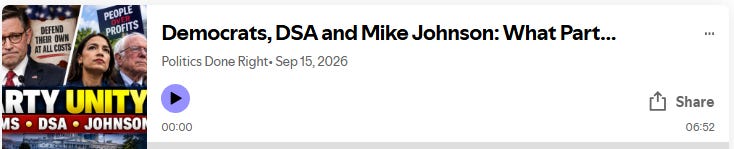
Summary
The segment argues that Democrats face a strategic question about coalition politics: whether ideological disagreements should lead party leaders to distance themselves from progressive and democratic-socialist candidates, or whether candidates who win Democratic primaries should be allowed to make their case through legislation and governing.
- The segment uses Speaker Mike Johnson’s support for Republican nominee Brandon Herrera as an example of party leaders standing behind their nominee despite scrutiny of Herrera’s past online rhetoric. CNN reported that Herrera had the backing of both President Trump and Johnson, while Herrera is the Republican nominee in Texas’ 23rd District.
- Johnson’s criticism of DSA mixes accurate references with broader characterizations.
-
The segment argues that many DSA-backed priorities involve bread-and-butter economic issues such as Medicare for All, paid family leave, higher wages, housing, and environmental policy. DSA’s published program includes universal health care, paid family leave, a living minimum wage, and a Green New Deal.
-
Hillary Clinton recently took a more procedural approach to the ideological divide. In a September 2026 Morning Joe interview, she said some positions on the far left go “way too far,” but also said lawmakers should write competing bills, debate them, and move from slogans to legislative results.
-
House Democratic Leader Hakeem Jeffries has similarly said he does not support the DSA agenda but acknowledged that candidates elected through Democratic primaries who win in November will become part of a broad House Democratic caucus.
The factual issue, then, is not whether Democrats and DSA agree on everything—they plainly do not—but how a broad party coalition handles internal ideological conflict. Inclusion and legislative competition: the current public record shows that this debate is already happening openly inside the Democratic coalition.
Premium Content (Complimentary)
American political parties have always contained factions, but the 2026 midterm cycle has sharpened a particular Democratic argument: what should a broad party do when candidates emerge from its primaries with ideological positions that party leaders do not share?
The attached segment answers that question by contrasting Democratic infighting with Republican coalition discipline. Its example is House Speaker Mike Johnson’s support for Brandon Herrera, the Republican nominee in Texas’ 23rd Congressional District. Herrera, a gun-rights activist and YouTuber, has faced renewed scrutiny over crude and offensive comments from his online career. CNN reported in September that Herrera had the backing of both President Donald Trump and Johnson. Herrera became the Republican nominee after former Rep. Tony Gonzales left the race.
The segment’s broader point is organizational rather than ideological: Republicans often close ranks around nominees because they prioritize control of governing institutions. The argument then asks whether Democrats should show similar coalition discipline toward progressives, liberals, moderates and candidates affiliated with the Democratic Socialists of America.
Some of Johnson’s rhetoric about DSA goes beyond the organization’s text. Saying DSA wants to “abolish the border,” for example, is broader than DSA’s stated demand to abolish ICE. Describing its economic agenda as ending private property altogether also compresses a more specific program calling for public ownership of major corporations and essential industries. Political debate is clearer when critics challenge what an organization actually proposes rather than a more sweeping version of it.
The other side of the DSA platform is equally concrete. It calls for universal health care, paid family leave, a living minimum wage, free public education, stronger labor rights and major public investment. Those are the policy areas the segment emphasizes when it argues that ideological labels can obscure substantive disputes about wages, health care, housing, and working-class economic security.
Hillary Clinton recently offered a useful description of how such disagreements can function institutionally without requiring ideological agreement. On Morning Joe, she said some far-left rhetoric and positions go too far. But she also argued that members of a diverse Democratic caucus should write their bills, defend them and debate alternatives. She specifically contrasted Medicare for All with restoring Affordable Care Act subsidies and said Congress should move from slogans to actual legislative results.
House Democratic Leader Hakeem Jeffries has drawn a similar distinction. He said he does not support the DSA agenda, including proposals such as abolishing the Senate or defunding police, while also acknowledging that Democrats who win primaries and then general elections will be members of the House Democratic Caucus.
That leaves Democrats with a practical coalition question rather than a simple ideological one. A party can disagree internally over policing, health care, economic ownership, foreign policy, and constitutional structure while still deciding whether to settle those disputes through primaries, legislation, and votes—or through efforts to exclude particular factions altogether.
The segment clearly prefers the former approach. The evidence shows that Clinton and Jeffries, despite substantial disagreements with DSA, have both articulated versions of a broad-caucus model. Whether that model produces durable unity will depend less on slogans than on how elected Democrats govern, negotiate and explain their competing policies to voters.


