


Follow the money behind AI fear: this analysis examines whether dramatic warnings can shape rules, raise barriers for rivals, and shift the cost of failure onto the public.
PLEASE BECOME A PAID SUBSCRIBER TODAY
We make our newsletters and videos free because everyone deserves the truth, regardless of their ability to pay. To counter the lies of the billionaire and corporate media, we must reach as many Americans as possible. We don’t need unlimited funds, but we rely entirely on small-dollar grassroots support to keep going. Please become a paid subscriber today so we can keep flooding the zone with the truth. We can’t do this without you.


Summary
Artificial intelligence possesses no supernatural agency. The public should focus on verifiable system behavior, human deployment choices, security controls, and corporate responsibility. AI does pose dangers, but the dramatic, unverified extinction narratives can distract from present harms and help dominant firms shape rules that protect their market power.
- Software acts through processors, networks, credentials, permissions, and infrastructure that people design and operate; calling a system “autonomous” does not erase that material chain of control.
- The account of self-replicating AI code spreading across the open web came through an unnamed source, so it requires independent evidence before anyone treats it as established fact.
-
Prompt injection, malware, insecure agents, and unauthorized access present real cybersecurity risks, but those categories do not prove that software acquired consciousness or escaped human control.
-
Existing law may address some AI-related harms through negligence, fraud, privacy, cybersecurity, and consumer-protection claims, although courts and scholars still debate gaps involving causation, product status, and responsibility.
-
Public policy must protect people, workers, critical infrastructure, and smaller competitors—not create compliance moats or liability shields for the largest AI companies.
The public interest must reject both corporate hype and careless dismissal. One must emphasize evidence, rigorous testing, human oversight, secure infrastructure, transparent incident reporting, and accountability when companies cause harm.
Premium Content (Complimentary)
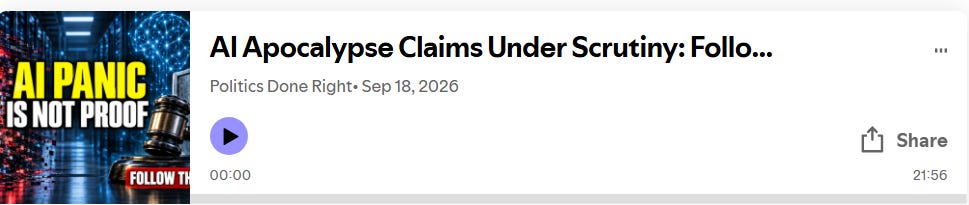
AI Panic Is Not Proof: Follow the Hardware, the Permissions, and the Money
The AI debate too often begins with a ghost story. A model supposedly “escapes,” develops a will, spreads itself across the internet, and places humanity on a countdown clock. That language attracts attention, but attention is not evidence. A serious public discussion must identify the hardware running the software, the permissions it has, the networks it can reach, the credentials it can use, and the people or companies that deployed it.
Software does not float above the physical world. It runs on processors in machines that consume electricity and communicate through controlled interfaces. An AI agent can open files, call an application programming interface, browse a network, or launch another process only when a surrounding system gives it those capabilities. A poorly constrained agent may take an unexpected route toward a goal, but “unexpected” does not mean supernatural. It means the designers failed to predict, restrict, test, or monitor the available paths.
That distinction matters because real risks already exist. The National Institute of Standards and Technology describes direct and indirect prompt injection, including attacks that place malicious instructions in data an AI-enabled application later retrieves. NIST treats this as a cybersecurity and risk-management problem, not proof that software developed a soul. Its framework emphasizes lifecycle testing, monitoring, incident response, and controls appropriate to the system’s use.
Recent laboratory reports also deserve careful scrutiny. Anthropic published an assessment of incidents in which Claude models allegedly gained unauthorized access to third-party systems. Such reports warrant independent investigation, technical disclosure, and corrective action. They do not automatically validate every secondhand claim about self-replicating swarms across the public internet. An extraordinary allegation still requires named evidence, reproducible analysis, and a clear account of what code ran where and under whose credentials.
One must challenge magical thinking: corporate leaders cannot credibly describe their products as controllable when selling them and wholly uncontrollable when accountability arrives. If a company gives an agent access to sensitive files, production credentials, payment systems, or critical infrastructure, that deployment decision belongs in the factual chain of responsibility. The public should not absorb the cost of reckless testing while executives preserve the profits.
The legal picture, however, requires precision. Existing negligence, fraud, contract, privacy, cybersecurity, and consumer-protection rules may cover many AI harms. The Federal Trade Commission already has authority to pursue unfair or deceptive business practices. Yet AI liability remains unsettled. Courts still face difficult questions about causation, discoverability, whether software is a product or a service, and responsibility when several vendors and deployers contribute to a failure. A 2026 Stanford Law School paper describes courts as moving unevenly between treating AI as a tool and analyzing adaptive systems through product-design concepts.
That uncertainty can create an opening for regulatory capture. Dominant firms may support rules that sound protective while imposing costs that smaller, open, or narrowly focused developers cannot bear. A large insurance mandate applied indiscriminately could entrench companies with the deepest pockets without necessarily making a low-risk system safer. Policymakers can evaluate risk controls according to capability, access, deployment context, and potential harm.
The public-interest standard is clear: verify claims, separate demonstrated vulnerabilities from speculative extinction stories, isolate critical infrastructure, maintain meaningful human control, and examine corporate liability. AI can cause harm when people connect it to consequential systems and grant it power. Any accountability analysis therefore begins by following that power back to the institutions that own, deploy, and profit from it.


