


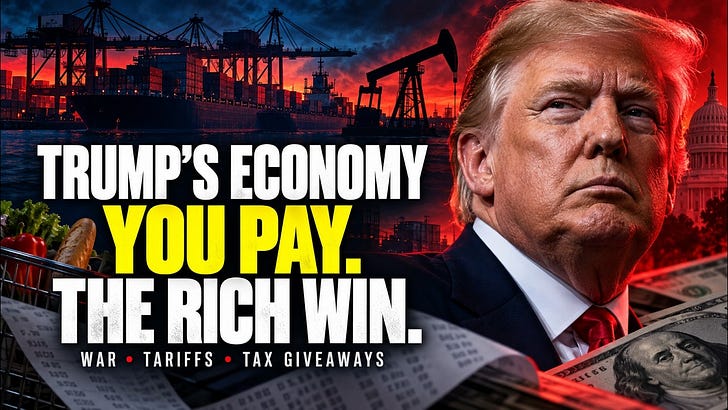
Tariffs, war, and tax giveaways: Trump’s choices squeeze working Americans while wealthy interests benefit. Follow the evidence behind the affordability crisis.
BE A PART OF REACHING ALL. YOUR PAID SUBSCRIPTION DOES IT
We are almost ready to win big, if we can reach everyone. We make our newsletters and videos free because everyone deserves the truth, regardless of their ability to pay. We are countering the billionaire and corporate media to reach as many Americans as possible. We don’t need unlimited funds, but we rely entirely on small-dollar grassroots support to keep going. Please become a paid subscriber today so we can keep flooding the zone with the truth. We can’t do this without you.

Summary
Donald Trump’s economic agenda makes working families absorb costs while wealthy interests collect rewards. The commentary challenges the fiction that corporate profits automatically translate into public prosperity and connects economic insecurity to policies that privilege ownership over labor. Current evidence strengthens that argument: tariffs increase prices, war disrupts energy supplies, and Republican budget choices undermine essential support for poorer households.
- Trump’s tariffs impose real costs on households. Yale’s Budget Lab estimates approximately $1,100 in annual household costs under the tariff policies covered by its August 2026 update.
- The Iran war compounds the affordability crisis. Reuters reports that the conflict’s disruption of energy supplies has driven gasoline prices higher.
-
Republican fiscal policy favors those already ahead. CBO projects that the 2025 reconciliation law reduces resources for households near the bottom while increasing resources for middle- and upper-income households, with the largest gains toward the top.
-
China’s manufacturing strength exposes the limits of tariff boasting. Its September trade surplus reached $133.5 billion worldwide, reinforcing the transcript’s emphasis on productive capacity and industrial knowledge.
-
Presidential family enrichment demands scrutiny. Reuters reported more than $1.4 billion in disclosed income from Trump-family cryptocurrency ventures, raising serious questions about private benefit alongside public power.
The central issue is political responsibility. Trump chose policies that impose identifiable costs, and working Americans deserve an economy organized around their security rather than the enrichment of powerful owners.
Premium Content (Complimentary)
Trump’s Economy: Working Families Pay While Billionaires and His Family Cash In
Donald Trump cannot dismiss the economic pain his policies create as somebody else’s problem. Presidents do not control every price, paycheck, or investment decision. But they do choose whether to impose tariffs, wage wars, and sign legislation that redistributes resources. When those choices raise household costs and weaken protections for vulnerable people, accountability belongs at the president’s desk. Patriotic branding cannot erase the bills. While presidents often get too much credit or blame for the economy, Trump’s destruction of the middle-class and working-class segment of the economy is undeniable.
The tariff evidence makes that responsibility concrete. Research published by the Federal Reserve Bank of New York finds that tariffs raise prices on imported goods and domestically produced alternatives. American manufacturers pay more for imported materials, while some domestic producers increase markups as foreign competition becomes more expensive. The administration’s claim that foreigners absorb the burden collapses against research finding roughly 90 percent pass-through into American import prices.
Yale’s Budget Lab estimates approximately $1,100 in annual household costs under the tariff policy examined in its August update. That figure represents a modeled average, but its meaning is straightforward: trade policy reduces purchasing power. Families already stretching paychecks must accommodate another expense imposed by a president who promised relief. Announcing an import tax does not build a factory, train a machinist, or guarantee a union wage.
War adds another burden. Reuters reported on October 14 that September gasoline prices jumped 9.1 percent as the Iran conflict helped intensify energy pressures. Overall consumer prices rose 3.7 percent from a year earlier. Those increases reach beyond the filling station because transportation and production depend on energy. Working households experience geopolitical recklessness through ordinary necessities.
The tax-and-spending agenda reveals whose security receives priority. CBO projects that the 2025 reconciliation law reduces resources for households toward the bottom of the income distribution, chiefly through diminished benefits, while increasing resources for households in the middle and toward the top. Its 2026 outlook identifies the largest gains toward the top. The indictment is precise: Republican lawmakers chose to weaken support for poorer people while delivering substantial advantages to wealthier households.
The commentary also identifies a deeper failure: corporate success can coexist with community decline. When owners pursue cheaper production without responsibility for displaced workers, communities can lose wages, skills, and industrial capacity. Rebuilding that capacity requires sustained investment, apprenticeships, infrastructure, and worker power. China’s $133.5 billion September trade surplus underscores its manufacturing strength; that worldwide figure does not represent its surplus with America alone.
Meanwhile, presidential family enrichment sharpens the moral indictment. Reuters reported that Trump disclosed more than $1.4 billion in income from family cryptocurrency ventures. He responded by pointing to stock-market gains and claiming widespread prosperity. That answer evades the conflict: a president’s family participates in businesses affected by the political environment he helps shape. Family management does not remove the president’s financial interest or resolve the public’s concern about influence.
Incompetence describes the failure to deliver affordable prosperity. Cruelty describes choices that deprive vulnerable people of support. The documented family-business entanglements warrant investigation into conflicts and potential self-dealing. Establishing a particular criminal offense requires additional evidence, but political accountability does not require waiting for a conviction.
The progressive response must confront the economic structure that rewards these choices. An extractive capitalist system treats workers as costs and essential services as profit opportunities. Democratic government should establish different priorities: universal healthcare, strong unions, public investment, progressive taxation, and enforceable protections against presidential profiteering. Prosperity deserves that name only when the people who produce society’s wealth can live securely within it.


