


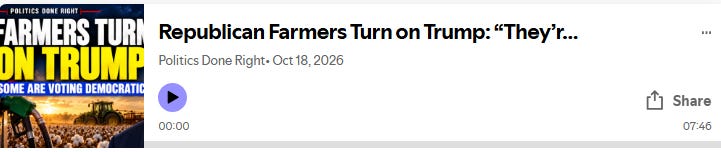
A two-time Trump voter rejects him and says farmers he knows are voting Democratic. Rising farm costs expose the gap between Republican promises and rural reality.
BE A PART OF REACHING ALL. YOUR PAID SUBSCRIPTION DOES IT
We are almost ready to win big, if we can reach everyone. We make our newsletters and videos free because everyone deserves the truth, regardless of their ability to pay. We are countering the billionaire and corporate media to reach as many Americans as possible. We don’t need unlimited funds, but we rely entirely on small-dollar grassroots support to keep going. Please become a paid subscriber today so we can keep flooding the zone with the truth. We can’t do this without you.


Summary
Republican loyalty cannot pay a farmer’s diesel bill. The segment captures a political breaking point: a self-described hardcore Republican who voted for Trump twice rejects another Trump candidacy and reports that farmers he knows plan to vote Democratic. His frustration exposes the distance between Republican promises of prosperity and the economic pressures facing the people who produce America’s food.
- A loyal Republican breaks with Trump. The interviewed farmer says his frustration also extends to candidates Trump endorses.
- Farm expenses undermine political messaging. The segment describes rising diesel and fertilizer costs squeezing already strained operations.
-
His experience challenges anti-Democratic propaganda. He recalls no comparable presidential impact on his operation under Obama, Biden, or George W. Bush.
-
Other farmers reportedly plan to switch parties. He says several farmers he has spoken with intend to vote Democratic.
-
The commentary calls for grassroots organizing. It argues that Democrats must meet people directly and connect economic hardship to policy choices.
Democrats’ opening rests on material reality: farmers need reliable markets, affordable inputs, and a government that protects their livelihoods. Political loyalty becomes expensive when it shields leaders from accountability.
Premium Content (Complimentary)
Republican Farmers Are Breaking With Trump—and His Economic Betrayal Explains Why
A farmer cannot fuel a tractor with a campaign slogan. He cannot purchase fertilizer with partisan loyalty. And he cannot protect a multigenerational operation by pretending that the president he supported bears no responsibility for policies that make survival harder. That reality drives the attached interview: a self-described hardcore Republican who voted for Donald Trump twice now says he would never vote for him again.
The farmer’s testimony cuts through years of Republican branding. Asked about previous presidents, he recalls no comparable difference in his operation under Barack Obama, Joe Biden, or George W. Bush. His account challenges the political mythology that Democrats inevitably threaten rural livelihoods while Republican presidents protect them. He judges this administration by what reaches his farm, his equipment, and his balance sheet.
His anger also reaches beyond Trump personally. Asked whether his frustration extends to Trump-endorsed candidates, he answers yes. He then reports that several farmers he knows plan to vote Democratic. That distinction matters. Disappointment becomes politically consequential when voters connect a leader’s decisions to the party that enables and defends them.
The economic pressure extends beyond one interview. USDA’s September 2026 forecast projects farm production expenses of $492.8 billion, up $21.2 billion from 2025. Fertilizer, lime, and soil-conditioner expenses are projected to rise 15.3 percent; fuel and oil expenses, 28.8 percent. Those figures describe an increasingly expensive task: producing what the country needs while absorbing costs producers cannot simply wish away.
Trump’s trade agenda deserves particular scrutiny because agriculture has already paid the price. USDA researchers estimated that retaliatory tariffs imposed by trading partners caused more than $27 billion in lost American agricultural exports from mid-2018 through 2019. Rural communities have already experienced the consequences of treating their customers as bargaining chips. Repeating that gamble does not transform recklessness into economic strategy.
The segment also connects farm distress to the Iran war’s disruption of fuel and fertilizer supplies. In an October 18 report, Australia’s ABC interviewed a Nebraska farmer who voted for Trump three times and now rejects him. He described substantial increases in operating costs, although his frustration pointed toward abstention rather than voting Democratic. Republican disillusionment creates an opening; Democrats still must earn the resulting votes.
A progressive response should confront the economic structure underneath the immediate crisis. Farmers do indispensable work, yet they must navigate markets where purchasing power, financing, and access to buyers can determine whether hard work produces a livelihood. An agricultural economy that treats family farms as expendable while prioritizing returns to capital deserves fundamental change. Food production should serve public needs and sustain the people doing the work.
Public assistance also exposes the emptiness of market fundamentalism. USDA projects $47.4 billion in direct government farm payments for 2026. Farmers deserve a functioning safety net. They also deserve policies that reduce avoidable instability instead of forcing them to depend on emergency relief after political decisions compound their difficulties.
The political task therefore requires more than celebrating an angry interview. Democrats should organize in rural communities, defend public investment, challenge concentrated corporate power, and offer credible commitments on healthcare, infrastructure, and agricultural stability. The segment’s insistence on direct engagement recognizes that trust develops through sustained relationships.
No farmer owes a political party permanent loyalty. When Republican policies threaten the livelihood that Republican politicians promised to protect, changing a vote represents accountability. Democrats have an opportunity to build solidarity around a straightforward principle: the people who feed the country deserve an economy and a government that works for them.


