2011-10-15 The Economics of Occupy Wall Street, Part I: The Glass-Steagall Act
"I believe that banking institutions are more dangerous to our liberties than standing armies. If the American people ever allow private banks to control the issue of their currency, first by inflation, then by deflation, the banks and corporations that will grow up around [the banks] will deprive the people of all property until their children wake-up homeless on the continent their fathers conquered. The issuing power should be taken from the banks and restored to the people, to whom it properly belongs."
— attributed to Thomas Jefferson
So far lacking a central spokesperson, the Occupy Wall Street (OWS) movement has not always clearly articulated specifics of its demand for justice through economic reform; even many who support the demonstrations seem unclear as to exactly what the protesters want, and insiders have reported that the demonstrators have yet to arrive on a consensus regarding their platform. Interviews and research, however, reveal a few specific proposals for economic reform that have been suggested among OWS protesters, including: re-instating the Glass-Steagall Act, overturning the Supreme Court’s decision in Citizens United, and organizing an Article V Convention to pass amendments to the U.S. Constitution. This post focuses on the Glass-Steagall Act, regulatory legislation that was passed after the 1929 stock market crash and repealed by President Clinton. Many economists identify this repeal and other Clinton-era deregulation measures as the main causes of the current global economic crisis.
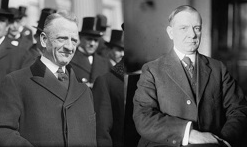
Following the 1929 crash that led to the Great Depression, more than 5,000 banks failed, and roughly US$ 7 billion of depositors’ money was erased; millions of U.S. citizens lost their homes and life savings. Many blame the crash on stock market speculation by the banks, which were said to have taken too much risk with depositors’ money. Allegations of rampant corruption, stock market manipulation, bad loans, and conflicts of interest surfaced. In 1933, congressmen Carter Glass and Henry Steagall introduced the Glass-Steagall Act, a bank-rescue measure that aimed to minimize conflicts of interest and risky speculation by creating a wall between commercial and investment banking: banks had to choose either one activity or the other, and commercial banks could derive only a small percentage of their revenue from securities.
Throughout the past generation, however, the financial sector succeeded in slowly eroding Glass-Steagall’s restrictions. Gradually, the banks largely won back the ability to engage in various forms of market speculation. Meanwhile, Congress made 12 separate attempts to repeal Glass-Steagall. Former Federal Reserve Chairman Paul Volcker expressed concern that lenders would market bad loans to consumers, in order to win bigger earnings on securities. But in 1987 Alan Greenspan (former J.P. Morgan director) replaced Volcker at the Fed, and supported further deregulation. By 1997, the Fed had eliminated many of Glass-Steagall’s restrictions, and permitted banks to acquire securities corporations.
2011-10-15 The Economics of Occupy Wall Street, Part I: The Glass-Steagall Act | WL Central
