The pervasive view of art-making as a hobby rather than a legitimate career has helped perpetuate the well-known dilemma of the “starving artist.” Statistics confirm the truth of this cliché: Professional creatives in the U.S. are more likely to fall within the lowest income bracket than other members of the population, and only a small percentage of them earn a full living through their artistic work.
This unfortunate situation has persisted for centuries. Even Vincent van Gogh, posthumously recognized as one of history’s most influential painters, toiled in poverty and obscurity throughout his artistic career. Selling only one painting in his life, he side-hustled as a salesman, bookshop clerk, and assistant teacher, among other things.
Printmaker and painter Ron Rumford is well acquainted with the challenges of supporting oneself through creative work. “Very, very few artists—maybe the top 1 percent [or so], actually—do well by selling their art and being full-time artists,” he says. “I think most artists have some kind of support employment: a job or business they run that subsidizes their art-making practice. It’s not so different from actors waiting tables in between acting gigs.”
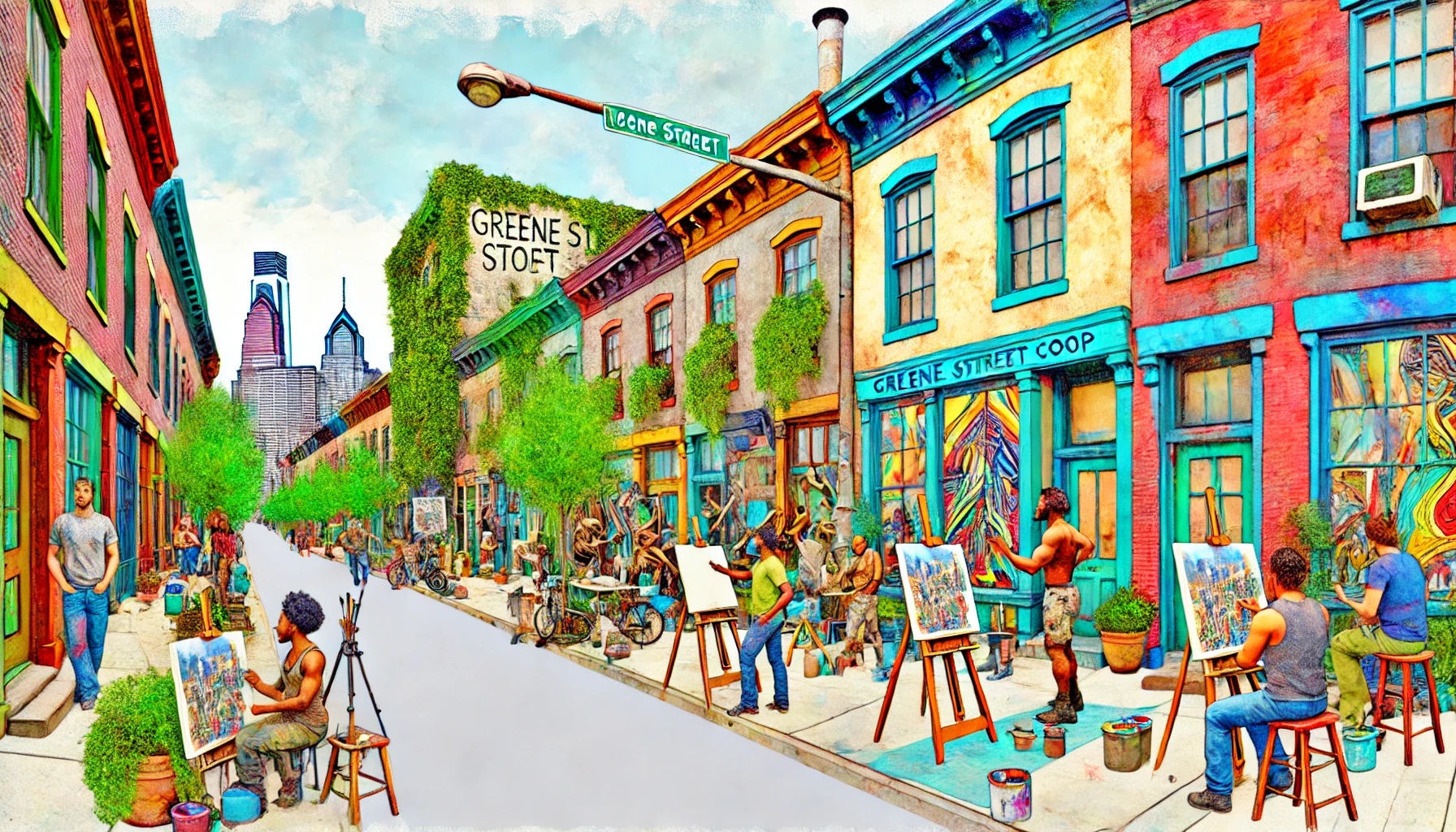
Rumford is the president of a housing collective in Philadelphia called Greene Street Artists Coop (GSAC). Situated in the Germantown area of northwest Philadelphia, GSAC offers visual artists, writers, and theater artists an affordable place to live and work. It also serves as a support network. “If one of us needs to go away, a neighbor will feed your cat, or if you’re getting a delivery or expecting something, we all look out for each other,” Rumford explains.
Group bonding in this community occurs during evening events where members showcase their work, describe their processes of creating art, and discuss their studios. Each year in October, the cooperative also participates in the Philadelphia Open Studios Tour, which “is the largest, self-guided, free-to-attend tour of artist studios and creative workspaces in the region.”
GSAC operates within a 22,000-square-foot building that dates back to 1919. The structure was originally built as an appliance factory for the Wirt Company.
The coop began in 1989 after the Artists Housing Project was formed by a group of artists “to create an affordable live/work space for themselves,” states the GSAC website. The Artists Housing Project incorporated as GSAC to be able to purchase their current building in 1991.
When GSAC’s initiators began exploring this structure, they discovered thousands of colorful transistors buried in the cracks of the second story’s hardwood floors. “There was evidence of this industrial history of the building embedded there,” Rumford states.
Rumford and about 20 colleagues began creating this cooperative at the end of the 1980s. At that time, a large portion of the site’s 1.5-acre lot was paved with asphalt. “In the back of the building, we removed approximately half of that with the idea of creating a community garden,” Rumford notes. He adds that several of the building’s present-day occupants are gardeners. “It’s a nice side benefit that we have gardening space.”
In 2024, GSAC received a grant to create a rain garden in front of the building. Gardens of this kind prevent pollution, erosion, and flooding by retaining stormwater rather than letting it run into the storm sewer system.
Over the years, various occupants of this cooperative’s 15 live/work units have been awarded Pew Fellowships in the Arts: grants for Philadelphia’s most promising artists. This includes the 2020–2021 poet laureate of Philadelphia, Trapeta Mayson.
Largely a Black neighborhood, GSAC’s surrounding Germantown district has been credited as the birthplace of the American antislavery movement. In light of the importance of art in furthering abolitionism in America and worldwide, it’s appropriate that the area is home to a thriving art scene.
GSAC and Germantown are connected to an artistic current that runs throughout Philadelphia. As Rumford explains, one benefit of this is that the city’s inhabitants have access to employment that feeds creativity, including preparatory work for museum exhibitions and teaching gigs at art schools and universities. “So, Philadelphia ends up being a place where a lot of artists are able to stay within the culture or the community, as [part of] a support network, for doing their own work,” he says.
AUTHOR BIO: Damon Orion is a writer, journalist, musician, artist, and teacher in Santa Cruz, California. His work has appeared in Revolver, Guitar World, Spirituality + Health, Classic Rock, High Times, and other publications. Read more of his work at DamonOrion.com.